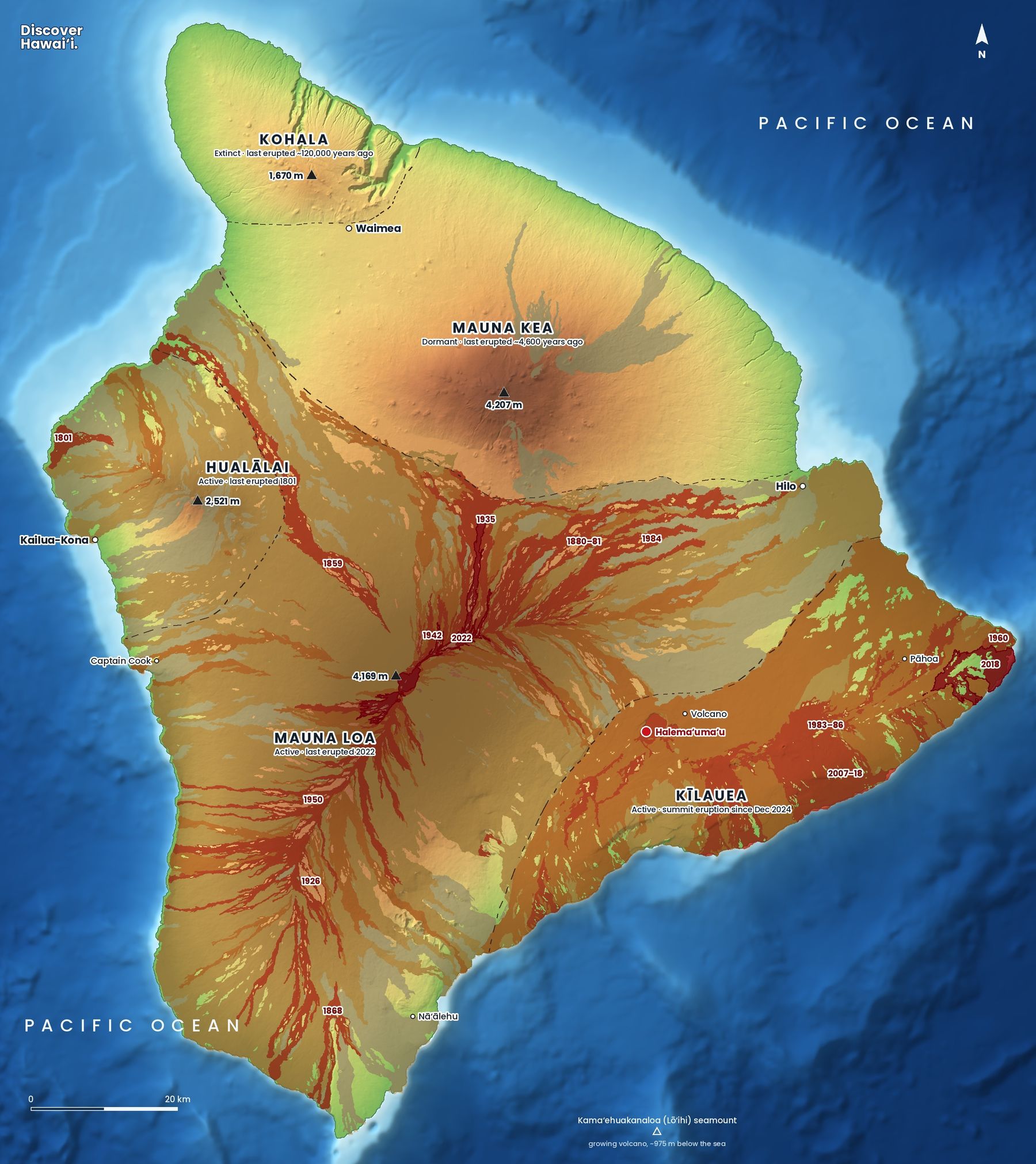
Hawaiʻi Island is not one volcano but five, fused together, and it is still growing. This map colours the ground by age: almost everything in red and orange is younger than 1,000 years, and some of it is younger than the phone in your pocket.
How many volcanoes are on the Big Island?
Five volcanoes make up the island. From oldest to youngest: Kohala in the north, Mauna Kea, Hualālai above Kona, Mauna Loa, the largest volcano on Earth by volume, and Kīlauea in the southeast. A sixth, Kamaʻehuakanaloa (formerly Lōʻihi), is growing on the seafloor off the south coast, about 975 metres below the surface.
They exist because the Pacific Plate is sliding slowly northwest over a hotspot in the Earth's mantle. Each volcano grows while it sits over the hotspot, then drifts away and goes quiet. That is why the islands get older towards Kauaʻi, and why the Big Island, the youngest, is the only one with active volcanoes today.
Which volcanoes are active?
- KohalaExtinct · last erupted about 120,000 years ago The oldest, most eroded volcano, with deep green valleys in the north.
- Mauna KeaDormant · last erupted about 4,600 years ago The island's highest point at 4,207 metres, sacred in Hawaiian tradition.
- HualālaiActive · last erupted 1801 Its 1801 flows reached the sea where Kona's airport stands today.
- Mauna LoaActive · last erupted 2022 4,169 metres high; its 2022 flows came within a few miles of the main cross-island road.
- KīlaueaActive · summit eruption since December 2024 Episodes of lava fountains inside Halemaʻumaʻu crater.
Three of the five are considered active. Kīlauea is one of the most active volcanoes in the world: it erupted almost continuously from 1983 to 2018, destroyed hundreds of homes in lower Puna in 2018, and since December 2024 has produced dozens of short, spectacular episodes of lava fountaining inside Halemaʻumaʻu crater. Mauna Loa last erupted in November and December 2022. Hualālai has been quiet since 1801 but is expected to erupt again.
How young is the ground on the Big Island?
Very young. Look at the dates on the map: lava flows from 1859, 1880, 1935, 1984 and 2022 fan out from Mauna Loa's summit, and Kīlauea's east rift is covered by flows from 1960, 1983 to 1986, 2007 to 2018 and 2018. Much of the south of the island has been resurfaced within the last few hundred years. Only Kohala and the upper slopes of Mauna Kea are old enough to have deep soil and steep, eroded valleys.
What are lava hazard zones?
The US Geological Survey divides the island into nine lava-flow hazard zones, based on how likely lava is to reach each area. Zone 1 covers the summits and rift zones of Kīlauea and Mauna Loa, where eruptions start. Zone 2 lies downhill and is often covered by lava. Zones 3 to 9 carry progressively less risk; Kohala, in zone 9, is the safest.
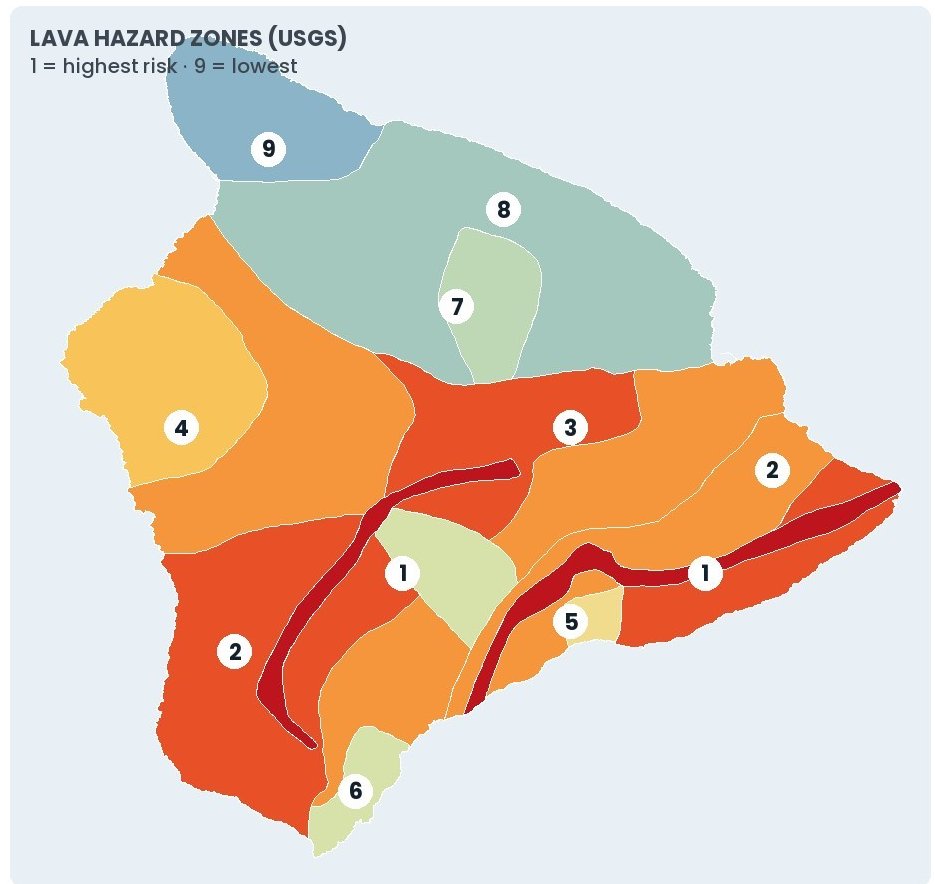
For visitors, the zones mostly matter if you are renting a house in Puna or Kaʻū. Hotels on the Kona and Kohala coasts are in low-risk zones.
Can you see lava on the Big Island?
Sometimes. During Kīlauea's current summit eruption, lava fountains inside Halemaʻumaʻu can be seen from viewpoints in Hawaiʻi Volcanoes National Park during an active episode, and the glow is often visible at night. Episodes come and go, sometimes a week or more apart, so check the USGS Hawaiian Volcano Observatory and the National Park Service before you drive up. Never leave marked trails or cross closed areas: volcanic gas, unstable crater edges and fresh lava are dangerous.
Even without an eruption, the park is worth a full day: steaming vents, lava tubes, craters and the long Chain of Craters Road down to the coast. Bring layers, as the summit sits at about 1,200 metres and is often cool and wet.
What is vog, and is it safe to visit?
Vog, short for volcanic smog, is the haze that forms when sulphur dioxide from an erupting volcano reacts with sunlight, moisture and oxygen in the air. When Kīlauea is erupting, the trade winds usually carry vog southwest and around to the Kona side, where it can sit as a hazy layer over the coast. On calm or southerly-wind days it can drift to other islands too.
For most healthy visitors, vog is an inconvenience: hazy views, sometimes a scratchy throat. People with asthma, heart or lung conditions, small children and pregnant visitors should take it more seriously. Check the state's vog forecast and air-quality readings, limit hard exercise outdoors on bad days, and stay away from the areas around active vents, where gas levels can be dangerous.
Is the Big Island safe to visit during an eruption? Yes. Eruptions at Kīlauea's summit stay inside the national park, the authorities close areas long before they become dangerous, and life in Kona, Hilo and Waimea carries on as normal. Follow park closures and USGS updates, and treat the volcano with respect: in Hawaiian tradition it is the home of Pele, the goddess of fire.
For where to stay and what else to see, read the Big Island guide and our Big Island snorkeling and diving map.
Facts checked October 2026. Rules, fees and conditions change, so check with the operator, park or lifeguard before you go.
- USGS Hawaiian Volcano Observatory
- National Park Service: Hawaiʻi Volcanoes National Park
- USGS Geologic Map of the State of Hawaii (Sherrod et al. 2021)
- USGS lava-flow hazard zones (1991) via Hawaiʻi Statewide GIS