Between the Hawaiian islands lie nine stretches of open ocean, deep, windy and fast-moving. Ancient Hawaiians crossed them in canoes; today a small number of swimmers try to cross them on their own, at night, among jellyfish and sharks. This map shows all nine channels and their shortest crossings.
What are the Hawaiian channels?
Each channel has its own Hawaiian name, and many describe the water. Kaʻiwi, between Oʻahu and Molokaʻi, is usually translated as "the bone". ʻAlenuihāhā, between Maui and Hawaiʻi Island, is often translated as "great billows smashing", and it lives up to it: the trade winds funnel between Haleakalā and the Kohala mountains and stack up steep, breaking seas.
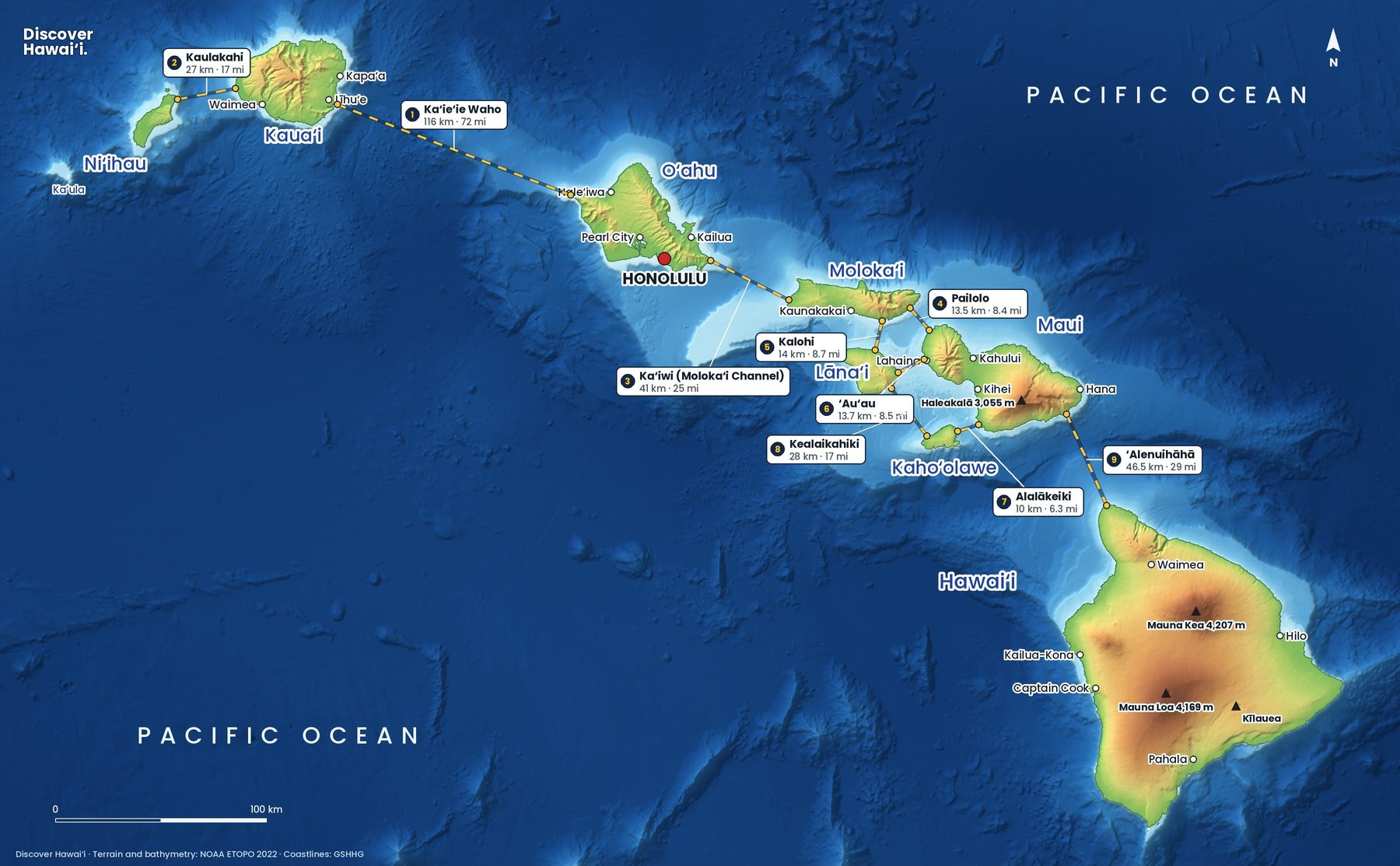
- Kaʻieʻie WahoKauaʻi – Oʻahu · 116 km (72 mi) First crossed in 2010 by a six-swimmer relay, in about 48 hours.
- KaulakahiNiʻihau – Kauaʻi · 27 km (17 mi) First swum in 2003, by Tom Robinson.
- Kaʻiwi (Molokaʻi Channel)Oʻahu – Molokaʻi · 41 km (25 mi) First swum in 1961, by Keo Nakama, in about 15½ hours.
- PailoloMolokaʻi – Maui · 13.5 km (8.4 mi) First swum in 1973, by Jim Caldwell.
- KalohiMolokaʻi – Lānaʻi · 14 km (8.7 mi) First swum in 1978.
- ʻAuʻauLānaʻi – Maui · 13.7 km (8.5 mi) First swum in 1970, by Jim Caldwell.
- AlalākeikiKahoʻolawe – Maui · 10 km (6.3 mi) Kahoʻolawe is off-limits, so swims are no longer allowed.
- KealaikahikiKahoʻolawe – Lānaʻi · 28 km (17 mi) First swum in 2005. Kahoʻolawe is now off-limits.
- ʻAlenuihāhāMaui – Hawaiʻi · 46.5 km (29 mi) First swum in 1970, by Harry Huffaker.
The distances are the shortest lines from coast to coast. Real swims are longer: swimmers start and finish at practical landing points, and currents and tides push them off course, often adding miles and hours.
Which is the hardest channel swim in Hawaii?
The Kaʻiwi Channel is the most famous and is one of the seven swims in the Oceans Seven, the marathon-swimming equivalent of climbing the highest peak on every continent, alongside the English Channel and the Strait of Gibraltar. Many swimmers rank it the hardest of the seven: it is long, the water is more than 600 metres deep, the currents are strong, and the swim almost always runs through the night.
By distance, nothing compares with Kaʻieʻie Waho between Kauaʻi and Oʻahu, at 116 kilometres. It is so long that it was first crossed by a relay team taking turns over about two days. ʻAlenuihāhā, at 46.5 kilometres, is the longest gap between Maui and the Big Island and has some of the roughest water in the chain.
Who first swam the Molokaʻi Channel?
In 1961, Keo Nakama, a 41-year-old from Maui and a former national swimming champion, became the first person to swim from Molokaʻi to Oʻahu, in about fifteen and a half hours. Nakama had been one of the "Three Year Swim Club", the plantation kids from Maui coached by Soichi Sakamoto in an irrigation ditch who went on to win national and Olympic titles. His crossing showed the channels could be swum, and others followed through the 1970s.
Why are Hawaii's channels so dangerous?
Several things combine. The channels are very deep, so there is no shelter and swells roll through unbroken. The trade winds accelerate between the islands, building chop that makes it hard to breathe and impossible to see far. Currents can run across the course for hours. Most swimmers start at night to finish in daylight, which means hours in the dark.
Then there is the wildlife. Box jellyfish and Portuguese man-of-war stings are a constant risk, and sharks, including tiger sharks, patrol open water. Escort boats carry kayakers, medical kits and sometimes electronic shark deterrents. The swims are only attempted with an experienced pilot, a support crew and months of cold, long training swims.
Can you swim to Kahoʻolawe?
No. Kahoʻolawe, the small island off south Maui, was used as a military bombing range from the Second World War until 1990 and still has unexploded ordnance. It is now managed as a cultural reserve, and access is only for approved restoration and cultural work. Two channels that touch Kahoʻolawe, Alalākeiki and Kealaikahiki, were swum in the past but are now off-limits.
How can visitors experience the channels?
You do not need to swim one to feel their power. Every year, outrigger canoe crews race across the Kaʻiwi Channel from Molokaʻi to Waikīkī in the Molokaʻi Hoe for men and Nā Wahine O Ke Kai for women, and prone and stand-up paddlers race the same route in the summer Molokaʻi 2 Oʻahu paddleboard championships. Watching the finish at Waikīkī is free.
You can also see the channels from the air on any inter-island flight, from the summit of Haleakalā on a clear morning, or from the coastal trails of West Maui and Lānaʻi, where the ʻAuʻau Channel fills with humpback whales in winter. For your own swims, stay close to shore in calm, lifeguarded bays, and read our guide to ocean safety in Hawaii first.
Facts checked October 2026. Crossing histories are as recorded by the open-water swimming community; distances were measured on the map.
- Distances measured on GSHHG coastlines; crossing history: Daily News of Open Water Swimming, OpenWaterSwimming.com, Patagonia (2011)
- Kahoʻolawe Island Reserve Commission
- Molokaʻi Hoe
- Map data: NOAA ETOPO 2022, GSHHG