In the autumn of 2015, the ocean around Hawaii stayed too hot for too long. Across the islands, corals turned white, and along the Big Island's Kona coast about half of them died. This map shows where the heat hit, and what divers measured on the reefs afterwards.
Why are Hawaii's coral reefs special?
Hawaii is the most isolated island chain on Earth, thousands of kilometres from the nearest continent. Only a small number of species ever managed to reach it, and many of those that did evolved into something new. A large share of Hawaii's reef fish, roughly a quarter by most counts, and many of its corals are found nowhere else in the world. That makes every reef here more irreplaceable than a reef in the crowded tropics of the western Pacific.
Hawaiian reefs also do a lot of quiet work. They break incoming waves and protect beaches and coastal roads, they feed island families who still fish for food, and they are the reason millions of people come to snorkel and dive each year. Losing them would change the islands far beyond the water.
What is coral bleaching?
Reef-building corals live in partnership with tiny algae inside their tissue. The algae turn sunlight into food for the coral and give it its colour. When the water stays even a degree or two above the normal summer maximum for weeks, that partnership breaks down: the coral expels the algae and turns white. A bleached coral is not dead, but it is starving. If the heat eases quickly, it can recover; if it lasts, it dies and is overgrown by algae.
Scientists measure heat stress in Degree Heating Weeks (DHW), which combine how much hotter than normal the water is with how long it stays that way. Above 4 DHW, significant bleaching is likely; above 8, widespread death becomes likely.
What happened to Hawaii's reefs in 2015?
Hawaii had rarely seen mass bleaching before 2014. Then came two hot years in a row. In 2014 bleaching hit Oʻahu and parts of Maui Nui; in 2015 a long marine heatwave pushed water temperatures well above normal across the whole chain from July to December. It was the most severe bleaching event on record in the main Hawaiian Islands.
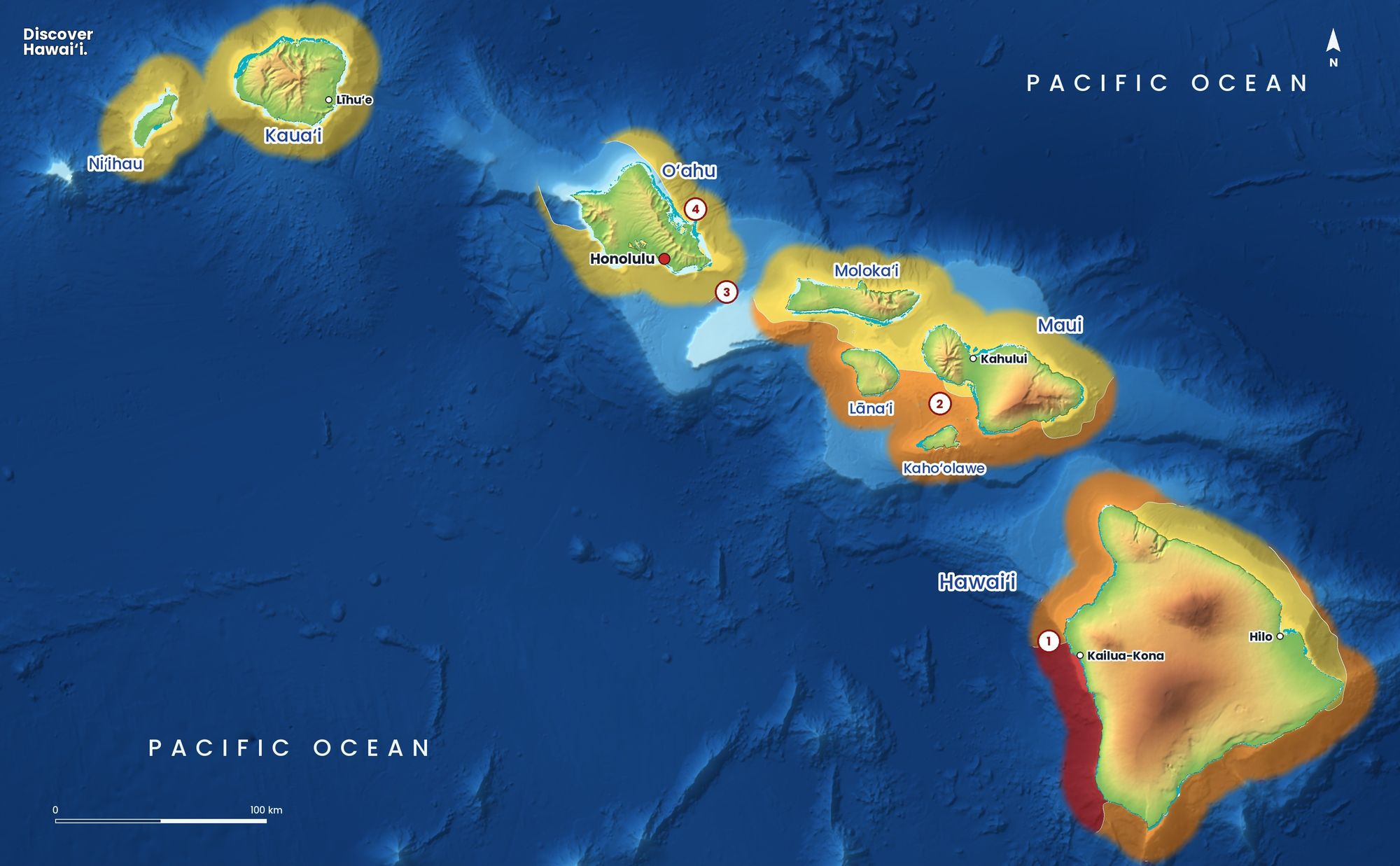
The coloured bands show peak satellite heat stress within 14 km of the coast (NOAA Coral Reef Watch, 5 km data). Reefs are mapped to about 30 metres depth (NOAA, 2007) and drawn slightly thicker so narrow reefs stay visible. Satellite heat stress shows the risk; the numbered dive surveys below show the damage actually measured.
Where was the damage worst?
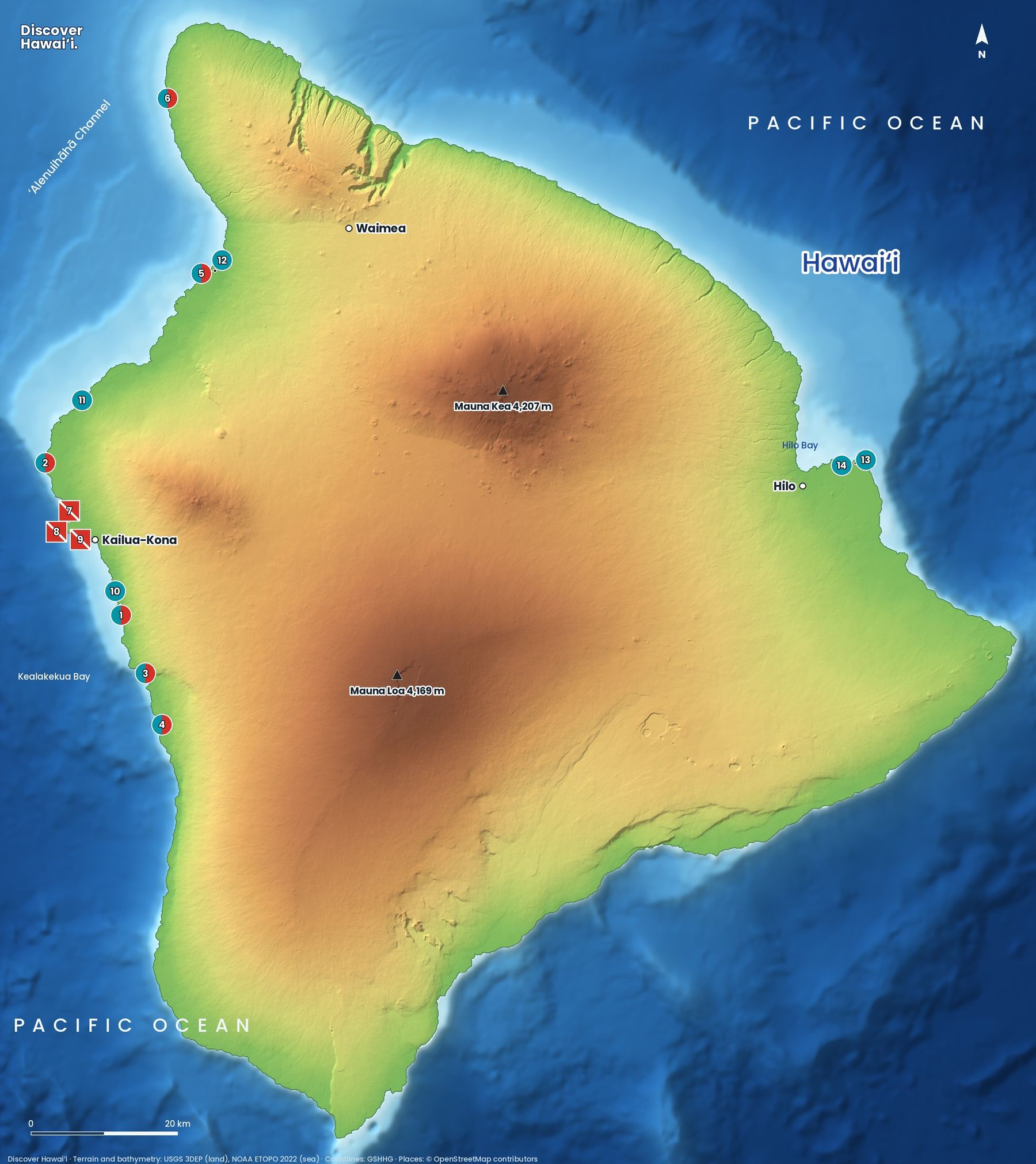
The Kona and Kohala coast of the Big Island took the longest, hottest spell, and the numbers from the reef match the map:
- West Hawaiʻi (Kona & Kohala)About 50% of corals died Reefs bleached heavily in October 2015. Source: Hawaiʻi DLNR Division of Aquatic Resources, 2016.
- Molokini & Olowalu, MauiBleached corals lost ~70% of live tissue Tagged bleached colonies, September–November 2015. Source: DLNR-DAR Maui monitoring report, 2016.
- Hanauma Bay, Oʻahu47% bleached · 9.8% died Surveys in October 2015 and January 2016. Source: Rodgers et al., PeerJ 2017.
- Kāneʻohe Bay, Oʻahu46% bleached · 22% died Bay-wide surveys in October and December 2015. Source: Bahr, Rodgers & Jokiel, Frontiers in Marine Science 2017.
On Maui, the state reported 20 to 30 percent coral death at the hardest-hit sites. Kauaʻi and Niʻihau saw lower heat stress, and many of their reefs came through in better shape.
Have Hawaii's reefs recovered?
Partly. Coral grows slowly, often only a centimetre or two a year, so a reef that lost half its coral needs many years without new shocks to rebuild. Some reefs have bounced back well; others have been overgrown by algae. Another heatwave in 2019 caused more bleaching, though less death than in 2015, and scientists expect hot years to become more frequent.
After 2015, the state surveyed more than 80 coral experts. Their top recommendation was a network of permanent, fully protected marine areas, plus less polluted runoff from land and more protection for the plant-eating fish that keep algae in check. You can see where Hawaii's protected areas are today in our guide to where the ocean is protected.
How can visitors help Hawaii's coral?
- Never stand on or touch coral. Even a fin kick can break years of growth. Float, and stay in sandy areas when you need to rest.
- Use mineral, reef-safe sunscreen or a rash guard. Hawaii bans the sale of sunscreens with oxybenzone and octinoxate.
- Leave the fish alone. Plant-eating fish such as parrotfish and surgeonfish clean algae off recovering reefs. Never feed them.
- Respect closed areas and the rules in Marine Life Conservation Districts.
- Report bleaching you see to the state's Division of Aquatic Resources; citizen reports help scientists track heat events.
For the best reefs to see, read our Oahu, Maui, Big Island and Kauai snorkeling guides.
Facts checked October 2026. Rules, fees and conditions change, so check with the operator, park or lifeguard before you go.
- Hawaii DLNR: State strategies to promote coral bleaching recovery (2016)
- NOAA Coral Reef Watch: CoralTemp 5 km Degree Heating Weeks
- Rodgers et al. 2017, PeerJ: Hanauma Bay bleaching
- Bahr, Rodgers & Jokiel 2017, Frontiers in Marine Science: Kāneʻohe Bay bleaching
- NOAA NCCOS Benthic Habitat Maps of the Main Hawaiian Islands (via Hawaiʻi Statewide GIS Program)