She turned down a throne, married for love and left the Kamehameha lands to educate Hawaiian children. Her husband built a museum in her memory. Both legacies still shape Hawaiʻi.
December 1872: a throne declined
In December 1872 King Kamehameha V lay dying in Honolulu. He was unmarried and had named no heir, and with him the direct line of Kamehameha the Great was about to end. At his bedside he turned to one woman: his childhood companion, Bernice Pauahi Bishop, and asked her to take the throne.
She refused, and on 11 December the king died without naming a successor. The legislature then held an election, and William Lunalilo became Hawaiʻi's first elected king.
Her refusal was not a retreat from public life. Over the next twelve years Pauahi became the largest landholder in the kingdom, and she used that position to make one of the most far-reaching decisions in Hawaiian history.
A chief's daughter
Pauahi was born in Honolulu on 19 December 1831 to the high chiefs Abner Pākī and Laura Kōnia, and descended from the Kamehameha line through her mother; Kamehameha Schools describes her as a great-granddaughter of Kamehameha I. As was common among aliʻi, she was given at birth to be raised by another chief, Kīnaʻu, the kuhina nui (premier), and returned to her parents in 1838.
From 1839 to 1846 she studied at the Chiefs' Children's School, run by the missionaries Amos and Juliette Cooke to educate the kingdom's future rulers. Her classmates included the future kings Kamehameha IV and Kamehameha V, Lunalilo and Kalākaua, as well as Queen Emma and the future Queen Liliʻuokalani. She grew up fluent in Hawaiian and English, a skilled musician and a natural host.
Marrying for love
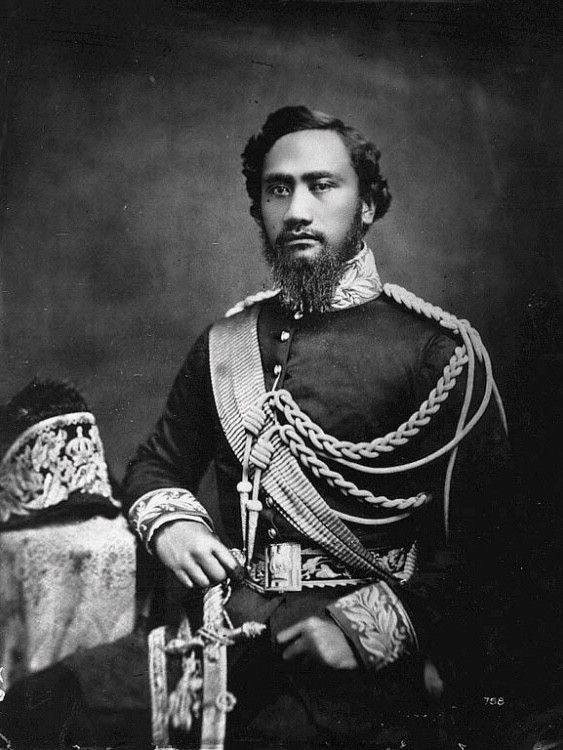
Pauahi had long been expected to marry Lot Kapuāiwa, the future Kamehameha V, uniting two branches of the chiefly line. Instead she fell in love with Charles Reed Bishop, a young American from Glens Falls, New York, who had arrived in 1846 and become a naturalised subject of the kingdom. They married on 4 May 1850, against her parents' wishes.
Bishop went on to found the kingdom's first bank, Bishop & Company, and to serve in government. Their home, Haleʻākala, became a centre of Honolulu society. The couple had no children of their own; an infant they adopted in 1862 died at six months.
Heir to the Kamehameha lands
Through her parents, her aunt ʻAkahi and other relatives, Pauahi inherited land across the islands. The largest gift came in 1883, when her cousin Princess Ruth Keʻelikōlani died and left her nearly 353,000 acres. That made Pauahi the largest private landowner in the kingdom, with about 9 per cent of its land.
By then she was ill with breast cancer. On 31 October 1883 she signed her will. She died at Keōua Hale in Honolulu on 16 October 1884, aged 52, and was buried in the Kamehameha crypt of the Royal Mausoleum at Mauna ʻAla.
The will that built a school
Pauahi left most of her estate in trust. Its thirteenth clause directed five trustees "to erect and maintain in the Hawaiian Islands two schools", one for boys and one for girls, to be called the Kamehameha Schools. The will also asked the trustees to give preference to Hawaiians "of pure or part aboriginal blood", at a time when the Native Hawaiian population had fallen steeply.
The boys' school was formally dedicated on 4 November 1887, with its first pupils already enrolled, on land at Kaiwiʻula in Kalihi. The girls' school opened in 1894. In 1940 the schools began moving to a larger campus on Kapālama Heights, and they later added campuses on Maui and Hawaiʻi Island and a network of preschools.
The trust, long known as the Bishop Estate, remains Hawaiʻi's largest private landowner, with about 363,000 acres, most of it agricultural and conservation land. Its history has not been free of controversy. In 1971 its plans for a suburb in Kalama Valley led to evictions and protests at the start of the Hawaiian Renaissance. In 1997 an essay called "Broken Trust", written by respected community leaders, accused the trustees of mismanagement; the uproar led to trustees being removed in 1999 and to reforms of how the trust is run.
Charles Reed Bishop's memorial
Charles Reed Bishop outlived his wife by more than thirty years. He served as one of the first trustees, paid for many of the school buildings himself and, in 1889, founded the Bernice Pauahi Bishop Museum on the boys' school grounds in her memory.
The museum's first purpose was to house Pauahi's collection of Hawaiian objects and royal heirlooms. It opened to the public in 1891, and its stone Hawaiian Hall and Polynesian Hall followed in 1898. Bishop moved to San Francisco in his later years and died there in 1915; he was later laid to rest in the same crypt as Pauahi at Mauna ʻAla.
Today the museum is the State Museum of Natural and Cultural History. It holds millions of cultural objects, documents and photographs, and more than 24 million natural history specimens, making it one of the most important research collections in the Pacific. Queen Liliʻuokalani deposited personal papers there, and its archives are a key source for Hawaiian-language newspapers.
What to see at Bishop Museum
- Hawaiian Hall: restored and reopened in 2009, its three floors trace Hawaiian life from the gods and the natural world to daily life and the history of the aliʻi. Look for feather cloaks and royal objects of the Kamehameha era.
- Kalaniʻōpuʻu's cloak and helmet: the ʻahu ʻula and mahiole the Hawaiʻi Island chief gave to Captain Cook in 1779 came home from New Zealand on loan in 2016 and have been held permanently at the museum since 2020.
- Pacific Hall: reopened in 2013 after restoration, with voyaging and cultures from across Oceania, including a Fijian fishing canoe in the atrium.
- Science Adventure Center and planetarium: volcanoes and ocean science for families; the J. Watumull Planetarium costs a few dollars extra.
The museum is at 1525 Bernice Street in Kalihi, between Waikīkī and Pearl Harbor. It opens daily from 9 am to 5 pm (last entry 4 pm) and is closed on Thanksgiving, 24–25 December and New Year's Day. Adult tickets cost roughly $34–39 depending on the date as of October 2026; book online and allow two to three hours.
Pauahi's legacy today
Pauahi's name is everywhere in Honolulu, from Bernice Street to Pauahi Street downtown. Each year around her birthday, 19 December, Kamehameha Schools marks Founder's Day, with ceremonies at the Royal Mausoleum where she lies. Her husband's name also reached Kalaupapa, where the Charles R. Bishop Home sheltered girls and women; see Kalaupapa's history.
To round off a day of royal history, combine the museum with the downtown sites in our things to do in Honolulu and the story of ʻIolani Palace. Pauahi's place among the aliʻi of the kingdom is told in full in The History of Hawaii.
Quick answers
Who was Bernice Pauahi Bishop?
A Hawaiian high chiefess (1831–1884), the last royal descendant of the Kamehameha line. She declined the throne in 1872 and left her vast lands in trust to found the Kamehameha Schools.
Who founded the Bishop Museum?
Charles Reed Bishop, Pauahi's American-born husband, founded it in 1889 in her memory to house her collection of Hawaiian objects and royal heirlooms. It opened to the public in 1891.
What is Kamehameha Schools?
A private school system created by Pauahi's will of 1883. The boys' school was dedicated in 1887 and the girls' school opened in 1894; today it has campuses on Oʻahu, Maui and Hawaiʻi Island and gives preference to children of Hawaiian ancestry.
How long do you need at Bishop Museum?
Allow two to three hours for Hawaiian Hall, Pacific Hall and the science galleries. The museum opens daily from 9 am to 5 pm, with last entry at 4 pm.
Did Bernice Pauahi Bishop refuse the throne?
Yes. When the dying Kamehameha V asked her to succeed him in December 1872, she declined. He died without naming an heir, and the legislature then elected Lunalilo as king.
Facts checked October 2026 against the sources below and the research for our book The History of Hawaii. Dates and figures for early Hawaiian history are estimates and scholars still debate some of them.
- Bernice Pauahi Bishop (Wikipedia)
- Our founders (Kamehameha Schools)
- The will of Bernice Pauahi Bishop (Kamehameha Schools)
- November 4, 1887: the founding of Kamehameha Schools (Kamehameha Schools)
- About Bishop Museum (Bishop Museum)
- Bishop Museum now permanent home of 2 artifacts gifted to Captain Cook (Hawaii News Now)
- Overview of the Bishop Estate controversy (ICNL)
- Bernice Pauahi Bishop (Philanthropy Roundtable)