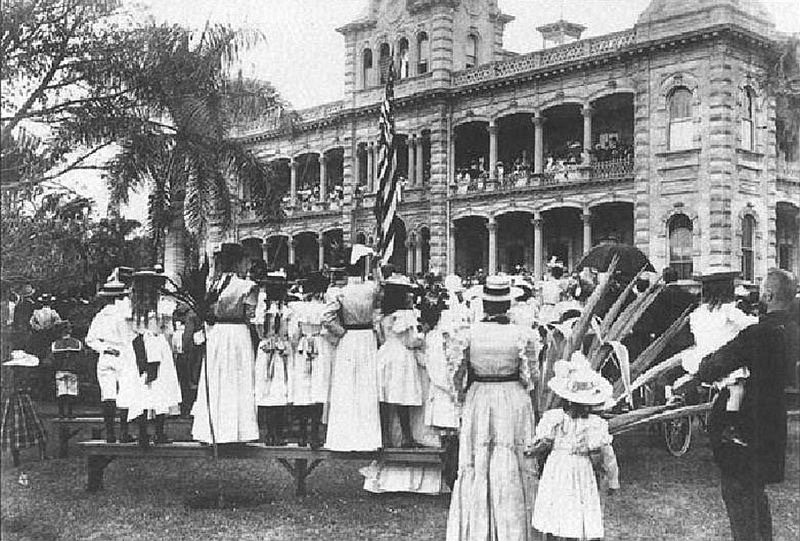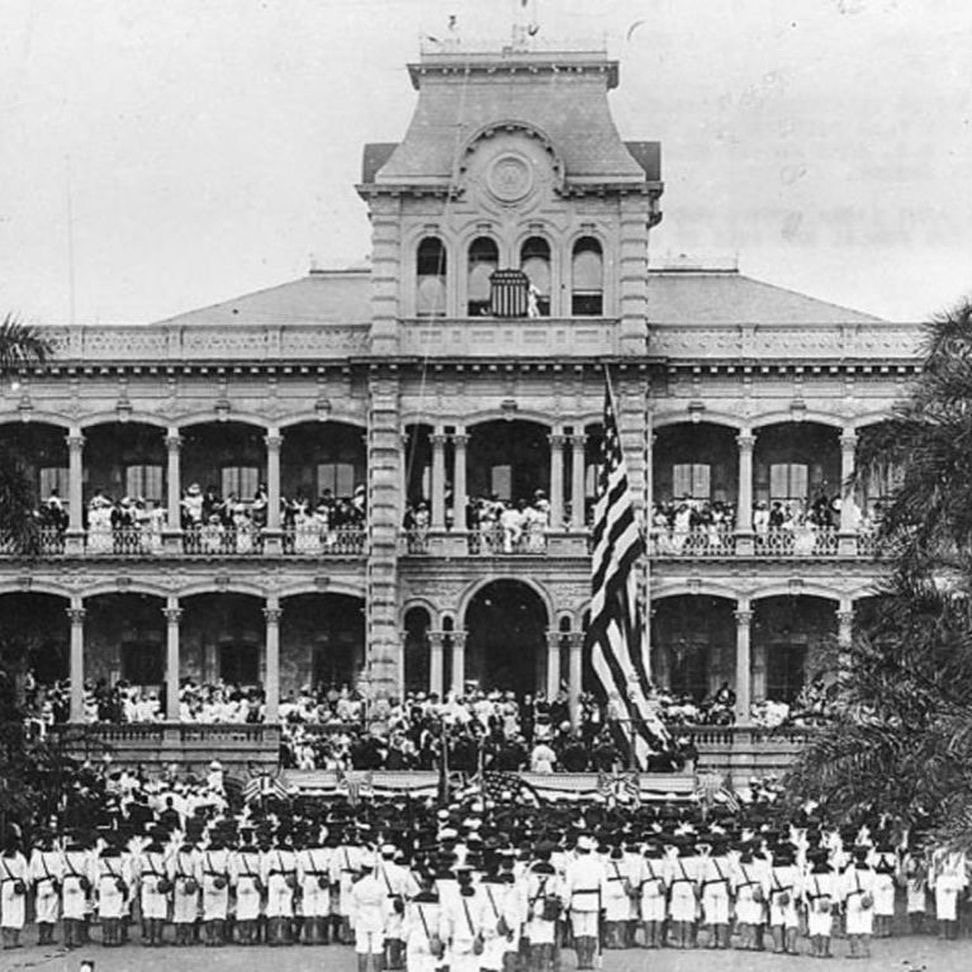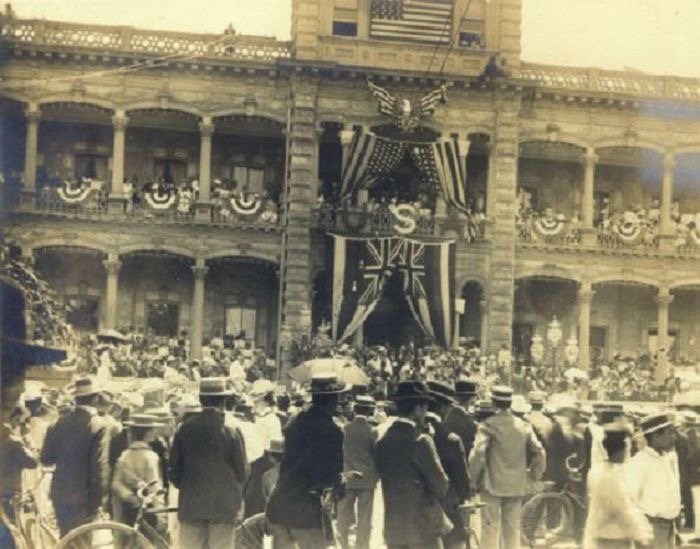
Built by a king who loved new technology, taken over by the men who toppled his sister and saved by a citizens' campaign, ʻIolani Palace holds the whole arc of the Hawaiian Kingdom in one building.
The night the lights came on
In November 1886 Honolulu turned out for King Kalākaua's 50th birthday jubilee. As darkness fell over the palace grounds on King Street, something new happened: electric lamps came on, lighting the lawns and the ornate front of ʻIolani Palace for crowds who had never seen anything like it.
By 1887 the palace had 325 incandescent bulbs, and in March 1888 the streets of Honolulu were lit too. The engineering body IEEE, which marks the achievement with one of its official milestones, notes that the Hawaiian Kingdom had electric light about four years before the White House.
That moment captures what the palace was built to say. Hawaiʻi was a modern, independent kingdom, recognised by the great powers and ready to stand among them. Barely twelve years later the same building would host the ceremony that ended that independence. This is the story of both.
A palace for a modern kingdom
Kalākaua was elected king in 1874 and soon wanted a royal residence to match his ambitions. An older, smaller royal house on the site was cleared, and on 31 December 1879 the cornerstone of the new palace was laid.
Completed in 1882, the building follows a style its designers called American Florentine: two main storeys wrapped in deep verandas, with corner towers and a taller central tower facing King Street. Inside are a grand koa-wood staircase, a throne room for state occasions, the Blue Room for receptions, a state dining room and private apartments upstairs for the king and Queen Kapiʻolani.
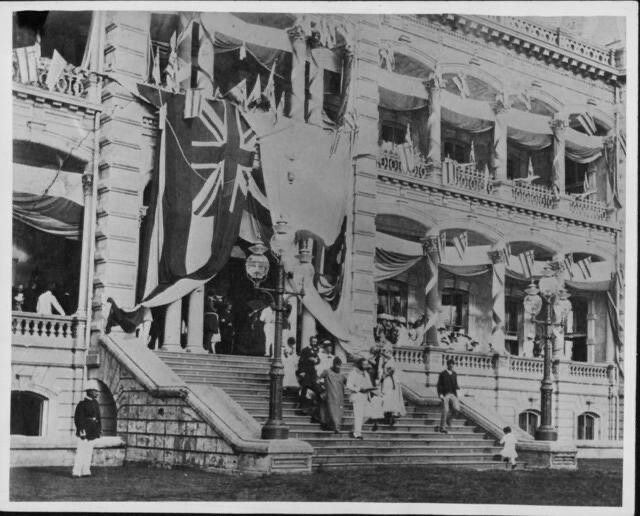
It was expensive. Estimates of the cost, including furnishings, range from about $340,000 to $360,000, a vast sum for a small kingdom, and critics in the business community called it extravagance. Kalākaua saw it as a statement of national confidence, and on 12 February 1883 he staged a formal coronation on the grounds, nine years after taking the throne.
The palace was also built for the future. Besides electric light it had a telephone line and indoor plumbing, comforts many grand houses in Europe and America still lacked. For the full story of the king behind it, read our guide to King Kalākaua, the Merrie Monarch.
A queen's palace, then her prison
When Kalākaua died in San Francisco in January 1891, his sister became Queen Liliʻuokalani and the palace became her official residence. She reigned for just under two years.
On 16 January 1893, 162 sailors and marines from the cruiser USS Boston came ashore and took up positions near the palace and the government buildings. The next day a self-appointed Committee of Safety proclaimed a Provisional Government from Aliʻiōlani Hale, directly across King Street, and the queen yielded under protest to avoid bloodshed. The full sequence is told in our article on the overthrow of the Hawaiian Kingdom.
The palace's darkest chapter came two years later. After a failed royalist rising in January 1895, Liliʻuokalani was arrested and confined to an upstairs bedroom of her former home. A military commission then tried her in the old throne room. She denied knowing of the plot but was convicted and, according to the National Park Service, fined $5,000 and sentenced to five years' hard labour, a sentence commuted to confinement.
She spent nearly eight months in that room with a single lady companion and no other visitors. She prayed, composed music, crocheted and quilted, and the quilt she worked on is now shown at the palace. Many visitors find this small, plain Imprisonment Room the most moving stop on a tour.
From royal home to working capitol
After the overthrow the palace became the seat of the new government. It served the Provisional Government and then, from 4 July 1894, the Republic of Hawaii. On 12 August 1898 the formal transfer of sovereignty to the United States took place on its front steps, as described in our article on Hawaii's annexation in 1898.
For the next seven decades the building worked as a capitol, first for the Territory of Hawaii and, after statehood in 1959, for the State. Lawmakers met in the royal rooms and offices filled the private apartments. Much of the original furniture had already been sold at public auctions in the 1890s and was scattered across the islands and beyond.
The government finally moved out in 1969, when the new State Capitol was ready next door. The palace was left empty, worn and stripped of most of what had made it a royal home.
Restoring the royal rooms
Its revival was led by citizens. The Friends of ʻIolani Palace was founded in 1966 as a non-profit group to campaign for the building, and once the offices left a full restoration began in 1969. Craftspeople repaired plaster, woodwork and finishes, while curators began the long search for the lost contents.
The palace opened to the public as a museum in 1978. The hunt continues: furniture, portraits and personal objects still surface in private homes and sales and come back to the palace by gift, loan or purchase. Today original pieces stand alongside careful reproductions.
The building is a National Historic Landmark and is often described as the only official residence of royalty in the United States. For many Native Hawaiians it is far more than a museum. It is a place of memory, where people gather each January to mark the anniversary of the overthrow.
Visiting ʻIolani Palace today
The palace stands at the corner of King and Richards Streets in downtown Honolulu, a short walk from Aliʻiōlani Hale, the Kamehameha statue and Washington Place, the queen's private home. The grounds are free to wander; to go inside you need a timed ticket. Prices and times below are as of October 2026.
| Tour | When | Adult price |
|---|---|---|
| Self-led audio tour (60 min, nine languages) | Tue, Fri and Sat 9 am–3.30 pm; short afternoon slots Wed and Thu | $28 (teen $23, age 5–12 $13) |
| Docent-led tour | Wed and Thu 9 am–12.30 pm; Sat 3 pm and 3.30 pm | $34 (teen $31, age 5–12 $16) |
| Children 0–4 | Any tour | Free |
Tickets are sold online only at iolanipalace.org, with no walk-ups or same-day bookings, and each entry time is capped at 15 guests, so book ahead. Collect tickets from the window at Hale Koa, the former ʻIolani Barracks on the grounds, which opens at 8.30 am. Allow 60 to 90 minutes, plus time for the basement galleries.
The palace is closed on Sundays, Mondays and listed holidays, which in late 2026 include 26 and 30 November and 25 December. Hawaiʻi residents pay reduced kamaʻāina rates. Combine your visit with the rest of downtown using our guide to things to do in Honolulu, or see where it fits among the islands' other royal sites in historic sites in Hawaii.
The palace and the people who lived in it also run through our book The History of Hawaii, which places them in the wider story from the first voyagers to statehood.
Quick answers
Why is ʻIolani Palace famous?
It was the official residence of Hawaiʻi's last two monarchs, King Kalākaua and Queen Liliʻuokalani. It had electric light before the White House, it was where Liliʻuokalani was imprisoned in 1895, and the 1898 annexation ceremony took place on its steps.
Can you go inside ʻIolani Palace?
Yes. As of October 2026 the palace is open Tuesday to Saturday for self-led audio tours and docent-led tours. Tickets must be booked online in advance at iolanipalace.org; there are no walk-ups or same-day sales.
How much does it cost to tour ʻIolani Palace?
As of October 2026 the self-led audio tour costs $28 for adults and the docent-led tour $34, with lower teen, youth and kamaʻāina rates. Children up to age 4 go free.
Did ʻIolani Palace have electricity before the White House?
Yes. Electric lights lit the palace grounds in November 1886 and by 1887 the palace had 325 bulbs. IEEE notes that the Hawaiian Kingdom had electric light about four years before the White House.
Where was Queen Liliʻuokalani imprisoned?
After the failed royalist rising of January 1895 she was confined to an upstairs bedroom of ʻIolani Palace for nearly eight months. The room, now called the Imprisonment Room, is part of palace tours.
Facts checked October 2026 against the sources below and the research for our book The History of Hawaii. Dates and figures for early Hawaiian history are estimates and scholars still debate some of them.
- ʻIolani Palace: Tours & Admission
- ʻIolani Palace: Hours of operation and 2026 closures
- ʻIolani Palace: Docent-Led Tours
- ʻIolani Palace: Imprisonment Room
- IEEE Milestone: Electric Lighting of the Kingdom of Hawaii, 1886–1888
- EBSCO Research Starters: ʻIolani Palace
- National Park Service: Did You Know? Queen Liliʻuokalani