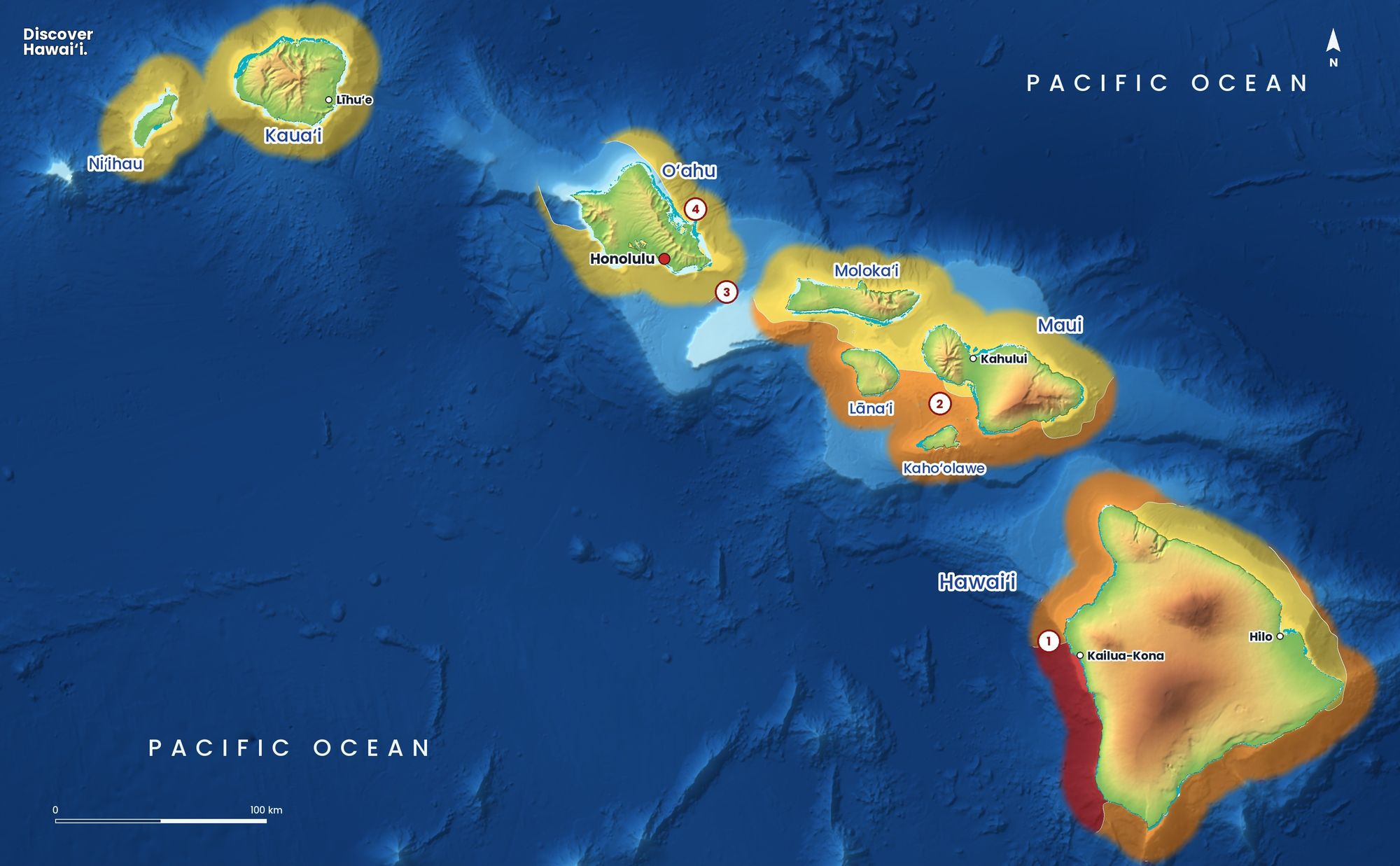
The Big Island's Kona coast is young lava meeting deep water, and that is what makes it special: calm conditions most of the year, clear water, and giant manta rays feeding right off the shore at night. Here are 14 sites around Hawaiʻi Island on one map.
Where are the best snorkel and dive sites on the Big Island?
Almost all of it is on the west side, the Kona and Kohala coasts, which sit in the rain shadow of Mauna Loa and Mauna Kea and are sheltered from the trade winds. The lava here is young and drops quickly into deep water, so visibility is excellent and big animals come close to shore. The east side around Hilo is wetter and rougher, but has two easy spring-fed snorkel spots.
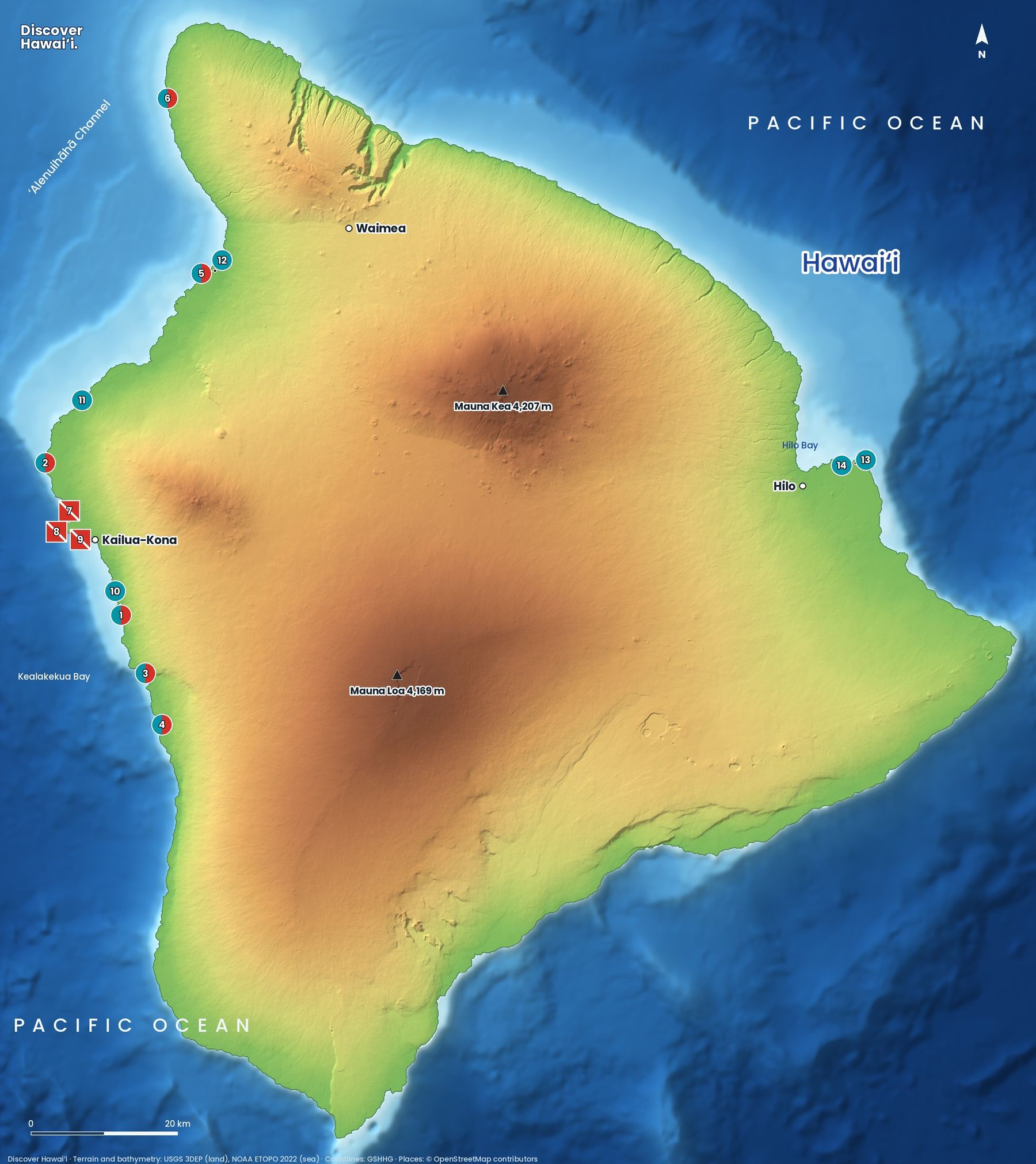
- Manta Ray Night Dive (Keauhou / Manta Village)Boat · beginner Giant mantas feeding under lights at night.
- Manta Heaven (Garden Eel Cove)Boat · intermediate The second manta night site, near Kona airport.
- Kealakekua Bay (Captain Cook Monument)Boat · beginner A Marine Life Conservation District with dolphins and clear coral.
- Two Step (Hōnaunau Bay)Shore · beginner Natural lava steps beside Puʻuhonua o Hōnaunau.
- Puakō ReefShore · intermediate Miles of healthy coral, arches and lava tubes.
- MahukonaShore · intermediate An old sugar harbor with wreckage and clear water.
- Turtle Pinnacle (Honokōhau)Boat · beginner A turtle cleaning station on a sandy pinnacle.
- Long Lava TubeBoat · intermediate A swim-through lava tube with skylights and rare fish.
- Pawai Bay (Old Kona Airport)Boat · intermediate Lava arches, caverns and finger reefs north of Kailua.
- Kahaluʻu Beach ParkShore · beginner A breakwater-protected bay packed with turtles and fish.
- Kua Bay (Maniniʻōwali)Shore · intermediate Turquoise water and a lava-edged reef, calm in summer.
- Beach 69 (Waiʻalea Bay)Shore · beginner A shady cove with coral heads and turtles.
- Richardson Ocean Park, HiloShore · beginner A black-sand cove with cold springs and turtles.
- Carlsmith Beach Park, HiloShore · beginner Clear, spring-fed pools often visited by green turtles.
Is the manta ray night dive worth it?
Yes. It is one of the great wildlife encounters anywhere. After dark, boats anchor at Manta Village (1) off Keauhou or Manta Heaven (2) near the airport and shine lights into the water. The light attracts plankton, and reef manta rays with wingspans of several metres arrive to feed, looping and somersaulting just below the surface. Snorkelers float at the surface holding a lit board; divers kneel on the sand below and watch from underneath.
Mantas are protected under Hawaii state law. Keep your hands to yourself, stay flat at the surface and let them come to you. Sightings are frequent but never guaranteed, and many operators offer a free repeat trip if no mantas show.
Where can you snorkel from shore in Kona?
Kahaluʻu Beach Park (10) is the easiest snorkel on the island: an old breakwater shelters a shallow bay full of turtles and reef fish, right in town. North of Kona, Beach 69 (12) is a shady cove with coral heads, Kua Bay (11) has bright turquoise water that is best in summer, and Puakō (5) runs for miles along the Kohala coast with healthy coral, arches and small lava tubes. Further north, Mahukona (6) is an old sugar harbor with scattered wreckage in very clear water.
Can you snorkel at Kealakekua Bay?
Yes, and it is one of the best snorkels in Hawaii. Kealakekua Bay (3) is a Marine Life Conservation District with clear water, healthy coral and frequent spinner dolphins. The reef in front of the Captain Cook Monument is reached by boat tour, by permitted kayak tour or by a steep hike. Spinner dolphins rest in the bay during the day: stay at least 50 yards away and do not swim towards them.
Just south, Two Step (4) at Hōnaunau Bay is a shore entry down natural lava steps, beside the Puʻuhonua o Hōnaunau National Historical Park, a historic place of refuge. Be respectful of this sacred area.
What are the best dives in Kona?
Kona's boat dives are short rides from Honokōhau Harbor. Turtle Pinnacle (7) is an easy dive where turtles line up to be cleaned by reef fish. Long Lava Tube (8) is a swim-through with skylights and rare fish, and Pawai Bay (9) north of Kailua has lava arches, caverns and finger reefs. Add the manta night dive and you have one of the best dive weeks in the Pacific.
Where do you snorkel near Hilo?
The Hilo side is wetter and rougher, but two spots are worth knowing. Richardson Ocean Park (13) is a small black-sand cove where cold freshwater springs mix with the sea, and turtles graze on the rocks. Carlsmith Beach Park (14) has clear, spring-fed pools that are calm on most days and popular with families and green turtles.
When is the best time to snorkel the Big Island?
Kona is one of the few places in Hawaii where you can snorkel well in almost any month. The big mountains block the trade winds, so the west coast is usually calm in the morning and often all day. The main exceptions are swells: in winter, roughly October to April, north and northwest swells can wrap around to the Kohala coast and make Mahukona and Kua Bay rough, while in summer, south swells occasionally reach Kahaluʻu and Two Step.
Winter also brings humpback whales to the Kohala and Kona coasts, from about December to April, and you can often hear them singing on dives. Whatever the month, go early: the water is calmer, the light is better and the most popular spots are quieter before 9 am. Check the surf forecast, and if the lifeguard says no, pick another spot.
One more Big Island rule: the water off Kona gets deep very quickly. Stay close to shore, swim with a buddy, and use a float or snorkel vest if you are not a strong swimmer.
For more, see the Big Island guide, our guide to ocean safety in Hawaii and the Big Island's volcanoes.
Facts checked October 2026. Rules, fees and conditions change, so check with the operator, park or lifeguard before you go.
- NOAA Fisheries: Viewing marine wildlife in Hawaii
- Hawaii DAR: Marine Managed Areas
- NPS: Puʻuhonua o Hōnaunau National Historical Park
- Map data: USGS 3DEP, NOAA ETOPO 2022, GSHHG, © OpenStreetMap contributors