In January 1893 Hawaiʻi's last monarch lost her throne in three days. A century later the United States Congress apologised. This is what happened in between, and why it still matters.
An afternoon in January
On the afternoon of 17 January 1893, Queen Liliʻuokalani sat down in Honolulu to put her name to a protest. Across the street from her palace, a group of businessmen had just declared her government abolished. American sailors and marines, landed the day before, were stationed nearby.
She chose her words with care. She was yielding, she wrote, not to the men who had seized power but to the United States: "I yield to the superior force of the United States of America". She did so, she added, to avoid bloodshed, and only until the American government learned the facts and restored her.
That restoration never came. But exactly a century later Congress quoted her protest in a formal apology. The road between those two moments explains much of modern Hawaiʻi.
A queen inherits a crisis
Liliʻuokalani became queen on 29 January 1891, after the death of her brother, King Kalākaua. She was 52, a gifted composer and an experienced traveller who had represented Hawaiʻi at Queen Victoria's Golden Jubilee in London.
She inherited a weakened crown. In 1887 an armed league of mostly white businessmen had forced Kalākaua to sign the so-called Bayonet Constitution, which stripped the monarch of much of his power and used property tests to take the vote from most Native Hawaiians (see King Kalākaua, the Merrie Monarch). Then the US McKinley Tariff of 1890 wiped out the price advantage Hawaiian sugar had enjoyed since 1875, and plantation profits slumped.
Many Hawaiians petitioned the queen for a new constitution that would restore the crown's powers and their own votes. She resolved to give them one.
Three days that ended a kingdom
Saturday 14 January. The queen told her cabinet she wished to proclaim a new constitution. Her ministers refused to support it and the plan stalled, but the announcement was enough. That same day a Committee of Safety formed in Honolulu, led by the lawyer Lorrin A. Thurston. Its 13 members were six Hawaiian subjects, five American citizens, one German and one Briton. Many favoured annexation to the United States.
Monday 16 January. At the request of the US minister, John L. Stevens, 162 sailors and marines from the cruiser USS Boston came ashore with arms. Stevens said they were there to protect American lives and property. They took up positions close to the palace and the government buildings.
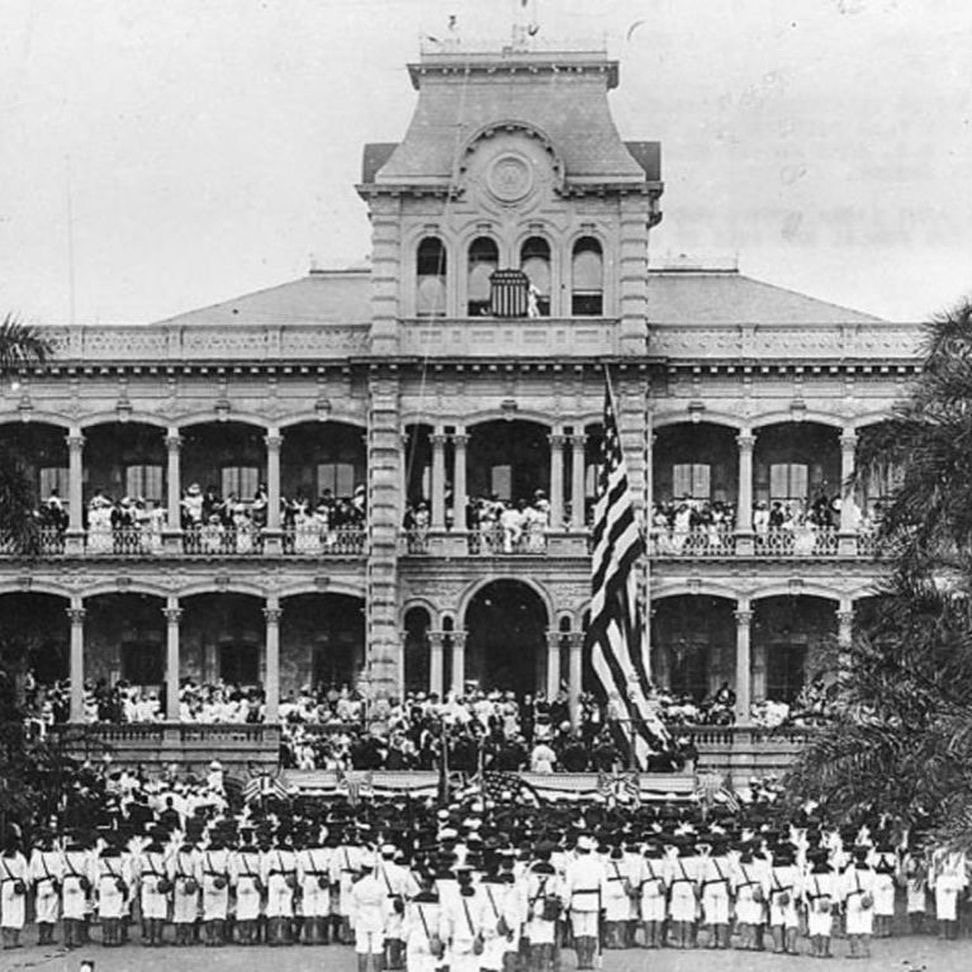
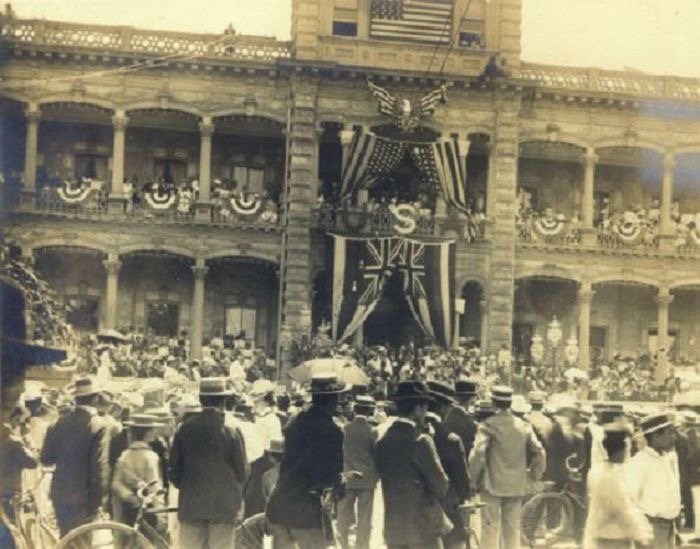
Tuesday 17 January. A Hawaiian police officer, Leialoha, was shot trying to stop a wagon of guns bound for the committee. In the afternoon a proclamation was read at Aliʻiōlani Hale abolishing the monarchy and creating a Provisional Government under Sanford B. Dole, to rule until union with the United States. Stevens recognised it the same day, and the queen, outgunned, yielded under protest.
Blount, Cleveland and an "act of war"
The new government sent envoys to Washington, and in February 1893 President Benjamin Harrison sent an annexation treaty to the Senate. Weeks later Grover Cleveland took office, withdrew it and sent a former congressman, James H. Blount, to investigate.
Blount's report of 17 July 1893 concluded that Stevens had acted without authority, that the landing of US troops had been decisive and that most Hawaiians opposed the revolution. Stevens was recalled. On 18 December 1893 Cleveland told Congress the overthrow was an "act of war" committed with the participation of a US diplomat, and his new minister pressed for the queen's restoration. Dole refused to step aside.
A Senate committee chaired by John Tyler Morgan reached the opposite verdict in 1894, clearing Stevens and the troops. The two reports still frame the debate: the 1993 Apology Resolution rests on Blount's findings, while defenders of the revolution point to Morgan's.
1895: rising, arrest and abdication
On 4 July 1894 the Provisional Government declared itself the Republic of Hawaii. In January 1895 royalists led by Robert W. Wilcox and Samuel Nowlein rose in arms around Honolulu; within days they had been defeated.
Weapons were found buried at Washington Place, the queen's private home, and she was arrested and held in an upstairs room of ʻIolani Palace. On 24 January 1895, to spare jailed supporters from execution, she signed a document of abdication, which she later said she signed under duress. A military commission convicted her of knowing about the rising, which she denied, and the National Park Service records a sentence of five years' hard labour and a $5,000 fine, commuted to confinement. Her months in the palace are described in our article on ʻIolani Palace history. She received a full pardon in 1896.
The queen who kept protesting
Free again, Liliʻuokalani took her case to Washington. In June 1897 she lodged a formal protest against President McKinley's new annexation treaty, and in 1898 she published her memoir, Hawaii's Story by Hawaii's Queen. Native Hawaiians mounted their own resistance with the Kūʻē petitions, signed by more than 21,000 people, which helped defeat the treaty. Annexation came instead by a joint resolution of Congress in July 1898, as told in Hawaii's annexation in 1898.
Her best-known song, "Aloha ʻOe", was written in 1878 as a love song, but after 1893 many heard it as a farewell to the kingdom. She died at Washington Place on 11 November 1917, aged 79, and lies in the royal mausoleum at Mauna ʻAla.
A century later: the Apology Resolution
On 23 November 1993, in the centenary year of the overthrow, President Bill Clinton signed Public Law 103-150, introduced by Hawaiʻi's senators Daniel Akaka and Daniel Inouye. In it Congress apologised to Native Hawaiians on behalf of the people of the United States for the overthrow and for the deprivation of their right to self-determination.
The resolution's preamble records that the Republic later ceded about 728,000 ha (1.8 million acres) of crown, government and public lands without the consent of or compensation to Native Hawaiians, and that the Hawaiian people "never directly relinquished their claims to their inherent sovereignty". Its final section states that nothing in it is intended to settle any claims against the United States, and in 2009 the US Supreme Court ruled in Hawaii v. Office of Hawaiian Affairs that it did not limit the state's authority over those lands.
What should follow is still debated. Some Native Hawaiians seek a form of federal recognition similar to that of Native American tribes; others argue the kingdom was never lawfully ended and call for independence; many simply work for land, language and culture, a movement traced in the Hawaiian Renaissance.
Where to see this history
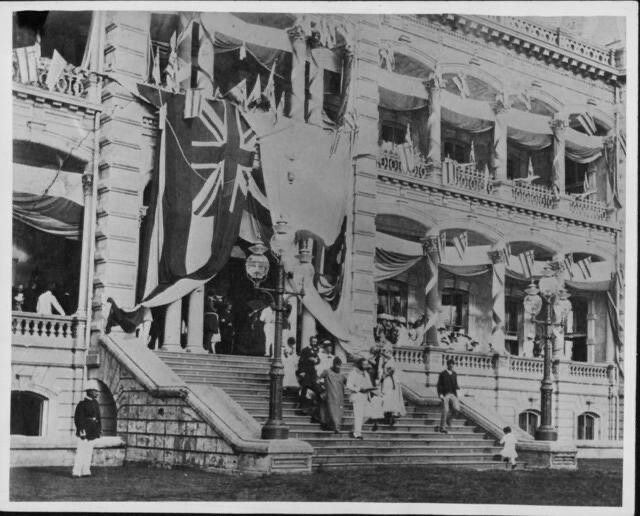
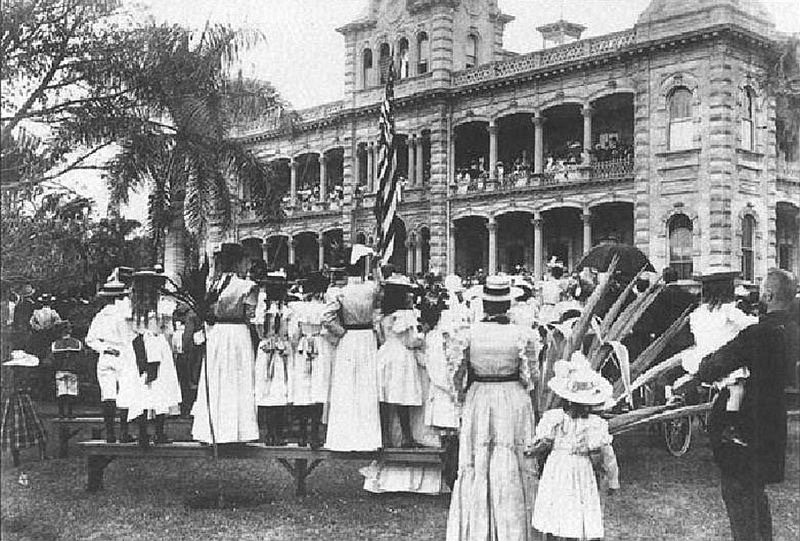
Almost every scene of January 1893 lies within a few minutes' walk in downtown Honolulu. ʻIolani Palace, open Tuesday to Saturday with tickets booked online (as of October 2026), tells the story in the rooms where it happened, including the room where the queen was confined. Across King Street, Aliʻiōlani Hale, where the monarchy was declared abolished, houses the free King Kamehameha V Judiciary History Center.
Washington Place, the queen's home, is now a museum; its tours were paused for repairs in 2026, so check washingtonplace.hawaii.gov before planning a visit. Up the Pali Highway, Mauna ʻAla holds her grave. Our things to do in Honolulu guide helps you fit them into a day.
Each January people gather at the palace to mark the anniversary of the overthrow. Visit with respect, and if you want the whole story, from Kalākaua's reign through annexation and the sovereignty movement, it is told chapter by chapter in our book The History of Hawaii.
Quick answers
Why was the Hawaiian Kingdom overthrown?
A group of mostly American and European businessmen, many tied to sugar and favouring annexation, moved against Queen Liliʻuokalani after she announced plans for a new constitution restoring royal power and Native Hawaiian voting rights. US troops landed on 16 January 1893, and the monarchy was declared abolished the next day.
Did the United States overthrow the Hawaiian Kingdom?
The overthrow was carried out by the local Committee of Safety, but the US minister John L. Stevens landed 162 armed sailors and marines and recognised the new government. The 1893 Blount Report found the US role decisive, President Cleveland called it an act of war, and the 1993 Apology Resolution apologised for US participation.
What happened to Queen Liliʻuokalani after the overthrow?
She lived at Washington Place and protested. After a failed royalist rising in 1895 she was arrested, forced to abdicate and confined in ʻIolani Palace for nearly eight months. She was pardoned in 1896 and died in 1917.
What is the Apology Resolution?
Public Law 103-150, signed on 23 November 1993, in which Congress apologised to Native Hawaiians for the US role in the 1893 overthrow. It states that it does not settle any claims against the United States.
Is Hawaii still a sovereign kingdom?
Legally, the United States and its courts treat Hawaiʻi as a US state. Some Native Hawaiian groups argue the kingdom was never lawfully ended and seek independence, while others pursue federal recognition or self-governance within the US.
Facts checked October 2026 against the sources below and the research for our book The History of Hawaii. Dates and figures for early Hawaiian history are estimates and scholars still debate some of them.
- Congress.gov: S.J.Res.19, Apology Resolution (enrolled text)
- govinfo: Public Law 103-150, 107 Stat. 1510
- Wikipedia: Overthrow of the Hawaiian Kingdom
- Wikipedia: Blount Report
- National Park Service: Did You Know? Queen Liliʻuokalani
- Legal Information Institute: Hawaii v. Office of Hawaiian Affairs (2009)