It began with one war-surplus DC-3 and a grievance against the only airline in town. For 62 years Aloha Airlines flew islanders and visitors between the islands, until it stopped almost overnight.
26 July 1946: a DC-3 for the people
On 26 July 1946 a war-surplus Douglas DC-3 took off from Honolulu, bound for Maui and Hilo. Painted on the side was the name of a brand-new company, Trans-Pacific Airlines, and behind it stood a Honolulu businessman named Ruddy F. Tongg.
Tongg and his partners had a grievance. Inter-island air travel belonged to a single company, Hawaiian Airlines, and they had been turned away when they tried to book seats on its flights. So they started their own airline, with the slogan "The People's Airline". Over the next six decades it would become Aloha Airlines, one of the best-loved companies in the islands, before a sudden end in 2008.
The older rival: Hawaiian Airlines
Hawaiian had been flying since 1929. Founded as Inter-Island Airways, it began with sightseeing flights over Oʻahu that October, and on 11 November 1929 it started scheduled service with Sikorsky S-38 amphibians from Honolulu to Hilo, stopping at Molokaʻi and Maui. On 1 October 1941 it renamed itself Hawaiian Airlines.
Before the planes, travel between the islands meant the steamers of the Inter-Island Steam Navigation Company, often an overnight voyage across rough, windy channels. The new airlines turned a night at sea into an hour or two in the air, and they knitted the islands together as never before.
From Trans-Pacific to Aloha
The upstart grew slowly at first. It won federal approval for scheduled service in February 1949, began regular flights on 6 June that year and reported its first annual profit in 1952. In 1958, under its chief executive Hung Wo Ching, it changed its name to Aloha Airlines, and in 1959, as statehood and the first jets transformed tourism, it went public and introduced Fairchild F-27 turboprops.
The timing was perfect. Visitors arriving by jet in Honolulu wanted to see the other islands, and the Hawaii Visitors Bureau was urging them to (see Hawaii tourism's golden age). Both airlines grew fast on the traffic.

Viscounts, One-Elevens and Funbirds
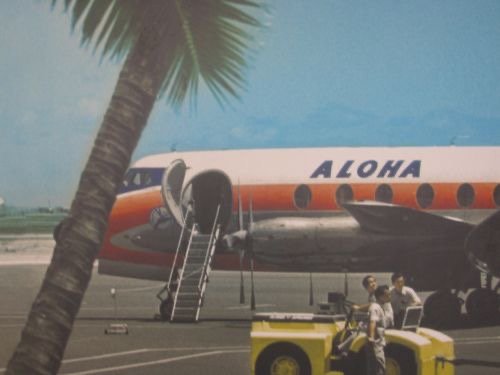
In 1963 Aloha bought two Vickers Viscounts from Austrian Airlines and later added a third from Northeast Airlines. The British-built turboprop, with its four Rolls-Royce Dart engines and big oval windows, was fast, smooth and quiet by the standards of the day, and passengers loved the views. The photograph at the top of this page shows one on the ramp, Aloha's name in blue on a white roof above an orange stripe.
The jet age reached the inter-island routes in 1966. Hawaiian began flying Douglas DC-9s, and on 16 April that year Aloha's first jet, a British BAC One-Eleven, arrived in Honolulu. Hawaiian's larger DC-9s had the edge, so Aloha ordered Boeing 737-200s, which entered service in March 1969 as the "Funbirds". In October 1971 Aloha sold its last Viscount and became an all-jet airline.
For decades the two companies fought for every passenger between Honolulu, Kahului, Līhuʻe, Hilo and Kona. They tried to merge three times, in 1970, 1988 and 2001, and each time the deal fell apart. For travellers the rivalry meant frequent flights, friendly crews and, at times, fierce fare wars.
Each airline wore its identity on its tail. From 1973 Hawaiian's logo showed the face of Leinaʻala Drummond, Miss Hawaii 1964, framed by a flower, and the image, later known as Pualani, became one of the most recognisable airline symbols in the world. Aloha leaned on cheerful colour and its very name: for many islanders, flying Aloha to see family on another island was simply part of life, and the company never stopped presenting itself as the home-grown airline it had been since its first slogan. In an era when visitors were pouring into Waikīkī, both companies sold themselves as the islands' own airlines, run by and for people who lived there.
Flight 243: 28 April 1988
Aloha's most famous flight was a near-disaster. On 28 April 1988 Flight 243, a 19-year-old Boeing 737-200, left Hilo for Honolulu. At its cruising height of about 7,300 m (24,000 ft), south of Kahului on Maui, a section of the upper fuselage tore away, ripping off around 5.5 m (18 ft) of the cabin roof.
The senior flight attendant, Clarabelle "C.B." Lansing, was swept out of the aircraft; her body was never found. With passengers strapped into their seats under open sky, Captain Robert Schornstheimer and First Officer Mimi Tompkins brought the crippled jet down at Kahului about 13 minutes later. Sixty-five people were injured, eight of them seriously, but everyone else survived.
Investigators found that the aircraft had made 89,680 flights, far more pressurisation cycles than most 737s, because inter-island hops are so short. The National Transportation Safety Board blamed metal fatigue and corrosion that Aloha's maintenance programme had failed to detect, and also criticised the oversight of the Federal Aviation Administration. The accident became a turning point in how airlines and regulators inspect ageing aircraft worldwide, and it was retold in the 1990 television film Miracle Landing. Lansing, aged 58, had flown with Aloha for 37 years.
Last call: 31 March 2008
Aloha survived bankruptcy once, filing in December 2004 and emerging in February 2006. Its second crisis was fatal. A fare war with go!, a low-cost rival launched in 2006 by the mainland company Mesa Air Group, and soaring fuel prices drove it back into bankruptcy on 20 March 2008. Ten days later it announced the end of passenger flights, and the last ones flew on 31 March 2008. About 1,900 of its roughly 3,500 employees lost their jobs almost overnight, a shock still remembered across the islands.
One part survived. The profitable cargo division, whose quick-change 737s could swap seats for freight in under an hour, was sold to the Seattle-based Saltchuk group. As Aloha Air Cargo it still flies freight, from fresh produce to live animals, between the islands six days a week.
Island hopping today
Hawaiian Airlines outlived its old rival, flying Boeing 717s on the inter-island network since 2001. In September 2024 it became part of Alaska Air Group, and in October 2025 the two airlines merged their operating certificates, though the Hawaiian name and brand were kept. Southwest Airlines entered the inter-island market on 28 April 2019 with flights between Honolulu and Kahului, and smaller commuter airlines serve the quieter airports.
The flights are still short and scenic, and on a clear day the neighbouring islands slide past the window like a map. Our guide to island hopping in Hawaii explains how to plan a multi-island trip, and our island pages help you choose which ones to visit. For the bigger picture of the jet age that made it all possible, see vintage Hawaii travel posters and ads.
Quick answers
What happened to Aloha Airlines?
Aloha Airlines filed for bankruptcy on 20 March 2008 after a fare war with go! and high fuel prices, and flew its last passenger flights on 31 March 2008. Its cargo division survives as Aloha Air Cargo.
What happened on Aloha Airlines Flight 243?
On 28 April 1988 part of the cabin roof of the Boeing 737 tore away at about 24,000 ft between Hilo and Honolulu. Flight attendant Clarabelle Lansing was killed, 65 people were injured and the pilots landed safely at Kahului, Maui.
When was Aloha Airlines founded?
It was founded in 1946 as Trans-Pacific Airlines by Ruddy F. Tongg and partners, making its first flight on 26 July 1946. It was renamed Aloha Airlines in 1958.
Is Hawaiian Airlines still flying inter-island?
Yes. Hawaiian Airlines, part of Alaska Air Group since 2024, still flies between the main islands under its own brand, alongside Southwest and smaller commuter airlines.
How long are inter-island flights in Hawaii?
Most are short: roughly 30 to 50 minutes between Honolulu and the neighbour-island airports, which is why inter-island jets make so many takeoffs and landings.
Facts checked October 2026 against the sources below and the research for our book The History of Hawaii. Vintage photos and adverts are shown as period illustrations; adverts are credited to their original advertisers.
- Wikipedia: Aloha Airlines
- Wikipedia: Aloha Airlines Flight 243
- Wikipedia: Hawaiian Airlines
- Maui News: Aloha Airlines Flt. 243, 30 years later (2018)
- Aloha Air Cargo: About
- Fox5 / Hawaii News Now: 94 years ago, it launched inter-island air service
- AirlineGeeks: Alaska, Hawaiian secure single operating certificate (2025)
- Honolulu Star-Advertiser: Southwest Airlines to launch interisland service Sunday (2019)