It took forty years of petitions, a political upheaval and a vote in which more than nine in ten said yes. Then the jets arrived, and the new state changed faster than at any time since sugar.
21 August 1959: a fiftieth star
On 21 August 1959, in the White House, President Dwight D. Eisenhower signed the proclamation that admitted Hawaiʻi to the Union and unveiled a new flag with fifty stars, to become official on 4 July 1960. In Honolulu, some 8,000 km (about 4,800 miles) away, the islands celebrated.
The moment had been a long time coming, and its meaning is still debated. For many residents, especially the children of plantation workers, statehood meant full citizenship at last: votes in Congress, an elected governor and an end to rule by appointees. For others, above all many Native Hawaiians, it sealed a process that had begun with the overthrow of 1893 and the annexation of 1898.
Forty years of asking
Under the Organic Act of 1900, Hawaiʻi became a US territory. Washington appointed its governor, and the islands sent a single non-voting delegate to Congress. In 1919 that delegate, Prince Jonah Kūhiō Kalanianaʻole, introduced the first statehood bill. It went nowhere, and so did dozens of others over the next four decades.
Money sharpened the argument. In 1934 a federal law cut Hawaiʻi's sugar quota, and planters who had once been lukewarm about statehood saw what a territory without senators could lose. In 1940 island voters backed statehood by roughly two to one, 46,174 to 22,426. In 1950, before Congress had agreed to anything, they went further and approved a state constitution of their own.
War, loyalty and a stalled Senate
The Second World War froze the campaign, but it also changed the argument. The record of Hawaiʻi's Nisei soldiers in the 100th Infantry Battalion and the 442nd Regimental Combat Team (see our Pearl Harbor history) made it much harder to question the loyalty of a population that was more than a third Japanese American.
The House of Representatives passed statehood bills, but the Senate kept blocking them. Some Southern senators feared admitting a state with a non-white majority that would vote for civil rights. Others claimed that the powerful dockworkers' union, the ILWU, was a channel for communist influence. In February 1954 islanders sent Congress a giant petition, rolled onto a wooden spool, bearing somewhere between 116,000 and 120,000 signatures depending on the count. It survives today in the National Archives.
Not everyone at home wanted statehood. Territorial senator Alice Kamokila Campbell testified against it before a congressional committee at ʻIolani Palace in 1946, on the anniversary of the overthrow, and in 1947 opened an anti-statehood office to keep up the fight.
The Revolution of 1954
For half a century island politics had belonged to the Republican Party and the sugar companies of the Big Five. In November 1954 that order fell. Democrats won solid majorities in both houses of the territorial legislature for the first time, an upset still remembered as the Revolution of 1954.
Its architect was John A. Burns, a former Honolulu police officer who had built links with the Japanese American community during the war. He rebuilt the Democratic Party around returning Nisei veterans, including Daniel Inouye, and the multi-ethnic membership of the ILWU. Inouye later said the veterans simply "wanted our place in the sun." Elected delegate to Congress in 1956, Burns argued patiently that the objections to statehood were unfair.
His decisive move was tactical: he let Alaska go first. Alaska became the 49th state on 3 January 1959, and the path for Hawaiʻi opened.
The votes that decided it
Events then moved quickly. The Senate passed the Hawaii Admission Act on 11 March 1959 (by 76 votes to 15 in most accounts; the state's own timeline records 75 to 15), the House followed the next day and Eisenhower signed it on 18 March. The Act took effect only if island voters accepted it, so a plebiscite was held on 27 June.
| Date | Vote | Result |
|---|---|---|
| 11 March 1959 | US Senate passes the Admission Act | 76 to 15 |
| 12 March 1959 | US House passes the Admission Act | 323 to 89 |
| 27 June 1959 | Plebiscite: "Shall Hawaii immediately be admitted into the Union as a State?" | 132,773 yes, 7,971 no |
About 94 per cent of those voting said yes, and approval topped 93 per cent on every major island. At the first state elections in July, Republican William Quinn became governor, Hiram Fong became the first Asian American US senator and Daniel Inouye the first Japanese American elected to Congress. Hawaiʻi now marks Statehood Day, a state holiday, on the third Friday in August.
A question not on the ballot
In December 1959 the United Nations General Assembly accepted that Hawaiʻi's people had chosen their status, and the United States stopped reporting on the islands as a non-self-governing territory. That conclusion remains contested. Critics, including many sovereignty advocates, point out that the ballot offered statehood or continued territorial rule, with no option of independence. Supporters answer that turnout was high and the margin overwhelming by any standard.
The Admission Act also settled the fate of land. The former Crown and Government lands of the Hawaiian Kingdom, estimates usually put them at about 1.2 to 1.4 million acres, passed to the new state as a public trust for five purposes. One of them is "the betterment of the conditions of native Hawaiians". How well that trust has been kept is a live political question, and it fed directly into the Hawaiian Renaissance of the 1970s and the 1993 Apology Resolution, in which Congress acknowledged the US role in the overthrow.
Jets, hotels and a new economy
Statehood arrived alongside the jet age. The first commercial jets reached Honolulu that same year, cutting the trip from the West Coast to about five hours. "Statehood and jet travel catapulted us," the banker Walter Dods later told the Honolulu Advertiser.
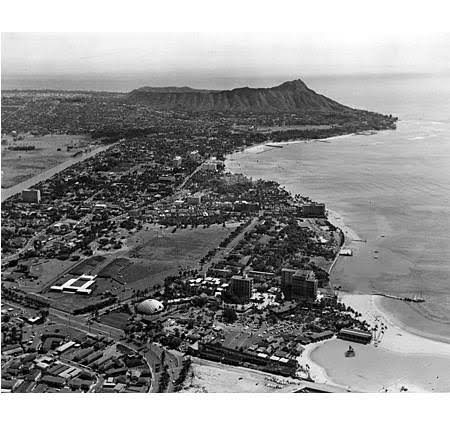
The numbers bear him out. In 1959 military spending was worth more than sugar and pineapple combined, and tourism ranked third. Within about two years it led all three. Visitor arrivals, about 243,000 in 1959, passed 296,000 in 1960 and reached roughly 1.6 to 1.7 million by 1970. Cranes rose over Waikīkī, where the first high-rise hotels had appeared in 1955, and Ala Moana Center opened in August 1959 with some 80 stores.
Growth brought prosperity and resentment in equal measure. Average incomes caught up with the national figure, but farmland disappeared under subdivisions and rents climbed. By the late 1960s a new question was being asked across the islands: who was the new Hawaiʻi for?
Seeing statehood history today
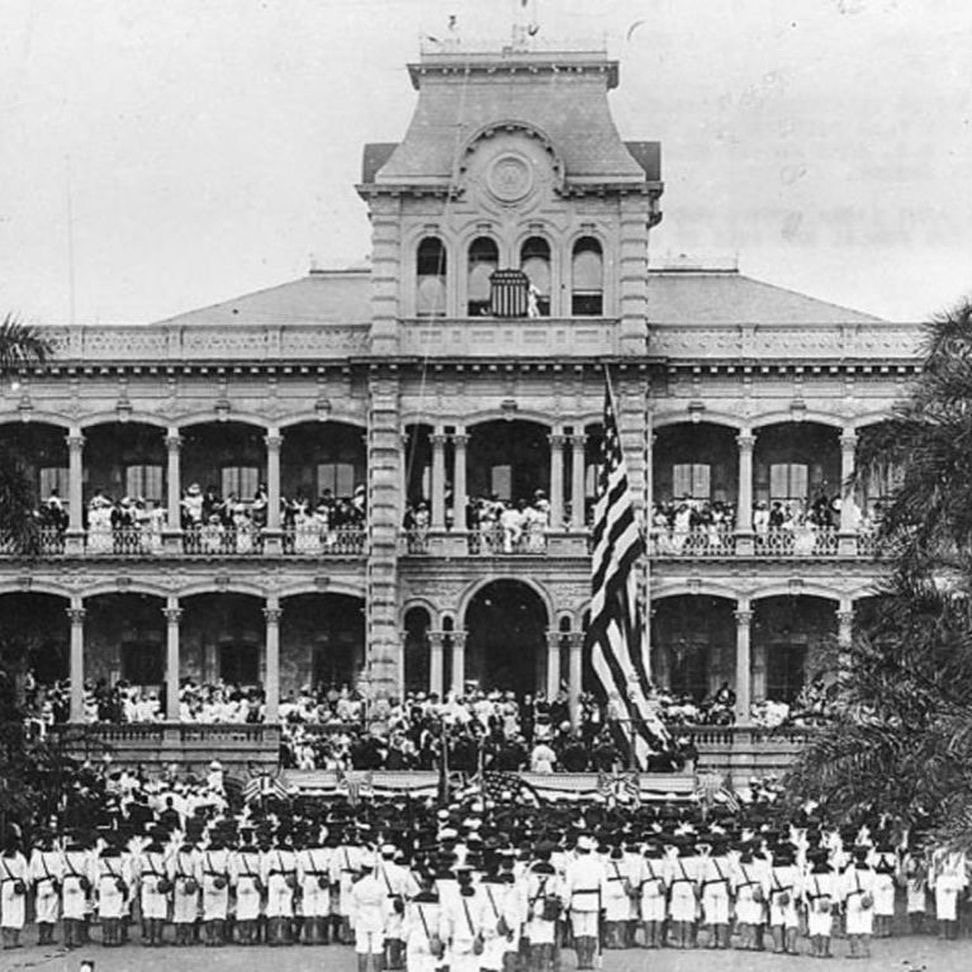
Start downtown at ʻIolani Palace, which served as the territorial and then state capitol until 1969; congressional hearings on statehood were held inside. Across the lawn, the open-sided Hawaiʻi State Capitol, completed in 1969, was designed to evoke a volcano rising from the sea. Both are an easy walk from the royal sites in our things to do in Honolulu guide.
In Waikīkī, the 1927 Royal Hawaiian and the 1901 Moana still stand among the towers that statehood brought, a vivid before-and-after in a single block. For the full story of the territorial decades, from the Big Five to the jet age, see The History of Hawaii.
Quick answers
When did Hawaii become a state?
Hawaiʻi became the 50th US state on 21 August 1959, when President Eisenhower signed the proclamation of admission. The Admission Act had been signed on 18 March 1959.
What percentage of Hawaii voted for statehood?
In the plebiscite of 27 June 1959, about 94 per cent of those voting approved immediate statehood: 132,773 yes against 7,971 no.
Why did it take so long for Hawaii to become a state?
Statehood bills were introduced from 1919, but the Senate blocked them for decades. Objections included fears about a state with an Asian American plurality and claims of communist influence through the ILWU dockworkers' union.
Was independence an option in the 1959 Hawaii vote?
No. Voters chose between statehood and remaining a territory. Many sovereignty advocates argue this means Hawaiians never had a full act of self-determination, while supporters point to the high turnout and large margin.
What is Statehood Day in Hawaii?
Statehood Day, also called Admission Day, is a state holiday held on the third Friday in August to mark admission to the Union on 21 August 1959.
Facts checked October 2026 against the sources below and the research for our book The History of Hawaii. Dates and figures for early Hawaiian history are estimates and scholars still debate some of them.
- Hawaii Admission Act (Wikipedia)
- Plebiscite: Proposition 1 results (statehoodhawaii.org)
- Admission Day (Images of Old Hawaiʻi)
- Revolution of 1954 (Densho Encyclopedia)
- Statehood and tourism, 16 August 2009 (Honolulu Advertiser)
- Waikīkī (Wikipedia)
- A Timeline to Statehood (State of Hawaii, archived)
- Aloha treatment for a 1954 Hawaii petition (National Archives, Prologue blog)