He swam faster than anyone alive, carried surfing around the world, played bit parts in Hollywood and kept the peace in Honolulu for a quarter of a century. Duke Kahanamoku was Hawaiʻi's first global star.
Honolulu Harbor, 11 August 1911
On 11 August 1911, Hawaiʻi held its first swimming meet under the rules of the Amateur Athletic Union. There was no pool: the races were swum in the open water of Honolulu Harbor.
A tall 20-year-old from Waikīkī named Duke Kahanamoku swam 100 yards in 55.4 seconds, beating the world record by more than four seconds. He set other records the same day. On the mainland, AAU officials refused to believe it. Their president urged "extreme caution", and sceptics suggested that currents or faulty stopwatches must have helped.
The doubters would not have to wait long. Within a year Duke was an Olympic champion, and within a decade he was the most famous Hawaiian in the world.
A Waikīkī childhood
Duke Paoa Kahanamoku was born in Honolulu on 24 August 1890, by his own account at Haleʻākala, the home of Bernice Pauahi Bishop. Duke was not a title but a family name: his father, Duke Halapu Kahanamoku, had been named in honour of Prince Alfred, Duke of Edinburgh, who visited Hawaiʻi in 1869.
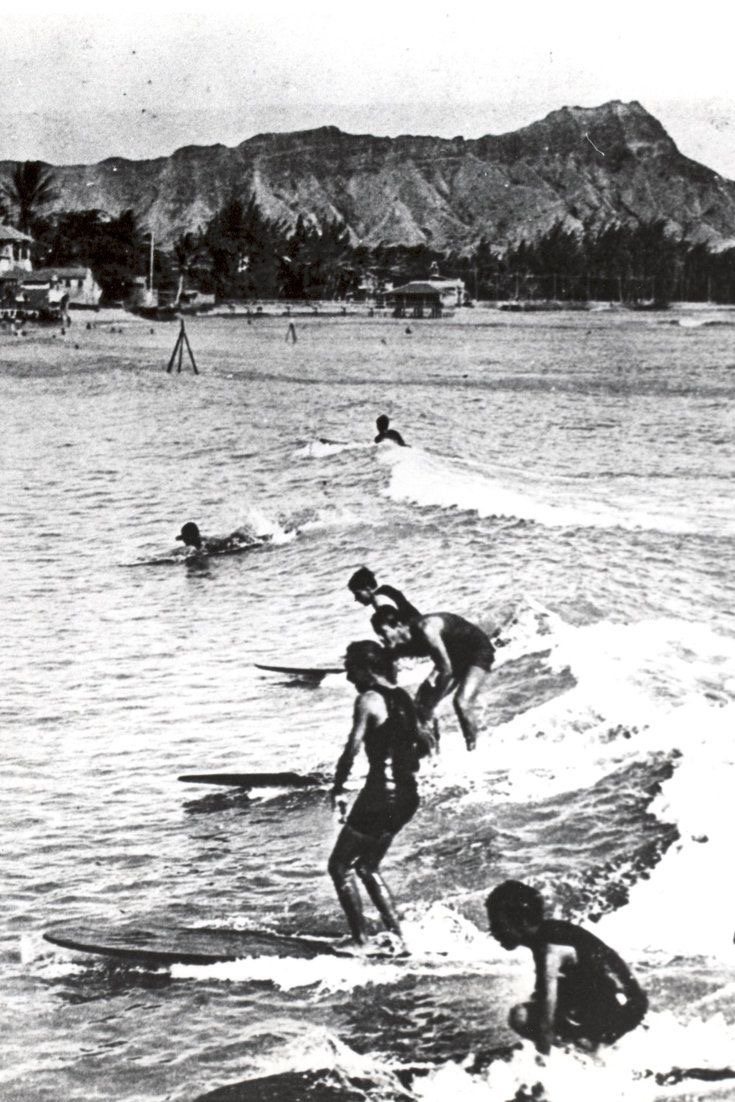
He grew up at Kālia in Waikīkī, one of six brothers, Duke, Sargent, Samuel, David, William and Louis, with three sisters besides, and the whole family seemed to live in the sea. He attended the Kamehameha School for Boys from 1904 to 1910 but later left school to help support his family. Several of his brothers became fine swimmers and surfers too; Sam would one day stand on an Olympic podium beside him. He spent his days surfing, swimming and paddling off Waikīkī, and with friends he formed the surf club Hui Nalu, whose story is told in our history of surfing in Hawaiʻi.
Olympic gold, twice over
At the Stockholm Olympics of 1912 Duke won the 100 m freestyle in 63.4 seconds and took silver with the US team in the 4 × 200 m relay. His long, flutter-kicking crawl stroke impressed coaches, and he is widely credited with helping to spread the flutter kick around the world. The 1916 Games were cancelled because of the First World War, costing him the chance to defend his title at his peak.
He came back in 1920 at Antwerp and won the 100 m again, twice in fact: after an Australian protest the final was re-swum, and he won it a second time. He added gold in the relay. In Paris in 1924, aged 33, he took silver in the 100 m behind a young Johnny Weissmuller, later Hollywood's Tarzan, with his own brother Sam winning bronze.
| Games | Event | Result |
|---|---|---|
| Stockholm 1912 | 100 m freestyle | Gold |
| Stockholm 1912 | 4 × 200 m freestyle relay | Silver |
| Antwerp 1920 | 100 m freestyle | Gold |
| Antwerp 1920 | 4 × 200 m freestyle relay | Gold |
| Paris 1924 | 100 m freestyle | Silver |
He was named an alternate in 1928 and, at 42, was named a reserve for the US water polo squad at the 1932 Los Angeles Games, two decades after his first Olympics.
Taking surfing to the world
Wherever he went to swim, Duke took a board. His exhibitions in California from 1912, and above all at Freshwater Beach near Sydney in December 1914, turned surfing from a Hawaiian pastime into an international sport. In 1925 he used his board to pull eight men from the surf after a fishing boat capsized at Newport Beach, California, a rescue that helped persuade lifeguards to adopt surfboards.
Those stories are told in our history of surfing. What matters here is how Duke carried himself: modest, generous and unfailingly courteous, he became the living face of the word aloha for millions who had never seen Hawaiʻi.
Hollywood and the sheriff's badge
In the 1920s Duke spent years in Los Angeles working in films, mostly in small roles as a chief, a sailor or an islander, from Lord Jim (1925) and Old Ironsides (1926) to Wake of the Red Witch (1948) and Mister Roberts (1955). Hollywood rarely gave him lead parts, but it gave him friends and fame.
Home in Honolulu, he entered politics. He was elected sheriff of the City and County of Honolulu in the 1930s and re-elected again and again, serving 13 consecutive terms, about 26 years in all, until the office was abolished around statehood. As sheriff he became, by chance, the named defendant in a landmark case: in Duncan v. Kahanamoku (1946) the US Supreme Court ruled that the wartime military trial of a civilian in Hawaiʻi had been unlawful (see Pearl Harbor history).
Ambassador of aloha
In 1940, aged 50, he married Nadine Alexander, a dance teacher from Ohio. When his years as sheriff ended he was named Hawaiʻi's Ambassador of Aloha, welcoming presidents, film stars and royalty, and he represented Hawaiʻi at the Olympic Games in Melbourne in 1956 and Tokyo in 1964. In 1965 he became the first person inducted into both the International Swimming Hall of Fame and the Surfing Hall of Fame.
Duke died of a heart attack in Honolulu on 22 January 1968, aged 77. After a beach boys' funeral his ashes were scattered at sea off Waikīkī, as mourners sang Hawaiian songs including Queen Liliʻuokalani's "Aloha ʻOe".
A statue with its back to the sea
In 1990, for the centenary of his birth, a 2.7 m (9 ft) bronze by the sculptor Jan Gordon Fisher was unveiled on Kalākaua Avenue at Kūhiō Beach. It shows Duke with arms open in welcome, standing in front of a long board. Some locals objected at first that he stands with his back to the ocean, something no waterman would do. Its plaque ends: "He has honored his name, he has honored his race, he has honored his state, he has honored us all."
Other tributes followed: a US postage stamp in 2002, a Google Doodle on his 125th birthday in 2015, the Duke Kahanamoku Aquatic Complex at the University of Hawaiʻi and Duke's OceanFest, a week of ocean sports held in Waikīkī each August around his birthday.
Following Duke in Waikīkī
Start at the Duke Kahanamoku statue on Kalākaua Avenue at Kūhiō Beach, where fresh lei are almost always draped over his arms; especially around his birthday on 24 August. Then walk a few blocks inland to the statue of Princess Kaʻiulani, by the same sculptor.
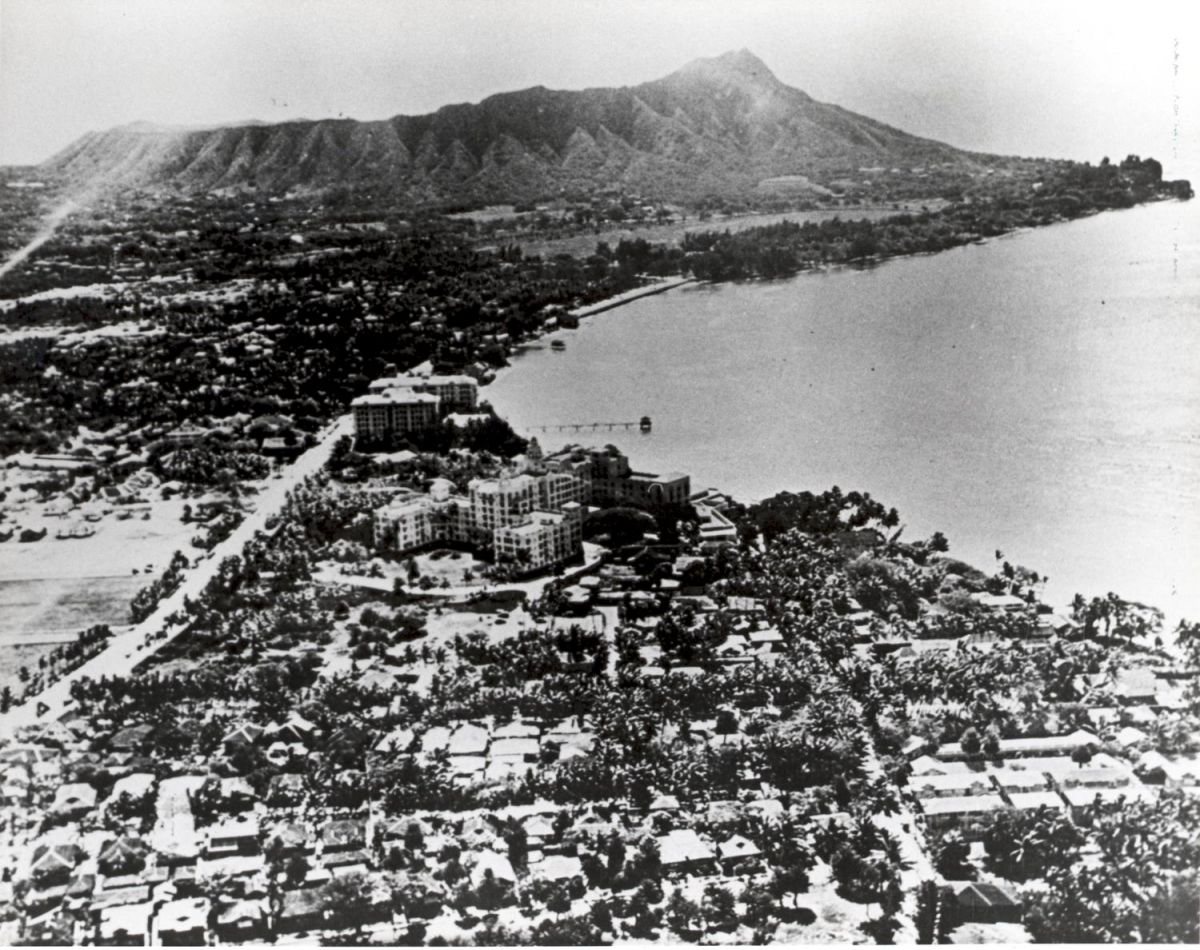
Rent a board or book a lesson on the gentle breaks off Waikīkī where Duke learned; our guide to where to surf in Hawaiʻi covers the best spots for beginners. The neighbourhood he grew up in, from Kālia to the Moana, is explored in the history of Waikīkī.
Duke's life bridges the old kingdom and the modern state, born under King Kalākaua and laid to rest in the age of jets. That whole story is told in our book The History of Hawaii.
Quick answers
How many Olympic medals did Duke Kahanamoku win?
Five: gold in the 100 m freestyle in 1912 and 1920, gold in the 4 × 200 m freestyle relay in 1920, and silver in the 1912 relay and the 1924 100 m freestyle.
Why is Duke Kahanamoku called the father of modern surfing?
Through exhibitions in California from 1912 and in Australia in 1914, and decades of travel and fame, he introduced surfing to new audiences and made it an international sport.
Was Duke a real title?
No. Duke was his given name, inherited from his father, Duke Halapu Kahanamoku, who was named in honour of Prince Alfred, Duke of Edinburgh, during his 1869 visit to Hawaiʻi.
Where is the Duke Kahanamoku statue?
On Kalākaua Avenue at Kūhiō Beach in Waikīkī, Honolulu. The 2.7 m (9 ft) bronze by Jan Gordon Fisher was unveiled in 1990.
When did Duke Kahanamoku die?
He died of a heart attack in Honolulu on 22 January 1968, aged 77, and his ashes were scattered in the ocean off Waikīkī.
Facts checked October 2026 against the sources below and the research for our book The History of Hawaii. Dates and figures for early Hawaiian history are estimates and scholars still debate some of them.
- Duke Kahanamoku (Wikipedia)
- Duke Kahanamoku (Olympedia)
- Duke Kahanamoku (International Swimming Hall of Fame)
- Duke Paoa Kahanamoku (Hawaiʻi biographies, RootsWeb)
- The statue of Duke Kahanamoku (Surfer Today)
- Statues of Oʻahu walking tour: Waikīkī (Historic Hawaiʻi Foundation)
- Duke's OceanFest, Waikīkī (Hawaii Guide)