In about ninety minutes on a Sunday morning, Pearl Harbor pulled the United States into the Second World War. For the people of Hawaiʻi, it was the start of four years of martial law, suspicion and extraordinary courage.
Before dawn: a warning nobody heeded
At 6.37 on the morning of Sunday 7 December 1941, the destroyer USS Ward fired on a small submarine trying to slip into Pearl Harbor behind a supply ship. The midget submarine sank. They were the first American shots of the Pacific war, and the report moved slowly up a sleepy weekend chain of command.
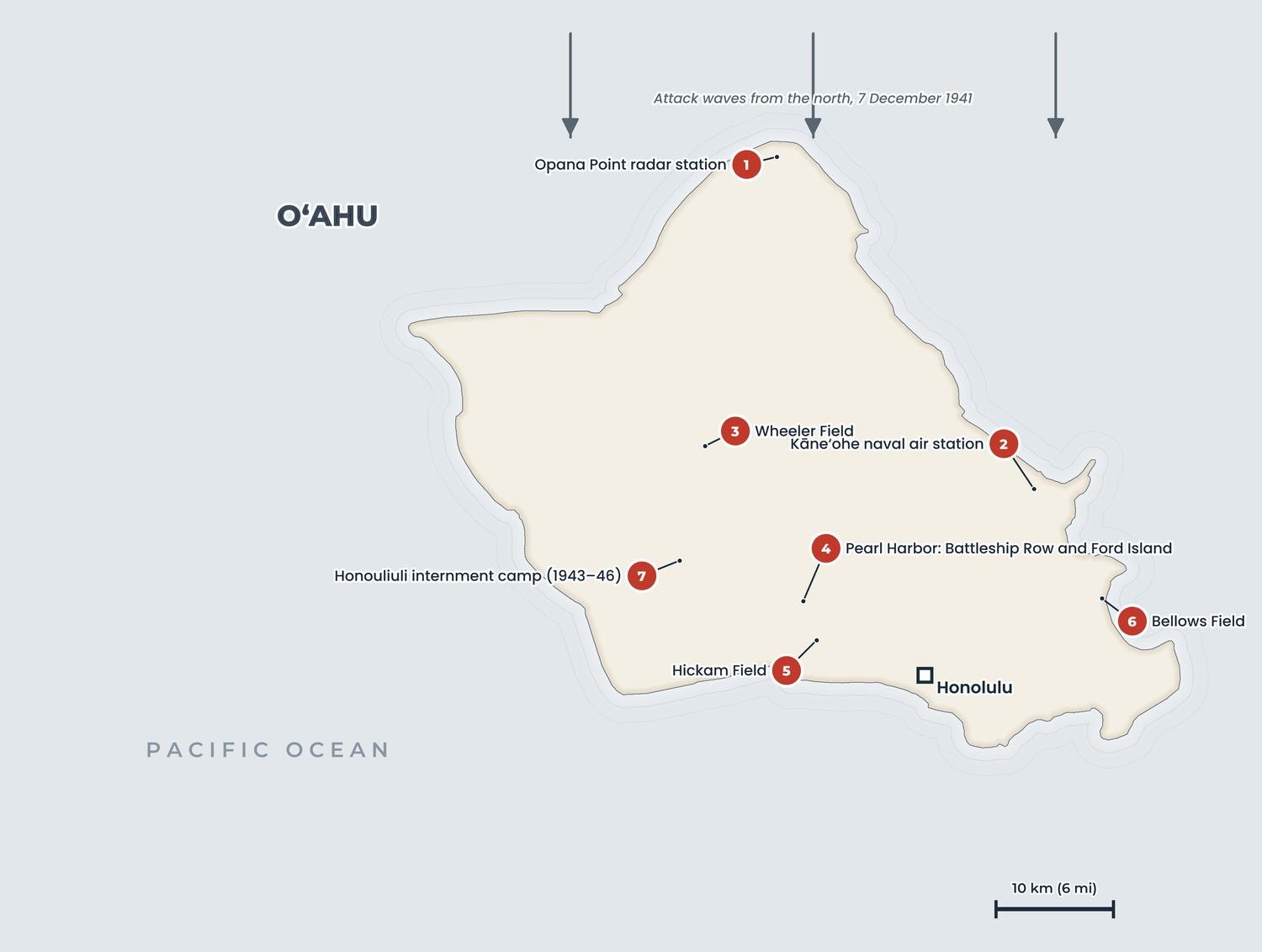
Shortly after 7 am, two privates at the Army radar station at Opana Point, on Oʻahu's northern tip, saw an enormous blip approaching from the north. The duty officer told them not to worry: a flight of American B-17 bombers was due from the mainland. The aircraft on the screen were the first wave of a Japanese strike launched from six carriers.
Within the hour, Hawaiʻi's history would change direction as sharply as it had in 1893 or 1898. This article follows that morning, the war years that followed it, and what you can see of them today.
Ninety minutes on 7 December 1941
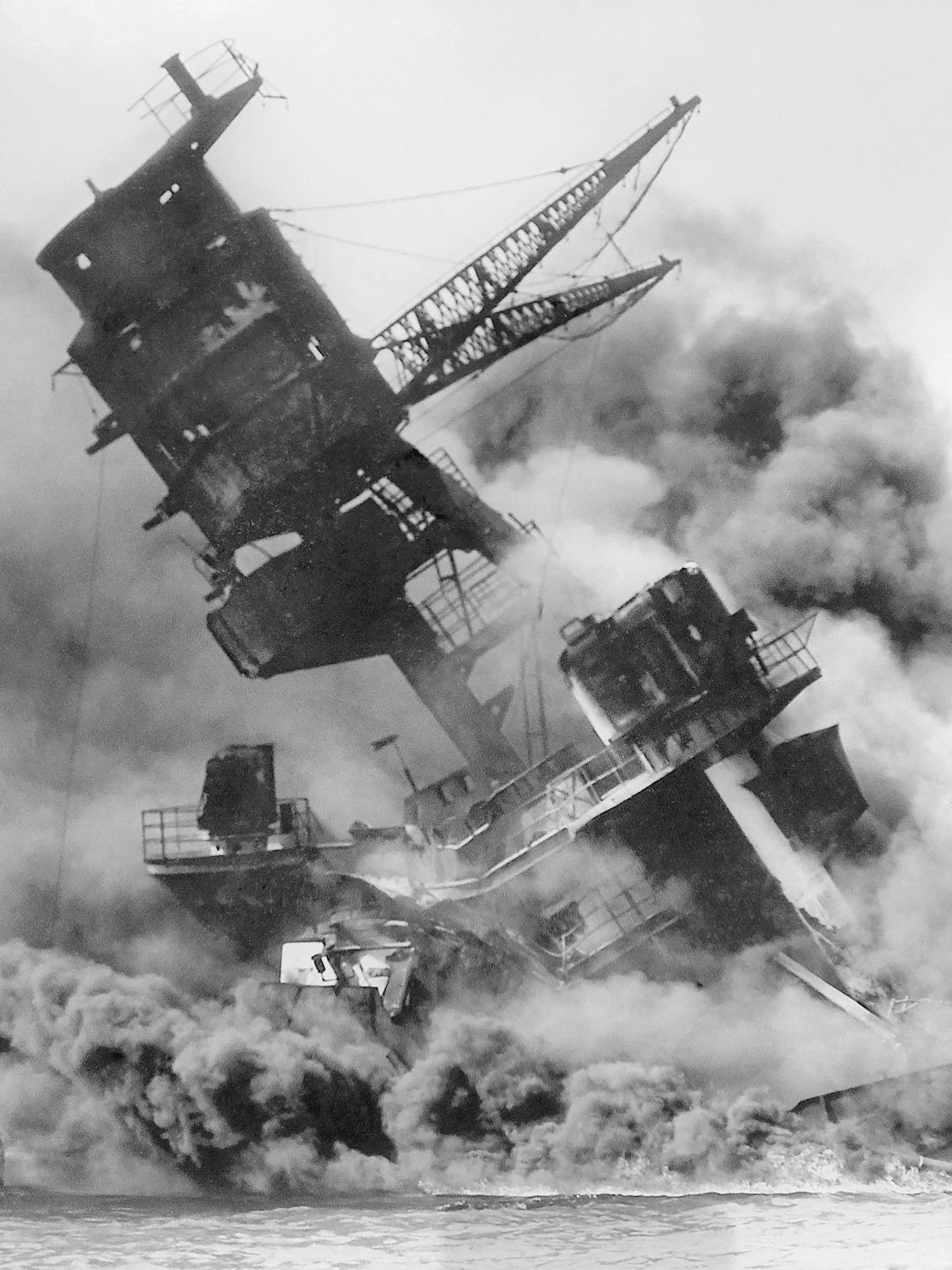
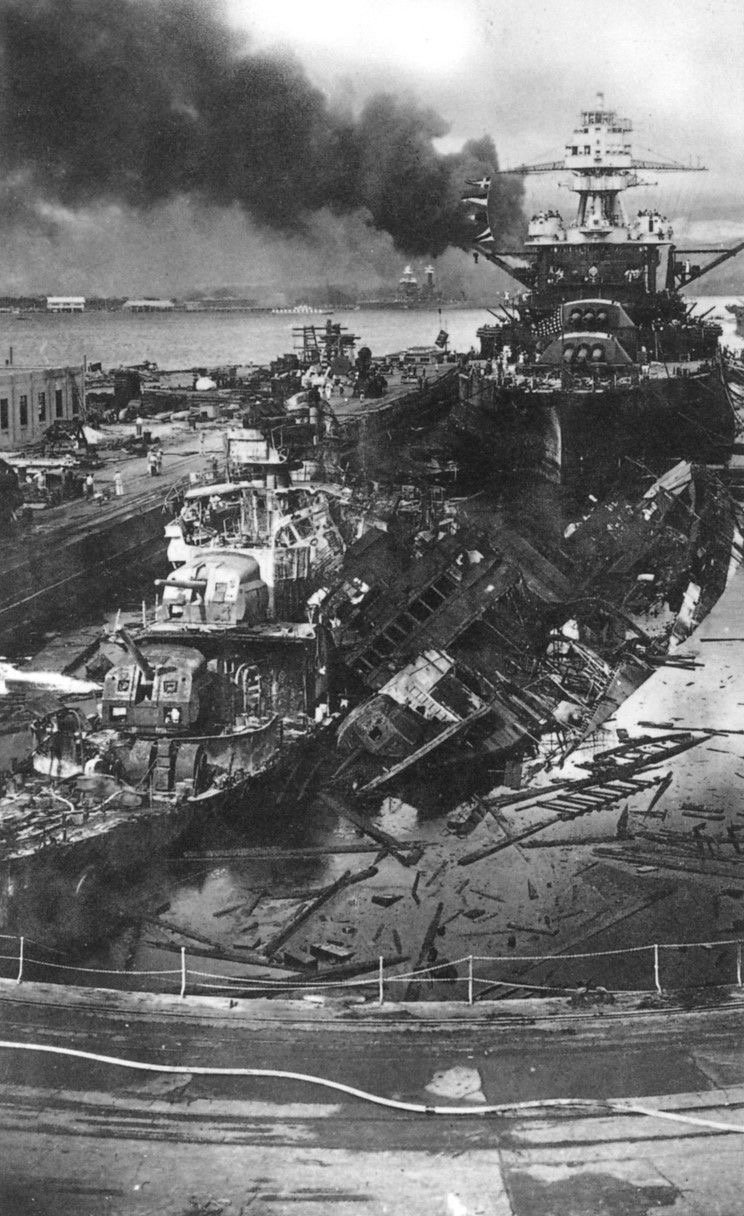
The attack began at 7.48 am. Two waves of aircraft hit the naval air station at Kāneʻohe, the Army airfields at Wheeler, Hickam and Bellows, and above all Battleship Row, where most of the Pacific Fleet's battleships lay moored beside Ford Island. Torpedoes tore into USS Oklahoma, which rolled over and capsized. An armour-piercing bomb detonated the forward magazine of USS Arizona, killing 1,177 of her crew in moments.
By mid-morning it was over. A US Census Bureau fact sheet, compiled from service records, puts the American toll at:
| Group | Killed | Wounded |
|---|---|---|
| US Navy | 2,008 | 710 |
| US Army | 218 | 364 |
| US Marine Corps | 109 | 69 |
| Civilians | 68 | 35 |
| Total | 2,403 | 1,178 |
Nearly half of those deaths happened aboard Arizona. Among the civilians were Honolulu firefighters who raced to Hickam Field. Yet the strike missed its most valuable targets. The fleet's aircraft carriers were at sea, the fuel tanks and repair yards survived, and most of the damaged battleships were later raised and sent back to war. Only Arizona, Utah and Oklahoma never sailed again.
On 8 December President Franklin D. Roosevelt asked Congress to declare war on Japan, calling 7 December "a date which will live in infamy". Congress agreed within the hour.
Martial law: Hawaiʻi as a garrison
On the afternoon of the attack, territorial Governor Joseph Poindexter suspended habeas corpus and handed civil government to the Army. For almost three years a military governor ran the islands. Civilians accused of offences, from traffic violations to more serious crimes, faced military tribunals rather than ordinary courts.
Daily life changed overnight. Blackouts and curfews emptied the streets after dark, beaches were strung with barbed wire, and residents were registered and fingerprinted. Martial law was not fully lifted until 24 October 1944.
The legal reckoning came after the war. In Duncan v. Kahanamoku, decided on 25 February 1946, the US Supreme Court ruled 6 to 2 that the Hawaiian Organic Act had never authorised military trials of civilians. The named defendant was Honolulu's sheriff at the time, one Duke Kahanamoku, better known as the Olympic swimmer who carried surfing to the world (see our history of surfing in Hawaii).
Japanese Americans under suspicion
In 1941 more than a third of Hawaiʻi's people, over 150,000, were of Japanese ancestry, many of them the children and grandchildren of workers brought in during the sugar plantation era. On the West Coast, the government removed Japanese Americans en masse to inland camps. In Hawaiʻi it did not. Interning a third of the workforce, including most of the islands' carpenters and mechanics, would have crippled the economy and the rebuilding of Pearl Harbor itself.
Instead the authorities arrested a selected group: Buddhist and Shinto priests, Japanese-language teachers, community leaders and others, more than 1,500 people in all by most counts, both citizens and non-citizens. The first were held on Sand Island in Honolulu Harbor, which opened the day after the attack.
From 1 March 1943 the remaining detainees were moved to Honouliuli, a hot, steep gulch near Waipahu that its inmates called jigoku dani, hell valley. The National Park Service estimates it held about 400 civilians and some 4,000 prisoners of war at any one time, among them Koreans, Okinawans, Japanese and Italians. It closed on 27 January 1946. In 1988 the Civil Liberties Act formally apologised for wartime incarceration and paid compensation to surviving detainees.
Go for Broke: the 100th and the 442nd
Hawaiʻi's Nisei (second-generation Japanese Americans) answered suspicion with service. In June 1942 about 1,400 Nisei soldiers from the Hawaii National Guard sailed for the mainland and became the 100th Infantry Battalion. In 1943, when the Army called for volunteers for a new all-Nisei unit, the 442nd Regimental Combat Team, thousands of young men from the islands came forward. Hawaiʻi-born soldiers made up about two thirds of the regiment.
The 100th fought up the length of Italy, losing so many men at Monte Cassino that it became known as the Purple Heart Battalion. Fighting under the motto "Go for Broke", the combined unit went on through Italy and France, where in late 1944 it rescued the trapped "Lost Battalion" in the Vosges mountains. The US Army calls the 442nd the most decorated unit for its size and length of service in American military history, with 21 Medals of Honor and more than 9,400 Purple Hearts.
One of those medals belongs to Daniel K. Inouye. A teenage Red Cross volunteer on 7 December, he lost his right arm leading an attack in Tuscany in April 1945. He went on to represent Hawaiʻi in the US Senate for almost fifty years. The veterans came home unwilling to accept second-class citizenship, and their political awakening helped carry Hawaiʻi to statehood in 1959.
Midway and the forward base
Six months after the attack, Pearl Harbor helped win the battle that turned the Pacific war. Navy codebreakers in a basement at Pearl Harbor, known as Station HYPO, worked out that Japan's next target was Midway Atoll. Shipyard crews patched up the damaged carrier Yorktown in about three days, and at Midway on 4 to 7 June 1942 American aircraft sank four of the six carriers that had struck Oʻahu.
For the rest of the war Hawaiʻi was the great forward base of the Pacific campaign. Hundreds of thousands of servicemen passed through, Waikīkī's Royal Hawaiian Hotel became a Navy rest centre (see our history of Waikīkī), and the islands emerged in 1945 transformed: more crowded, more connected to the mainland and impatient for a full voice in Washington.
Visiting Pearl Harbor today
The USS Arizona Memorial, a white bridge-like shrine designed by the architect Alfred Preis and dedicated on Memorial Day 1962, spans the sunken hull. More than 900 of the men killed aboard remain entombed there, and drops of oil still rise to the surface. Since 2019 it has formed part of Pearl Harbor National Memorial, which also protects the USS Utah and USS Oklahoma memorials. Practical details below were checked on the National Park Service website as of October 2026.
- Cost: the visitor centre, museums and USS Arizona Memorial programme are free. Recreation.gov charges a non-refundable $1 booking fee per ticket.
- Booking: reservations are strongly recommended. Timed tickets are released on recreation.gov at 3 pm Hawaiʻi time, eight weeks ahead and again 24 hours ahead, up to 10 per reservation. Everyone, including infants, needs a ticket.
- No ticket? Same-day ticket handouts have ended. A free Standby Callback system at the visitor centre texts you when seats open, but waits can run to several hours.
- Times: visitor centre daily 7 am to 5 pm, closed Thanksgiving, 25 December and 1 January. Boats leave every 15 minutes from 8 am to noon and 1 pm to 3.30 pm.
- Bags: no bags that offer concealment, including purses, backpacks, camera bags and fanny packs. Paid bag storage is near the entrance. Parking costs $7 a day.
The Battleship Missouri, on whose deck the war ended in 1945, the Pearl Harbor Aviation Museum and the USS Bowfin submarine museum sell their own tickets. Inland, Honouliuli National Historic Site began its first public guided tours in July 2026: about one free Saturday tour a month, booked by email through nps.gov/hono, with the remaining 2026 dates already full and waitlisted.
Combine the memorial with downtown's royal sites using our things to do in Honolulu guide. For the full wartime story, from codebreakers to the Niʻihau incident, see The History of Hawaii.
Quick answers
How many people died at Pearl Harbor?
2,403 Americans were killed, including 68 civilians, and 1,178 were wounded, according to US Census Bureau figures compiled from service records. 1,177 of the dead were aboard USS Arizona.
Do you need tickets for the USS Arizona Memorial?
Entry is free, but reservations are strongly recommended. Timed tickets are released on recreation.gov at 3 pm Hawaiʻi time eight weeks ahead and 24 hours ahead, with a $1 fee per ticket. A standby list operates on the day, but waits can be long (as of October 2026).
Can you bring a bag to Pearl Harbor?
No. Bags that offer concealment, such as purses, backpacks, camera bags and fanny packs, are not allowed in the visitor centre or on the memorial. Paid bag storage is available near the entrance; phones, cameras and wallets are fine.
Why were Japanese Americans in Hawaiʻi not mass interned?
They made up more than a third of the population and much of the skilled workforce. Removing them would have crippled the islands, so the authorities detained a selected group of community leaders instead, held first on Sand Island and later at Honouliuli.
Why is the 442nd Regimental Combat Team famous?
The all-Nisei unit, about two thirds of it from Hawaiʻi, is described by the US Army as the most decorated unit for its size and length of service in American history, with 21 Medals of Honor.
Facts checked October 2026 against the sources below and the research for our book The History of Hawaii. Dates and figures for early Hawaiian history are estimates and scholars still debate some of them.
- Basic Information, Pearl Harbor National Memorial (NPS)
- USS Arizona Memorial Programs (NPS)
- Frequently Asked Questions, Pearl Harbor National Memorial (NPS)
- U.S. Casualties at Pearl Harbor, fact sheet (US Census Bureau, archived)
- Historical Overview, Honouliuli National Historic Site (NPS)
- Public Tour Information, Honouliuli National Historic Site (NPS)
- Key Military Unit: The 442nd Regimental Combat Team (US Army)
- Duncan v. Kahanamoku (Densho Encyclopedia)