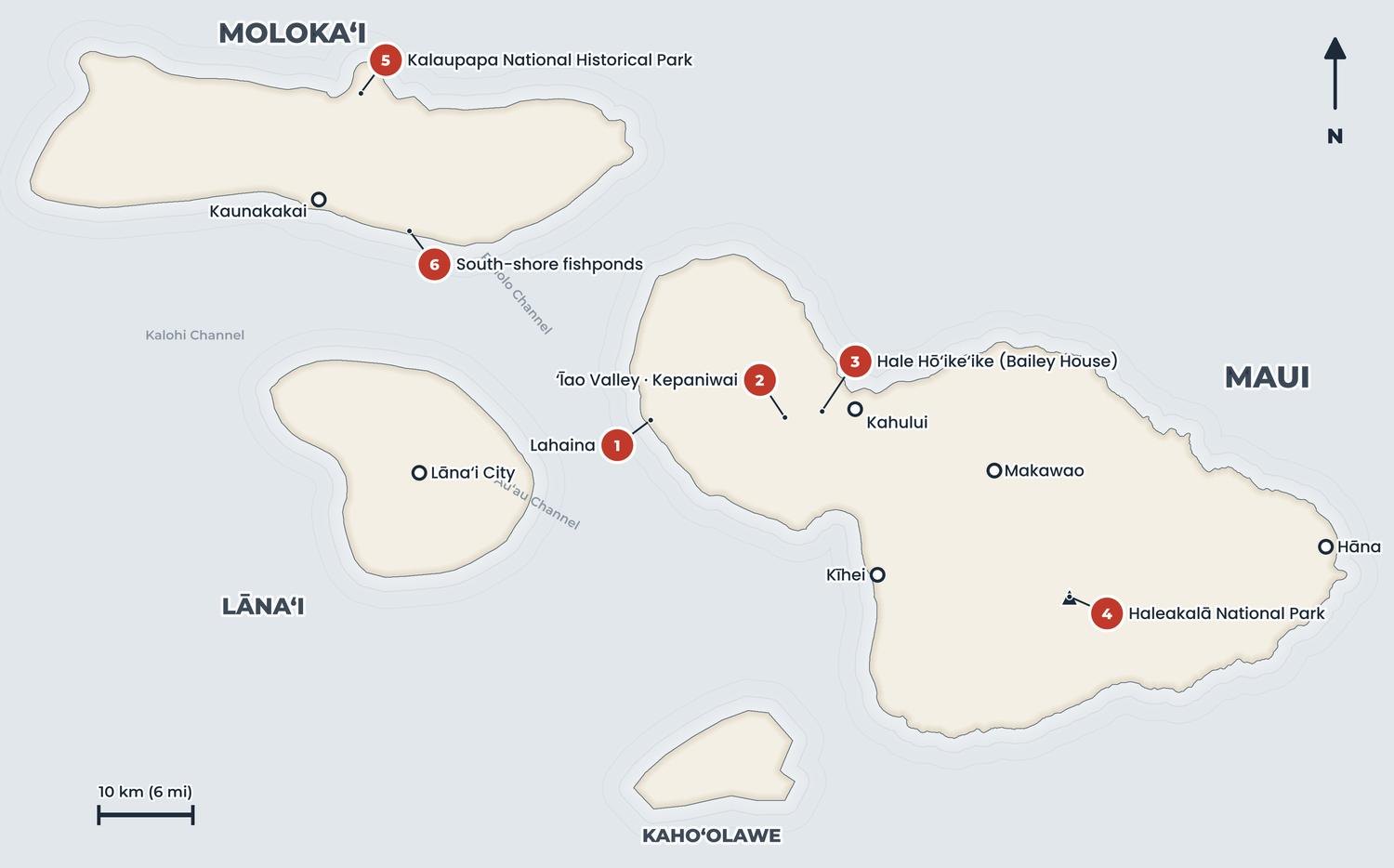
Before Honolulu, a sunny stretch of West Maui was the capital of a kingdom, a port for hundreds of whaleships and the birthplace of the Hawaiian press. Since 2023 it has been rebuilding.
24 April 1873: a tree for a jubilee
On 24 April 1873 the sheriff of Lahaina, William Owen Smith, planted a young Indian banyan beside the courthouse square. It marked fifty years since the first Protestant mission had come to the town. Over the next 150 years the tree spread into a single green roof over the whole square, the meeting place of Front Street and the most photographed tree in Hawaiʻi.
On 8 August 2023 fire swept through Lahaina. The banyan was scorched, yet within weeks new leaves appeared. For many people it became a symbol of the town itself: badly hurt, still alive.
Lahaina's history runs much deeper than its banyan. Before Honolulu, this sun-baked shore on the west coast of Maui was the royal capital of the Hawaiian Kingdom, a whaling port of world renown and the place where Hawaiian first went to press.
A royal shore
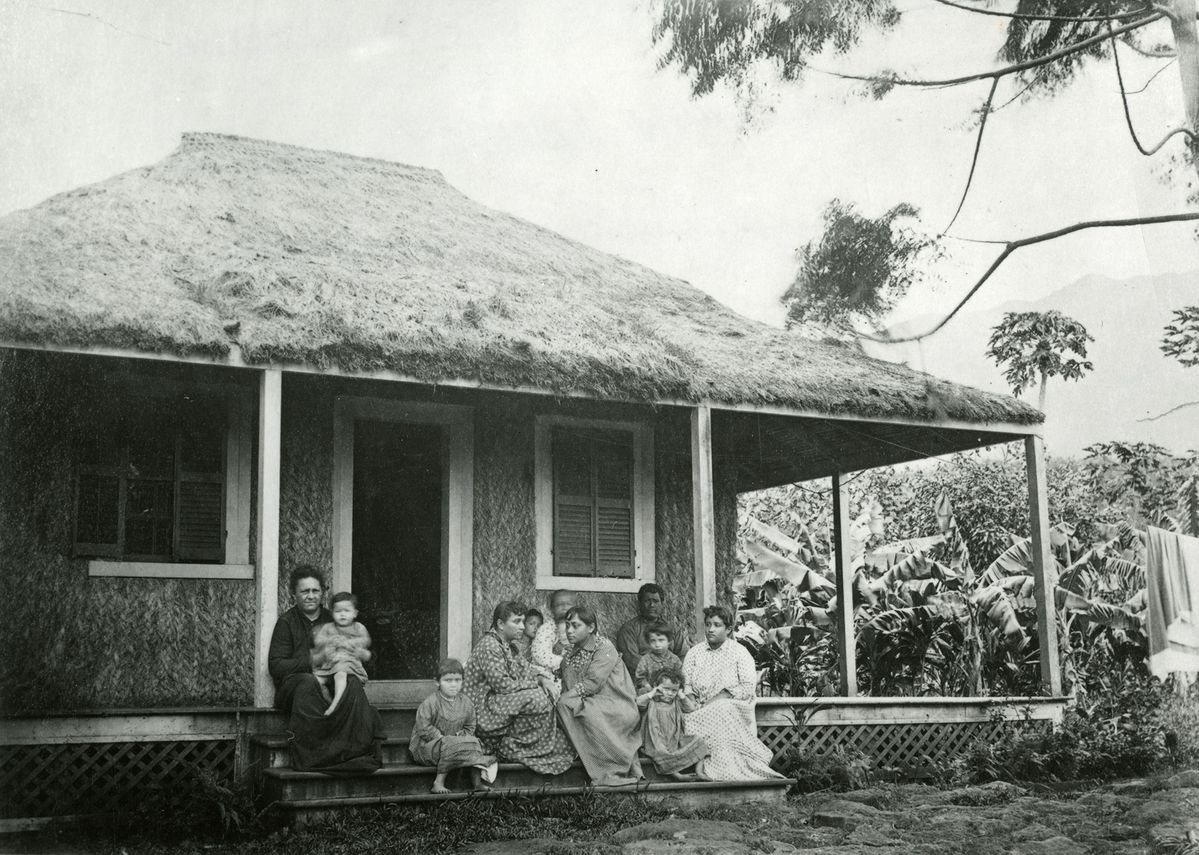
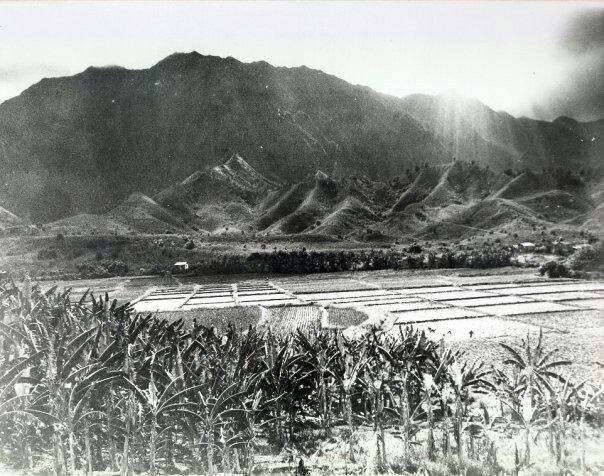
The name is usually explained as lā hainā, a cruel or merciless sun, a fair description of the dry leeward coast. Yet streams from the West Maui mountains once fed taro patches and fishponds here, and the chiefs of Maui, among them the island's great unifier Piʻilani, kept residences along the shore.
After his conquests, Kamehameha I made Lahaina a royal seat. Between 1798 and 1802 two foreign ex-convicts who had escaped Australia's Botany Bay colony built him the Brick Palace, the first Western-style building in the islands. Kaʻahumanu, for whom it was reportedly intended, refused to live in it. Its outline is now marked on the ground near the banyan (see Kamehameha the Great).
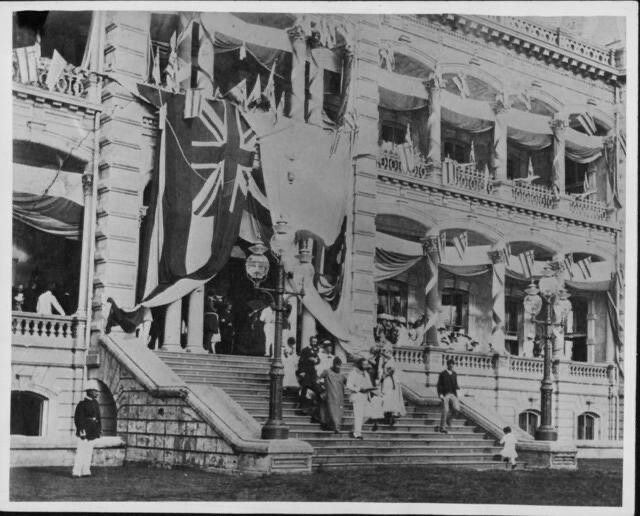
After Kamehameha's death in 1819 his heirs governed from Lahaina, and it served as the kingdom's capital until Kamehameha III moved the seat of government to Honolulu in 1845.
Mokuʻula: the hidden island
The most sacred spot in Lahaina is one most visitors never notice. Behind the shore lay Loko o Mokuhinia, a spring-fed pond of about 7 ha (17 acres), and in it a small island called Mokuʻula. Hawaiian tradition made the pond the home of Kihawahine, a moʻo (lizard) deity linked to the royal line and guardian of its waters.
Mokuʻula was the favoured residence of the highest chiefs into the mid-1800s. Kamehameha III lived there in the late 1830s and early 1840s, and members of the royal family were buried nearby. When the court moved to Honolulu the pond slowly decayed. It was filled in 1914, and in 1918 the site became Malu ʻUlu o Lele Park, with ball courts laid over an island that now lies about a metre (2 to 3 ft) below the surface.
In August 2024 the state handed the site to Maui County for cultural and ecological restoration, and a master plan for the Lahaina royal complex is due in 2027. Read more about pond-building in the history of Hawaiian fishponds.
Missionaries, printing presses and a seminary
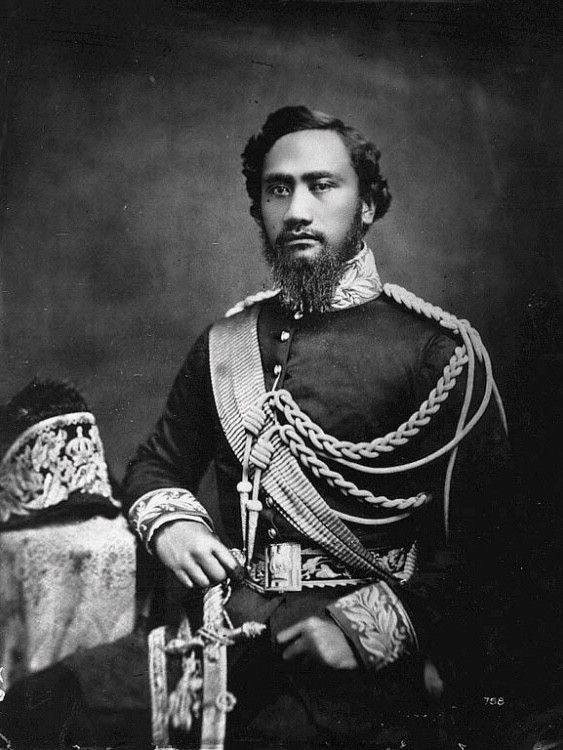
In 1823 Queen Keōpūolani, mother of Kamehameha II and Kamehameha III, moved to Lahaina and brought Protestant missionaries with her. She was baptised shortly before her death that year. Waiola Church, first called Waineʻe, rose on the mission grounds from 1828, and its churchyard became the resting place of Keōpūolani and other aliʻi.
Up the hill, missionaries founded Lahainaluna Seminary in 1831, and its students included the historian David Malo. On 14 February 1834 its press printed Ka Lama Hawaii, the first newspaper in Hawaiian and the first west of the Rocky Mountains. The seminary's printing house, Hale Paʻi, also produced the kingdom's first paper money. The story of that print revolution continues in the history of the Hawaiian language and the end of the kapu system.
Whalers on Front Street
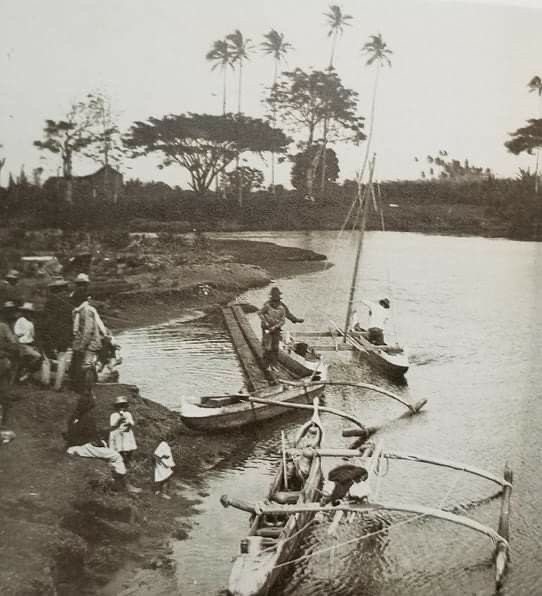
The first American whaleships reached Hawaiian waters in 1819, and Lahaina's sheltered anchorage soon made it a favourite port of call. EBSCO's history of the town counts 326 whalers calling in 1844 and around 400 two years later. Sailors came ashore by the thousand, with money to spend after months at sea.
That set them on a collision course with the missionaries and the Christian chiefs, who banned women from swimming out to the ships. In 1825 a whaling crew threatened the Reverend William Richards' house, and in 1827 the whaler John Palmer fired its cannon towards the mission. The chiefs built a coral-block fort by the harbour, and in the 1850s Hale Pāʻahao, the prison, filled with sailors who had missed the curfew.
The stone Baldwin House on Front Street, built in the mid-1830s, became the home of Dr Dwight Baldwin, a missionary physician who fought the smallpox epidemic of 1853 on Maui. The whaling boom ended in the 1860s, as petroleum replaced whale oil and the American Civil War cost the fleet dozens of ships, and sugar took over (see sandalwood, whaling and the Māhele).
8 August 2023: the fire
The Lahaina Historic District was named a National Historic Landmark in 1962. Six decades later, on 8 August 2023, a wildfire driven by fierce winds destroyed most of the town. Maui police have confirmed 102 deaths, and more than 2,200 structures burned, most of them homes.
The historic core suffered terribly. Waiola Church and the Pioneer Inn of 1901 were destroyed. The Old Lahaina Courthouse, Hale Pāʻahao, the Seamen's Hospital and the Baldwin House were gutted, though stone and masonry walls survived. The Lahaina Restoration Foundation has set out a plan of roughly $40 million to rebuild eight historic sites, with the courthouse planned as a community hub and museum. In March 2026 a storm brought down part of the weakened Baldwin House, and the foundation now plans to take it down carefully and rebuild with as much original material as possible.
Recovery is slow and personal. Front Street reopened to traffic on 1 August 2026. By late July county data showed 577 homes rebuilt or newly built and 315 under construction, while hundreds of households still relied on temporary housing.
Visiting Lahaina with care
Lahaina is a hometown being rebuilt by the people who lost it, not a ruin to tour. If you visit West Maui, these points come from county and community guidance as of October 2026:
- Roads are open. Front Street reopened on 1 August 2026, but temporary closures can appear around construction.
- Keep out of fenced lots and private property, and do not photograph homes, rebuilding sites or residents.
- The banyan is fenced. Arborists have removed a large part of the tree, and Banyan Court Park is expected to stay closed for about two more years. Admire it from the street.
- Museums are closed. The Lahaina Restoration Foundation's sites remain closed while restoration continues.
- Spend locally. Shops and restaurants reopening in and around Lahaina rely on visitors who come quietly and buy local.
Check mauirecovers.org, the County of Maui recovery site, before you go, and read visiting Hawaii respectfully and things to do on Maui for the rest of the island. Lahaina's years as capital, from Keōpūolani to Kamehameha III, are told in full in our book The History of Hawaii.
Quick answers
Was Lahaina the capital of Hawaii?
Yes. Lahaina served as the seat of the Hawaiian Kingdom's government from about 1820 until 1845, when Kamehameha III moved the capital to Honolulu. Kamehameha I had already made it a royal residence around 1802.
Is the Lahaina banyan tree still alive?
Yes. The 1873 banyan was scorched in the August 2023 fire but put out new leaves within weeks. Arborists have since removed a large part of it, and the park around it remains fenced while it heals; view it from Front Street.
Can you visit Lahaina now?
Yes, with care. As of October 2026 Front Street and the town's roads are open, and businesses are slowly reopening. Stay out of fenced lots and private property, and don't photograph homes or rebuilding sites.
What historic buildings survived the Lahaina fire?
Most historic buildings were destroyed or gutted. The walls of the Old Lahaina Courthouse, Hale Pāʻahao prison and Seamen's Hospital survived and are being stabilised. Waiola Church and the Pioneer Inn were lost, and the Baldwin House partly collapsed in a 2026 storm.
What was Mokuʻula?
A small island in a spring-fed pond in Lahaina that served as a sacred royal residence, home to Kamehameha III in the 1830s and 1840s. The pond was filled in 1914 and the site became a park; it is now being planned for restoration.
Facts checked October 2026 against the sources below and the research for our book The History of Hawaii. Dates and figures for early Hawaiian history are estimates and scholars still debate some of them.
- Wikipedia: Lahaina, Hawaii
- Wikipedia: Lahaina Historic District
- EBSCO Research Starters: History of Lahaina, Hawaii
- Maui Now: Mokuʻula in focus, master plan for Lahaina Royal Complex (2026)
- Lahaina Restoration Foundation: Hale Paʻi Printing Press
- Maui Now: Nonprofit faces $40 million task of restoring 8 historic sites in Lahaina (2025)
- The Maui News: Storm causes partial collapse at historic Baldwin Home (2026)
- Honolulu Star-Advertiser: Three years later, many Lahaina fire survivors are still waiting for a home (2026)