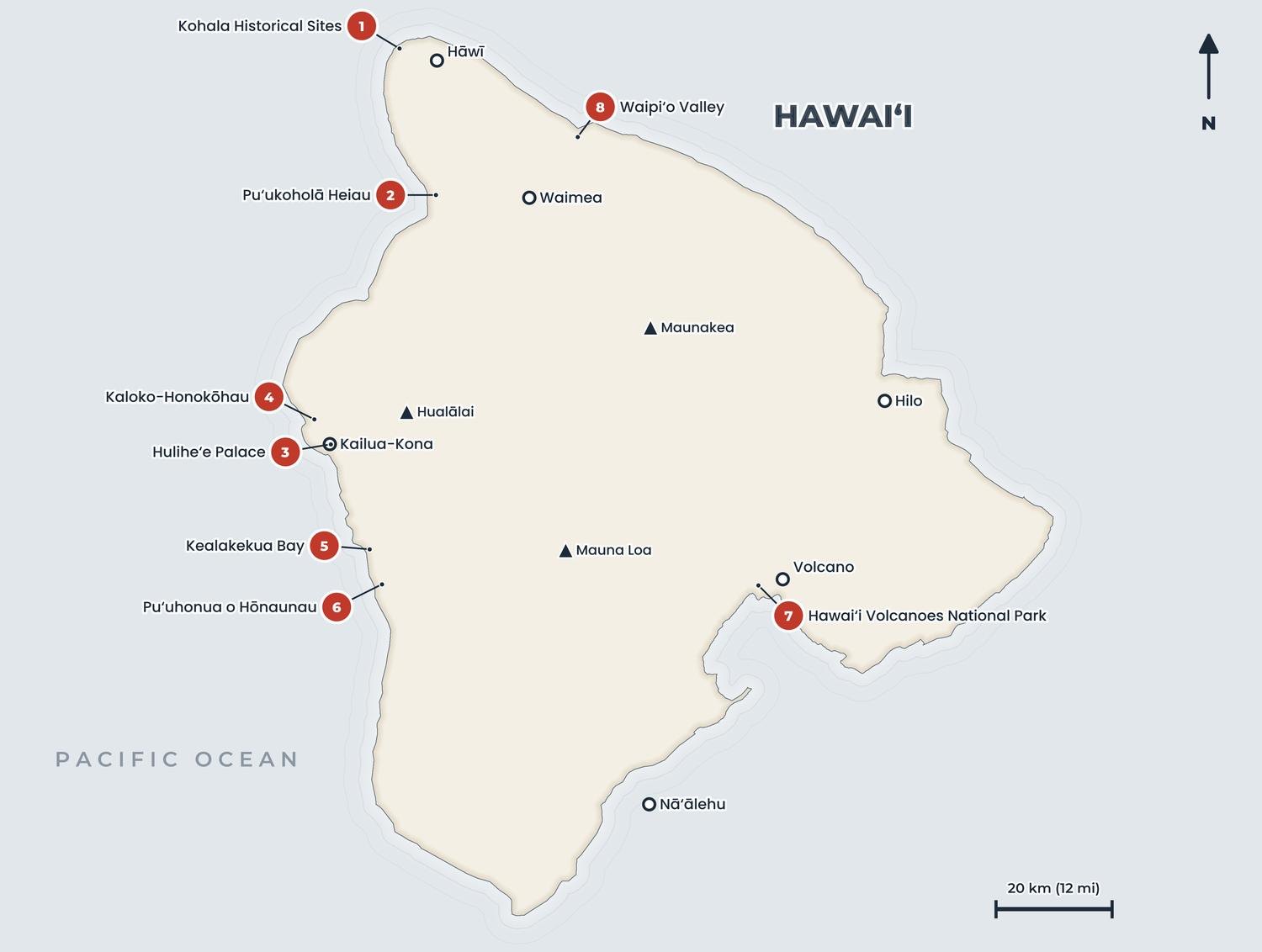
Break a sacred law in old Hawaiʻi and you could die, unless you reached a place of refuge first. At Hōnaunau the refuge, its royal temple and its great wall still stand.
1823: a sketch at Hōnaunau
In 1823 the English missionary William Ellis walked south along the Kona coast of Hawaiʻi Island and stopped at Hōnaunau. Behind a massive wall of black lava stood a thatched temple guarded by carved wooden figures. Inside, he was told, lay the bones of the chiefs of Kona. Ellis sketched what he saw.
Within a few years the temple was dismantled and the bones were gone. But Ellis's drawings survived, and in the 1960s the National Park Service used them to rebuild Hale o Keawe on its original platform. Today the thatched house and its kiʻi (carved images) stand again at the water's edge, at the heart of Puʻuhonua o Hōnaunau National Historical Park.
It is one of the most atmospheric places in the islands, and the best place to understand two pillars of ancient Hawaiian life: the puʻuhonua, or place of refuge, and the heiau, the temple.
What was a place of refuge?
Before 1819, life in Hawaiʻi was governed by kapu, sacred laws that protected the mana (spiritual power) of chiefs and regulated fishing, farming and eating (see ancient Hawaii daily life). Breaking a kapu was believed to anger the gods, and the punishment was often death. A commoner could be killed for letting his shadow fall on royal grounds, touching a chief's belongings or eating forbidden food.
There was one escape. If a kapu-breaker could reach a puʻuhonua ahead of his pursuers, often by swimming across the bay, the chase ended at its boundary, because no blood could be shed on sacred ground. A priest performed a ceremony of absolution, and the person could then go home forgiven.
In war, puʻuhonua sheltered defeated warriors and non-combatants, including women, children and the elderly. The National Park Service notes that the refuge at Hōnaunau was in use for more than 700 years, until the kapu system ended in 1819 (see the end of the kapu system).
The Great Wall and Hale o Keawe
The refuge is set apart from the royal grounds by the Great Wall, built around 1550 from unmortared lava rock. It runs for more than 300 m (1,000 ft) and stands about 3.7 m (12 ft) high and 5.5 m (18 ft) thick. On the landward side lay the royal grounds, with a royal fishpond (see Hawaiian fishponds) and a canoe landing reserved for chiefs; on the seaward side, the sanctuary.
Hale o Keawe was built around 1650 by the Kona chief Kanuha as a mausoleum for his father, the ruling chief Keaweʻīkekahialiʻiokamoku. Over the following generations the bones of 23 chiefs were placed inside. Hawaiians believed the mana in those bones protected the refuge; the last burial, a son of Kamehameha I, took place in 1818.
After the kapu fell, the temple was left to the weather. In 1825 a visiting British naval party under Lord George Byron carried off objects from it. In 1829 the Christian high chiefess Kapiʻolani removed the remaining bones, hid them in the cliffs above Kealakekua Bay and had the building destroyed; the remains were later moved to the Royal Mausoleum in Honolulu. Nearby stand the older platforms of ʻĀleʻaleʻa Heiau.
Heiau: the temples of old Hawaiʻi
A heiau was a place of worship, ranging from a simple stone shrine to a vast walled platform. Their purposes were as varied as Hawaiian life itself:
- Luakini: state temples dedicated to Kū, god of war, and the only heiau consecrated with human sacrifice. Only the paramount chief of an island or district could build one; anyone else who did so was a rebel.
- Hale o Lono: agricultural temples for Lono, god of rain, fertility and peace, where offerings sought good harvests.
- Koʻa: fishing shrines, some built on the shore and some under water, where fishermen left offerings of their first catch.
- Heiau hōʻola: healing temples, such as Keaiwa Heiau above ʻAiea on Oʻahu.
Some temples changed role over time: Ulupō in Kailua, Oʻahu, probably began as an agricultural heiau and later served as a luakini. When the kapu system was overthrown in 1819, worship at the heiau officially ended. Many were torn down, and some were later ploughed under for sugar cane, but families quietly cared for others, and many are sacred to Hawaiians today.
Puʻukoholā: Kamehameha's war temple
The greatest heiau of Kamehameha's time stands further up the coast, above Kawaihae in South Kohala. A prophet told Kamehameha that he would rule all the islands if he built a temple to his war god Kūkāʻilimoku on Puʻukoholā, the hill of the whale. In 1790 and 1791 thousands of workers raised it without mortar, by tradition passing stones hand to hand from Pololū Valley.
The platform measures about 68 by 30 m (224 by 100 ft), with walls up to about 6 m (20 ft) high. When it was finished in 1791, Kamehameha's rival and cousin Keōua was killed on arrival at Kawaihae, and his body was offered at the new temple (see Kamehameha the Great). Below lie the older Mailekini Heiau and, offshore, the submerged Hale o Kapuni, dedicated to sharks.
Puʻukoholā Heiau National Historic Site is free to visit, and a short trail of about 0.8 km (half a mile) loops past the temples. It is also one of three places where the Hawaiian flag flies alone (see Hawaiian flag history).
Visiting Puʻuhonua o Hōnaunau
The park lies on Hōnaunau Bay in South Kona, about 35 km (22 mi) south of Kailua-Kona. Details below are as of October 2026; check nps.gov/puho before you go.
| What | Details |
|---|---|
| Hours | Gates open daily from 8.15 am until sunset |
| Entry | $20 per private vehicle, $10 per person on foot or bicycle; age 15 and under free; valid 7 days |
| Payment | Cashless: cards only, or a QR code when the booth is unstaffed |
| Passes | $55 Hawaiʻi Tri-Park Annual Pass also covers Hawaiʻi Volcanoes and Haleakalā |
| Next fee-free day | 11 November 2026 (for US citizens and residents) |
Come early, before the heat and the tour buses. A self-guided walk of about an hour takes in the royal grounds, the Great Wall, Hale o Keawe and ʻĀleʻaleʻa Heiau. Stay off all walls and platforms, do not move or wrap stones, and leave nothing behind. Green sea turtles often rest on the shore here; give them plenty of space.
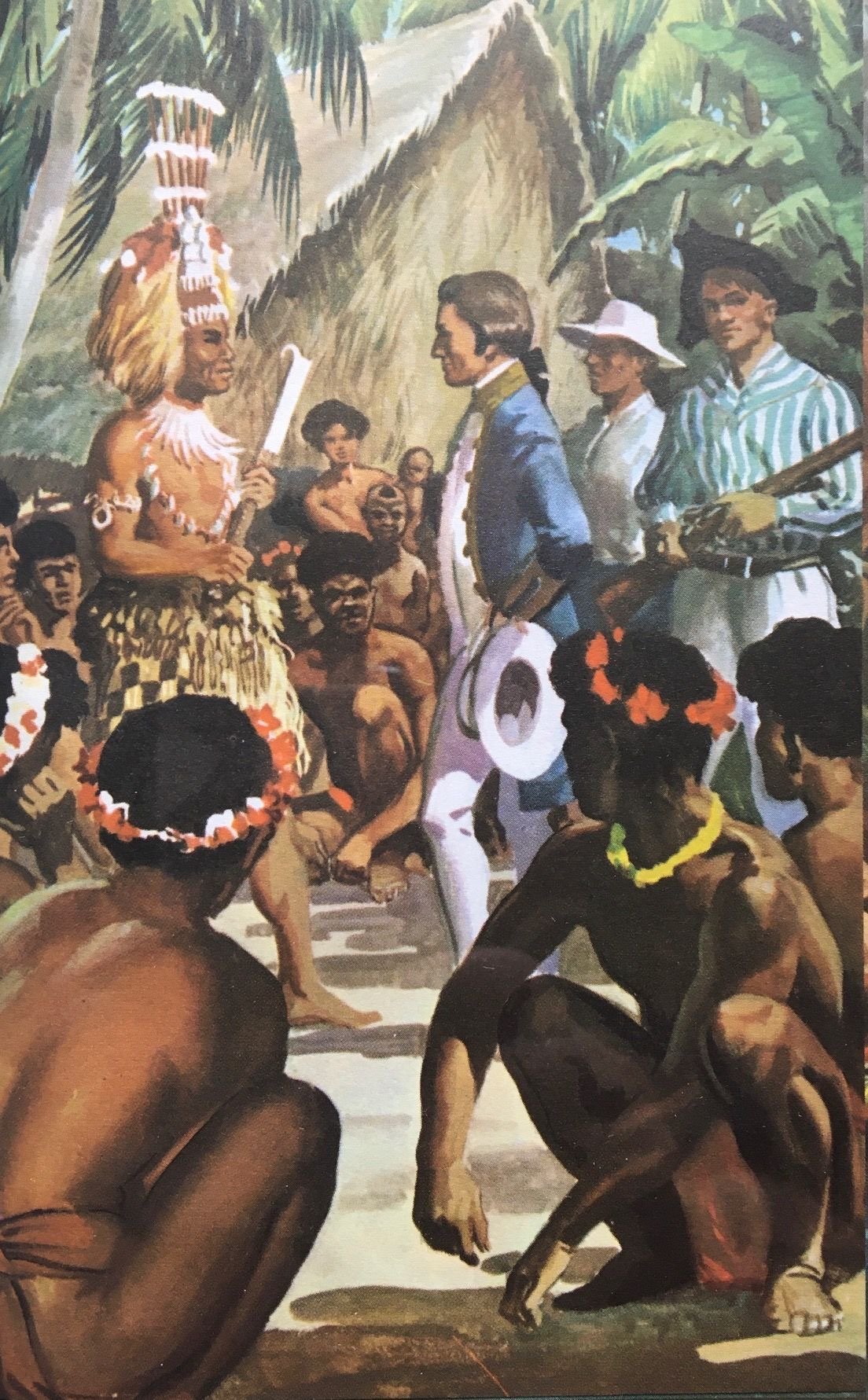
Combine the visit with Kealakekua Bay, where Captain Cook arrived in 1779, and with the rest of the Kona coast in things to do on the Big Island. For heiau on other islands, see historic sites in Hawaii. The kapu system, its temples and the chiefs who built them are explored in depth in our book The History of Hawaii.
Quick answers
What is Puʻuhonua o Hōnaunau?
A national historical park in South Kona on Hawaiʻi Island that preserves a puʻuhonua, a place of refuge where people who broke kapu (sacred law), and non-combatants in war, could be absolved and spared. It also protects royal grounds and the rebuilt temple Hale o Keawe.
How much does it cost to visit Puʻuhonua o Hōnaunau?
As of October 2026 entry is $20 per private vehicle or $10 per person on foot or bicycle, valid for seven days. Visitors aged 15 and under enter free. The park is cashless, so bring a card.
What happened at a place of refuge in Hawaii?
Anyone who broke a kapu faced death, but if they reached a puʻuhonua before their pursuers, they could not be harmed. A priest performed a ceremony of absolution and they could return home. Defeated warriors and families fleeing war also sheltered there.
What is a heiau?
A heiau is a Hawaiian temple or place of worship, from small fishing shrines to great stone platforms. Types included luakini war temples, Hale o Lono agricultural temples, koʻa fishing shrines and healing temples. Many remain sacred today.
Can you walk on a heiau?
No. Heiau are sacred sites and their dry-stacked walls are fragile. Hawaiʻi State Parks and the National Park Service ask visitors to stay off walls and platforms, not to move or add stones, and to follow posted signs.
Facts checked October 2026 against the sources below and the research for our book The History of Hawaii. Dates and figures for early Hawaiian history are estimates and scholars still debate some of them.
- National Park Service: Puʻuhonua o Hōnaunau (article)
- National Park Service: Fees & Passes, Puʻuhonua o Hōnaunau
- National Park Service: Operating Hours & Seasons, Puʻuhonua o Hōnaunau
- Wikipedia: Puʻuhonua o Hōnaunau National Historical Park
- Wikipedia: Heiau
- Hawaiʻi Tourism Authority: Puʻukoholā Heiau National Historic Site
- Hawaiʻi Division of State Parks: Wahi Pana brochure (visiting sacred places)