It is the only US state flag with the Union Jack in its corner. Hawaiʻi's flag has flown over a kingdom, a republic, a territory and a state, and today it is also a banner of protest.
Canton, 1817: a new flag at sea
In March 1817 a brig called the Kaʻahumanu, named after Kamehameha's powerful wife, sailed into the Chinese port of Canton loaded with sandalwood. Kamehameha I had bought the ship the year before from a Scottish captain, Alexander Adams, who now commanded it under what he called the flag of His Majesty. As far as historians can tell, it was the first Hawaiian vessel to reach a foreign port under a flag of its own.
That flag, with the British Union Jack in its corner and stripes across its field, looks strange at first to many visitors. Why does the flag of an American state carry the emblem of Great Britain? The answer runs through two centuries of diplomacy, occupation, loss and protest, and the same design still flies over the islands today.
Gifts from Captain Vancouver
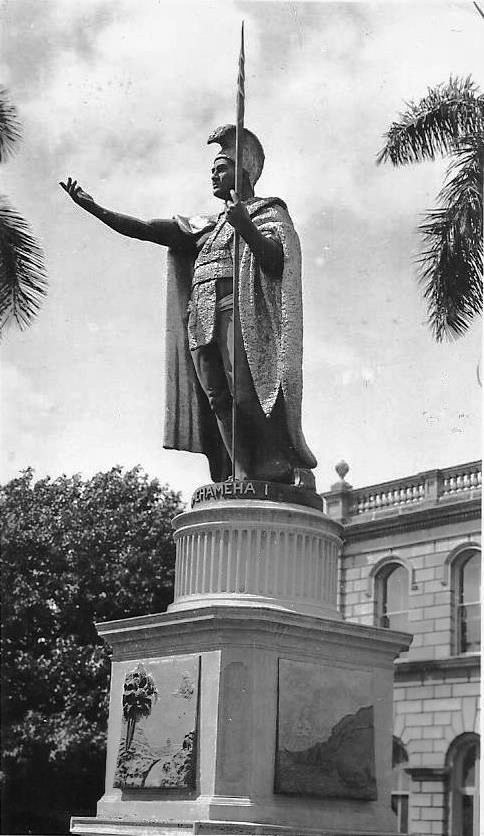
The British connection began with Captain George Vancouver, who visited the islands three times between 1792 and 1794 and became a trusted adviser to Kamehameha. He gave the chief a British Red Ensign, which Kamehameha flew on ceremonial occasions.
In February 1794, at Kealakekua Bay, the two men reached an agreement. Vancouver believed Hawaiʻi Island had been ceded to Great Britain; historians generally argue that Kamehameha and his chiefs understood something closer to a promise of protection, with Hawaiians keeping full control of their own affairs. London never followed it up, but for years a British flag flew in the islands as an unofficial emblem of Kamehameha's rule (see Kamehameha the Great).
A popular story says that during the War of 1812 between Britain and the United States, Kamehameha's advisers suggested blending British and American elements so as to offend neither side. It is a neat tale, but no contemporary record confirms it.
Who designed the flag?
By 1816 Kamehameha had a distinct flag, but who designed it is still debated. One tradition credits Captain Adams. Another, kept by the Beckley family, credits George Charles Beckley, a sea captain and adviser to the king, and dates it as early as 1806. The historian William DeWitt Alexander doubted both versions, and the original logbooks that might settle the question are lost.
Early descriptions vary. In 1818 the Russian navigator Vasily Golovnin described a Union Jack in the corner and seven horizontal stripes of red, white and blue. Other visitors over the next quarter-century recorded different numbers and orders of stripes, so the flag was clearly not yet fixed in every detail.
Flags were not just decoration in those years. They were claims. In 1816 agents of the Russian-American Company raised the Russian flag on Kauaʻi, where Georg Anton Schäffer began building forts with the consent of the island's ruler, Kaumualiʻi. Kamehameha's chiefs had the Russians expelled in 1817. A kingdom that wanted foreign ships to respect its ports and its sovereignty needed a flag that captains everywhere would recognise.
1843 and 1845: lowered, restored, made official
The flag's most dramatic moment came in 1843. On 25 February a British naval officer, Lord George Paulet, seized control of the kingdom in a dispute over the rights of British subjects. He had Hawaiian flags taken down and replaced with the Union Jack. For five months the islands lived under British occupation.
On 31 July 1843 Rear Admiral Richard Thomas arrived, disowned Paulet's action and restored the kingdom. On a plain east of Honolulu, now Thomas Square, the Union Jack came down and the Hawaiian flag went back up. Kamehameha III gave thanks with words that became the state motto: "Ua mau ke ea o ka ʻāina i ka pono". The full story is told in Kamehameha III and Sovereignty Restoration Day.
Two years later the design was standardised. On 25 May 1845, at the opening of the legislative council, a revised flag with eight stripes was unfurled. The stripes, in the order white, red and blue from the top, stand for the eight main islands. That design has not changed since.
One flag, five governments
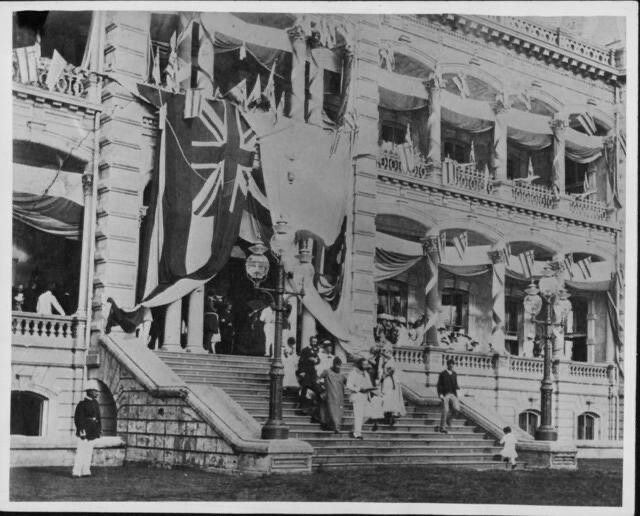
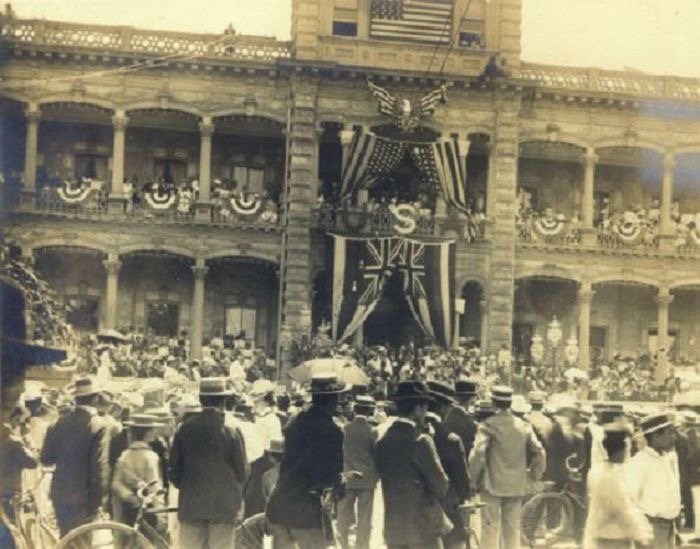
The Hawaiian flag outlived the monarchy that created it. After Queen Liliʻuokalani was overthrown in January 1893 (see the overthrow of the Hawaiian Kingdom), the Provisional Government and then the Republic of Hawaiʻi kept the same flag.
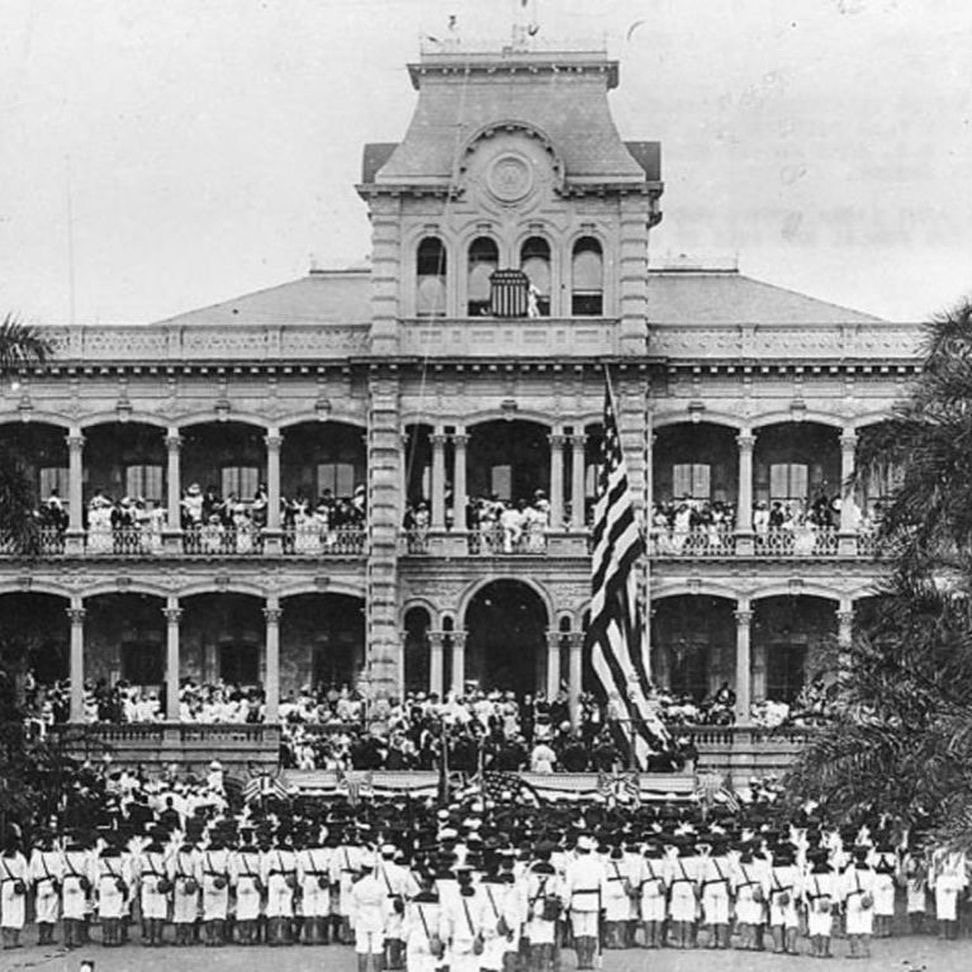
On 12 August 1898, at the annexation ceremony at ʻIolani Palace, the Hawaiian flag was lowered and the Stars and Stripes raised in its place (see Hawaii annexation 1898). The University of Hawaiʻi's Puna Wai Ola project contrasts the coverage: the Hawaiian-language paper Ke Aloha ʻĀina mourned the day with headlines of grief, while the English-language Pacific Commercial Advertiser reported a matter-of-fact change of flags.
Hawaiians kept the flag close in other ways. Flag quilts, known by names such as Kuʻu Hae Aloha (my beloved flag), had appeared by the 1870s and grew in popularity after the overthrow; families often kept them as treasured heirlooms rather than everyday bedding. The flag continued as the emblem of the Territory of Hawaiʻi and, from 1959, of the state. State law (HRS § 5-19) now sets its proportions.
A flag of pride and protest
For many Native Hawaiians the flag still stands for the independent kingdom more than the state. Since the Hawaiian Renaissance of the 1970s it has become a familiar sight at demonstrations, often flown upside down. An inverted flag is an internationally recognised signal of distress, and in Hawaiʻi it says that the nation is in distress. It was flown widely during the 2019 protests against the Thirty Meter Telescope on Mauna Kea, by sovereignty advocates and by others simply standing for the mountain.
Some Hawaiians prefer the Kanaka Maoli flag, with nine stripes of green, red and yellow and a shield with crossed paddles. Its supporters present it as an older national flag; its historical use is disputed, and it is best understood as a modern symbol of Hawaiian identity.
On 26 July 1990 Governor John Waiheʻe proclaimed 31 July Lā Hae Hawaiʻi, Hawaiian Flag Day, matching the kingdom's old Restoration Day holiday. The flag flies alone, without the US flag, at three sites dedicated with Hawaiian ceremony: ʻIolani Palace, the Royal Mausoleum at Mauna ʻAla and Puʻukoholā Heiau.
Where to see the Hawaiian flag's history
- ʻIolani Palace, Honolulu. The flag flies alone over the last royal palace; see ʻIolani Palace history for tours.
- Thomas Square, Honolulu. The park where the flag was raised again in 1843 hosts Lā Hoʻihoʻi Ea gatherings each 31 July.
- Puʻukoholā Heiau, Hawaiʻi Island. Kamehameha's war temple has marked Hawaiian Flag Day each year since 1990; read about it in Puʻuhonua o Hōnaunau and the heiau of Hawaiʻi.
- Honolulu Museum of Art. Its collection includes the early 20th-century flag quilt Kuʻu Hae Aloha; check the museum's website for what is on view.
The Hawaiʻi State Archives cares for original 19th-century flags. The flag's journey through every era of Hawaiian government is one of the threads of our book The History of Hawaii.
Quick answers
Why is there a Union Jack on the Hawaiian flag?
Kamehameha I received British flags from Captain George Vancouver in the 1790s and valued the friendship with Britain. When a distinct Hawaiian flag appeared by 1816, it kept the Union Jack in its corner and added red, white and blue stripes.
What do the 8 stripes on the Hawaii flag mean?
The eight horizontal stripes, white, red and blue from the top, stand for the eight main Hawaiian islands. The eight-stripe design became official on 25 May 1845 and has been used ever since.
Is the Hawaii state flag the same as the Kingdom of Hawaii flag?
Yes. The flag adopted under the kingdom was kept by the Provisional Government, the Republic, the Territory and, from 1959, the State of Hawaiʻi.
Why do people fly the Hawaiian flag upside down?
An inverted flag is an international signal of distress. In Hawaiʻi it is a protest symbol, used especially by sovereignty advocates to say the Hawaiian nation is in distress, and widely flown during the 2019 Mauna Kea protests.
When is Hawaiian Flag Day?
Lā Hae Hawaiʻi, Hawaiian Flag Day, is on 31 July. Governor John Waiheʻe proclaimed it in 1990, and it coincides with Lā Hoʻihoʻi Ea, the kingdom's Restoration Day of 1843.
Facts checked October 2026 against the sources below and the research for our book The History of Hawaii. Dates and figures for early Hawaiian history are estimates and scholars still debate some of them.
- Wikipedia: Flag of Hawaii
- Wikipedia: Sovereignty Restoration Day
- National Park Service: 5 Hawaiʻi National Parks to Celebrate Hawaiian Flag Day July 31
- National Park Service: La Hae Hawaii or Hawaiian Flag Day (Puʻukoholā Heiau)
- Honolulu Museum of Art: Here's to the White, Red and Blue on Hawaiian Flag Day
- Puna Wai Ola, University of Hawaiʻi at Mānoa: August 12, 1898, Lowering of the Hawaiian Flag
- Hawaii News Now: Here's why TMT protesters fly a Hawaiian flag that's upside down (2019)
- Ke Ola Magazine: The Hawaiian flag at 200 years