Composer, diarist, prisoner and lifelong protester: Hawaiʻi's last monarch reigned for under two years but shaped her people's story for a century. This is the woman behind the crown.
A farewell at Maunawili
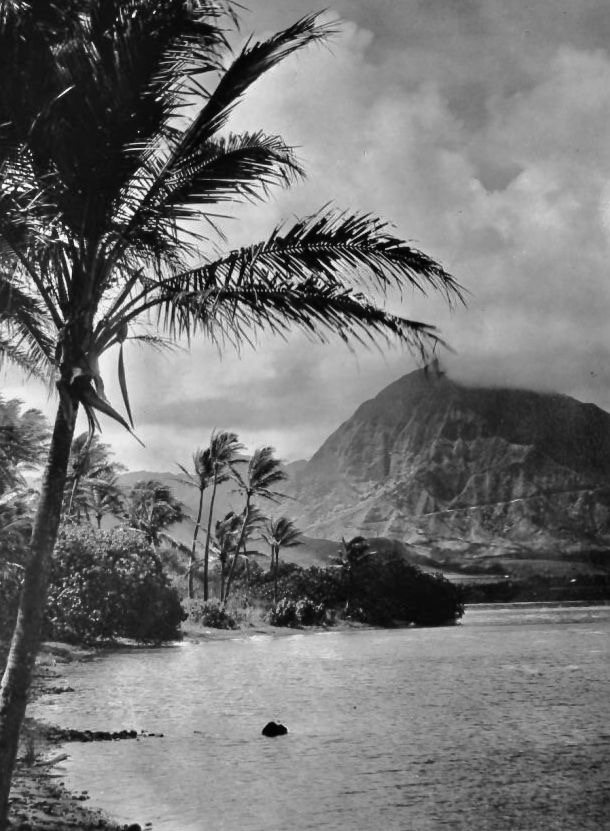
In 1878 a party of riders climbed out of Maunawili, on the green windward side of Oʻahu, and turned for home over the mountains to Honolulu. One of them was a 39-year-old princess, Lydia Kamakaʻeha Dominis. Tradition says she had just watched a long farewell embrace between a member of the party and a young woman at the ranch, and on the ride back she began to hum a melody.
Her handwritten score, now in the Hawaiʻi State Archives, is marked "Composed at Maunawili 1878". The song was "Aloha ʻOe", farewell to you. It became the most famous Hawaiian song ever written, recorded by everyone from the Hawaiian Quintette in 1913 to Elvis Presley and Johnny Cash.
Its composer would become Queen Liliʻuokalani. Most people know her as the monarch overthrown in 1893, a story told in our article on the overthrow of the Hawaiian Kingdom. This piece is about the rest of her life: the student, musician, traveller, prisoner, writer and benefactor.
A chief's daughter at the Royal School
She was born in Honolulu on 2 September 1838 to high-ranking chiefs, and by Hawaiian custom was given as a hānai (adopted) child to two other chiefs, Abner Pākī and Laura Kōnia. She grew up alongside their own daughter, Bernice Pauahi, later the founder of Kamehameha Schools. She was baptised Lydia.
At four she entered the Chiefs' Children's School, later the Royal School, run by the missionary teachers Amos Starr Cooke and Juliette Montague Cooke to prepare the next generation of rulers. Her classmates included four future monarchs. She learned English, the piano and the hymn tradition of the missions, and she sang and composed all her life.
On 16 September 1862 she married John Owen Dominis, son of a sea captain. They made their home at Washington Place, the white-columned house his father had built, which she would live in for more than half a century. The marriage was not always happy, and they had no children together, but she raised three hānai children, among them Lydia Aholo and her husband's son, John ʻAimoku Dominis.
Heir, regent and royal traveller
When her brother David Kalākaua became king, he named her heir apparent on 10 April 1877 and gave her a new name: Liliʻuokalani. The royal role came with real work. In 1881, while Kalākaua toured the world (see King Kalākaua, the Merrie Monarch), she served as regent and faced a smallpox outbreak in Honolulu. She closed the ports, stopped passenger boats leaving Oʻahu and enforced quarantine, firm measures aimed at stopping its spread.
In 1886 she founded an educational society for Hawaiian girls and a savings bank for Hawaiians. In April 1887 she sailed with Queen Kapiʻolani to London for Queen Victoria's Golden Jubilee, calling on President Grover Cleveland in Washington on the way. The trip ended abruptly: news arrived of the armed coup that forced the Bayonet Constitution on her brother, and the royal party hurried home.
She became queen on 29 January 1891. Her two-year reign, the three days of January 1893 and the armed rising of 1895 that led to her arrest are covered in depth elsewhere on this site. What follows is what she did with the years after.
Music, a quilt and a prayer from a palace room
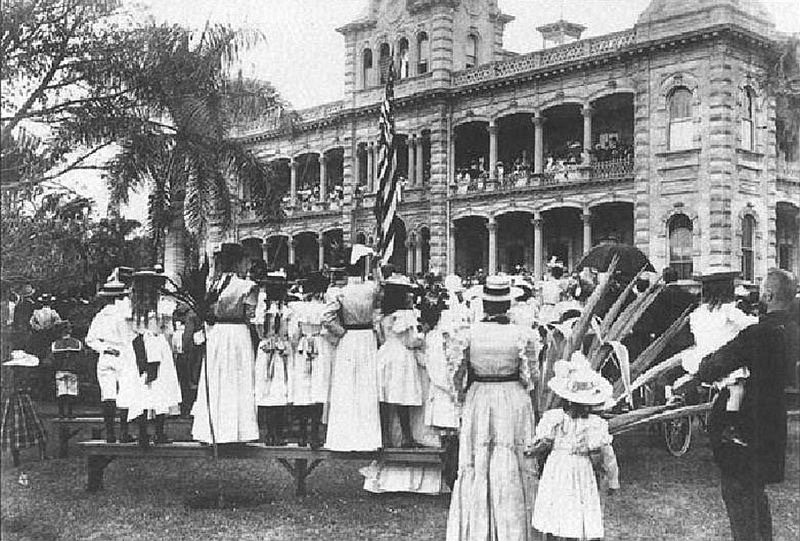
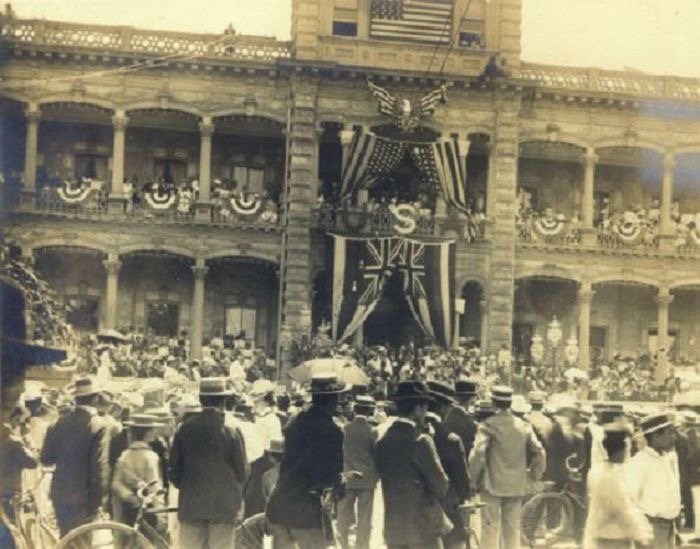
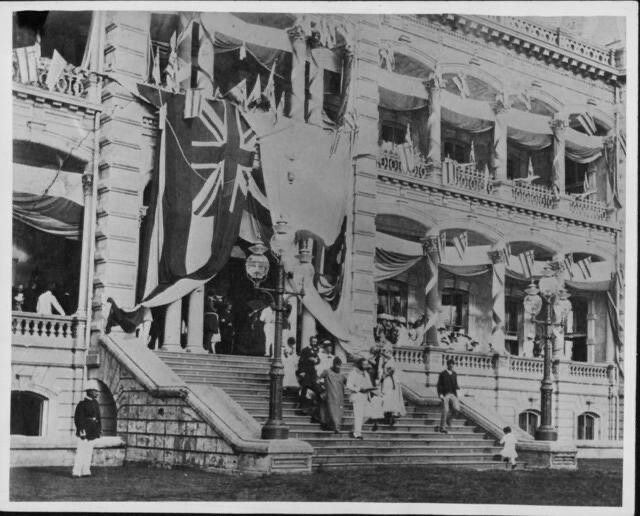
In January 1895 she was confined to an upstairs room of ʻIolani Palace for nearly eight months, with one companion. She was given little news and few visitors, so she turned to what she could do with her hands and her voice.
She composed. Among the songs of her imprisonment is "Ke Aloha o ka Haku", known in English as "The Queen's Prayer", a hymn asking for grace and forgiveness rather than revenge. She also wrote out scores of earlier songs, and over her life she composed more than 150 songs and chants.
She also sewed. With her companions she began a crazy quilt whose central square is embroidered with the words "Imprisoned at Iolani Palace" and "We began the quilt there". Around the Kalākaua coat of arms and crossed Hawaiian flags she stitched the dates of the events that had taken her throne. The embroidered dates show it was finished after her release, and today it hangs in the room where she was held.
In the same years she translated the Kumulipo, the great Hawaiian creation chant of more than 2,000 lines, into English. It was published in 1897, the first full English version of a chant her brother had first printed in Hawaiian.
In her own words: memoir and diaries
Pardoned in 1896, she travelled to the United States to fight the annexation treaty, lobbying in Washington and lodging a formal protest in June 1897. Native Hawaiians were mounting their own campaign through the Kūʻē petitions, told in Hawaii's annexation in 1898.
In 1898 a Boston publisher issued her memoir, Hawaii's Story by Hawaii's Queen. It is part autobiography, part legal brief: a calm, detailed account of her life and of the overthrow from the losing side, written for an American public that had mostly heard the other story. It remains in print and free online.
She also kept diaries. In 2019 the historian David W. Forbes published them as The Diaries of Queen Liliuokalani of Hawaii, 1885–1900, giving readers her daily view of court life, illness, money worries, music and politics, from the Jubilee journey to the years after annexation.
A trust for Hawaiian children
She had no children of her own and little income after the crown lands were taken. What she had left, she gave away. On 2 December 1909 she signed a deed of trust leaving her estate for the benefit of orphaned Hawaiian children, and in 1911 she extended it to destitute children.
That deed created the Liliʻuokalani Trust, which today runs early childhood, youth and family programmes across the islands, giving preference to children of Hawaiian ancestry. It is one of several royal trusts, alongside those of her childhood companion Bernice Pauahi Bishop and King Lunalilo, that still shape Hawaiian life.
She died at Washington Place on 11 November 1917, aged 79. Her body lay in state at Kawaiahaʻo Church, and on 18 November a state funeral was held in the throne room of the palace that had been her prison. She was laid to rest in the Kalākaua crypt at Mauna ʻAla, the Royal Mausoleum in Nuʻuanu, beside her brother and her niece, Princess Kaʻiulani, the heir who died before her.
Remembering the queen
Her name is everywhere in Hawaiʻi: on the Queen Liliʻuokalani Children's Center, on streets and schools, and on Liliʻuokalani Gardens in Hilo, a Japanese-style park of about 10 ha (25 acres) on Waiākea peninsula that the territorial legislature designated in 1917, the year she died, and which opened in 1919.
The most striking memorial stands in Honolulu. The Spirit of Liliʻuokalani, a 1.8 m (6 ft) bronze by the sculptor Marianna Pineda, was unveiled on 10 April 1982 between the State Capitol and ʻIolani Palace, facing Washington Place. In her hand the queen holds three papers: the score of "Aloha ʻOe", her proposed constitution of 1893 and the Kumulipo. Visitors often leave fresh lei on her arm.
Where to see her story today
ʻIolani Palace, downtown Honolulu: the throne room where she was tried and the upstairs room where she was confined, with her quilt. Tours are booked online. The Spirit of Liliʻuokalani: a minute's walk away, behind the palace, free to visit at any time.Washington Place, on South Beretania Street: her home for most of her adult life and the house where she was arrested in 1895 and died in 1917. It is now a museum, but a major restoration began in 2026 and public access is limited until the end of the year, so check washingtonplace.hawaii.gov before you go. Mauna ʻAla, on Nuʻuanu Avenue: her resting place. Behave as you would at any royal tomb.On Hawaiʻi Island, an early morning walk in Liliʻuokalani Gardens pairs well with our things to do on the Big Island. Her life threads through almost every chapter of the late kingdom, and if you want the whole arc, from Kalākaua's court to the Apology Resolution, it is told in our book The History of Hawaii.
Quick answers
What is Queen Liliʻuokalani famous for?
She was the last reigning monarch of the Kingdom of Hawaiʻi (1891–1893), overthrown with the help of US forces in 1893. She is also remembered as a composer of more than 150 songs, including "Aloha ʻOe", as the author of Hawaii's Story by Hawaii's Queen and as founder of the Liliʻuokalani Trust for Hawaiian children.
Did Queen Liliʻuokalani write Aloha Oe?
Yes. Her manuscript notes that she composed "Aloha ʻOe" at Maunawili on windward Oʻahu in 1878, while she was still a princess. Written as a love song about parting, it later came to be heard as a farewell to the kingdom.
What happened to Queen Liliʻuokalani after the overthrow?
After a failed royalist rising in 1895 she was arrested, forced to abdicate and held in ʻIolani Palace for nearly eight months. Pardoned in 1896, she lobbied against annexation in Washington, published her memoir in 1898 and lived at Washington Place until her death in 1917.
Where is Queen Liliʻuokalani buried?
In the Kalākaua crypt at Mauna ʻAla, the Royal Mausoleum on Nuʻuanu Avenue in Honolulu, alongside King Kalākaua and Princess Kaʻiulani.
Did Queen Liliʻuokalani have children?
She had no biological children. Following Hawaiian custom she raised hānai (adopted) children, including Lydia Aholo and John ʻAimoku Dominis, and she left her estate to a trust that still serves Hawaiian children today.
Facts checked October 2026 against the sources below and the research for our book The History of Hawaii. Dates and figures for early Hawaiian history are estimates and scholars still debate some of them.
- Liliʻuokalani (Wikipedia)
- Aloha ʻOe (Wikipedia)
- Queen's Quilt (Images of Old Hawaiʻi)
- The Spirit of Liliʻuokalani (Images of Old Hawaiʻi)
- Her Deed of Trust (Liliʻuokalani Trust)
- The Diaries of Queen Liliuokalani of Hawaii, 1885–1900 (UBC Press)
- Liliʻuokalani Gardens (Kaʻahele Hawaiʻi)
- Queen Liliʻuokalani's old mansion gets $7.3M makeover (Hoodline)