Palms, lei and a smiling dancer: for most of the twentieth century Hawaiʻi was sold with the same few pictures. Here is who made them, why they worked and what they left out.
A woman by the seawall
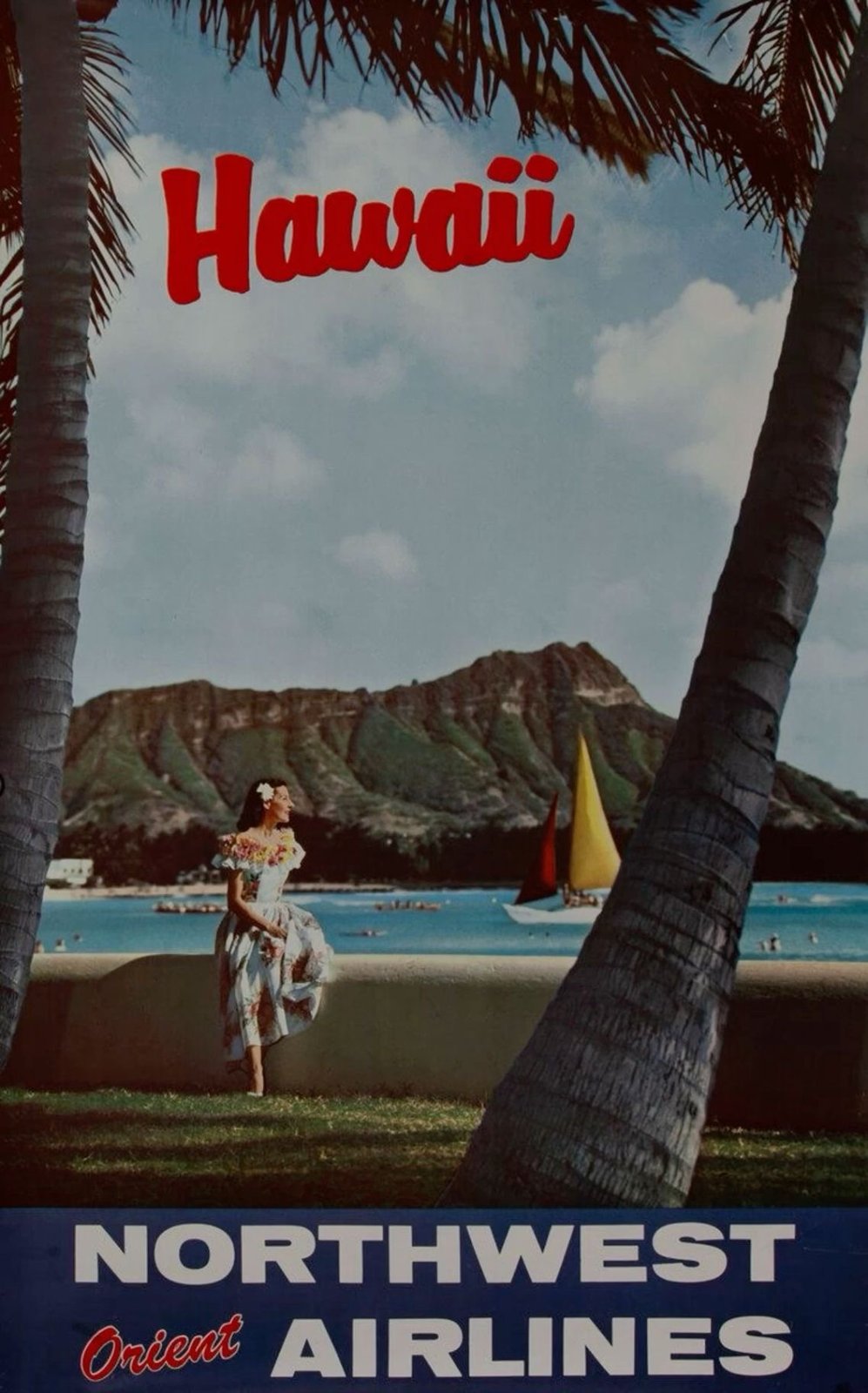
Two coconut palms frame the picture like stage curtains. Between them a young woman in a long white holokū printed with flowers sits on a sunlit seawall, a blossom in her hair and a ruffle of colour at her shoulders. Behind her the sea is turquoise, a catamaran with red and yellow sails slides past and Diamond Head fills the horizon. Across the sky, in bold red script, is one word: "Hawaii". Across the bottom, in white capitals on blue: Northwest Orient Airlines.
Northwest had been flying to Honolulu since the end of 1948, first with Douglas DC-4s, and posters like this one hung in ticket offices and travel agencies across the American Midwest. They were not just advertisements. They were invitations to a dream, and for most of the twentieth century that dream was carefully designed.
Selling an island since 1903
Hawaiʻi's promotion began as a business project. In 1902 Honolulu merchants hired a promoter, W. C. Weedon, to talk up the new territory on the mainland, and in 1903 the territorial legislature approved $15,000 for a Hawaii Promotion Committee. That year about 2,000 visitors arrived.
The committee became the Hawaii Tourist Bureau in 1919 and began counting visitors and hotel rooms; it recorded 8,000 arrivals in 1921. In 1945 it was relaunched as the Hawaii Visitors Bureau. Its magazine adverts, in titles read by millions of Americans, ended with a line that stressed civic pride: the bureau was "a non-profit organization maintained for your service by the people of Hawaii". From 1961 it worked under contract to the new state, and in 1996 it became the Hawaiʻi Visitors and Convention Bureau, with the state's Hawaiʻi Tourism Authority created in 1998.
One piece of its branding is still on the roadside. The red-caped warrior marker, a registered trademark of the bureau, points drivers to sites it considers culturally, historically or scenically important. Look out for them on any island drive.
Menus, murals and the Matson style
The richest artwork came from the shipping line. In 1938 Matson commissioned the American painter Eugene Savage to create a series of murals on Hawaiian themes. Finished in 1940, they were reproduced from 1948 as lithographed menu covers aboard the liner Lurline, so that first-class passengers could take home a piece of art with their dinner (the liners themselves star in boat days and the Matson liners).
Earlier Matson menus by the illustrator Frank Macintosh, with Art Deco scenes of fruit harvests and island feasts, are equally prized. Both artists painted a lush, golden Hawaiʻi of chiefs, canoes and abundance, closer to theatre than to history, and both set the visual tone that airline posters later borrowed.
Airlines, jets and the happiest Hawaiians
After the war the airlines took over. Pan Am, United and Northwest competed with bright, photographic posters of beaches, lei and hula, and with magazine spreads that sold the trip as a transformation. One Pan Am advert showed visitors in lei paddling an outrigger off Waikīkī under the headline "Pan Am travelers are the happiest 'Hawaiians'". The quotation marks did a lot of work: you could become, for a week, a kind of honorary islander.
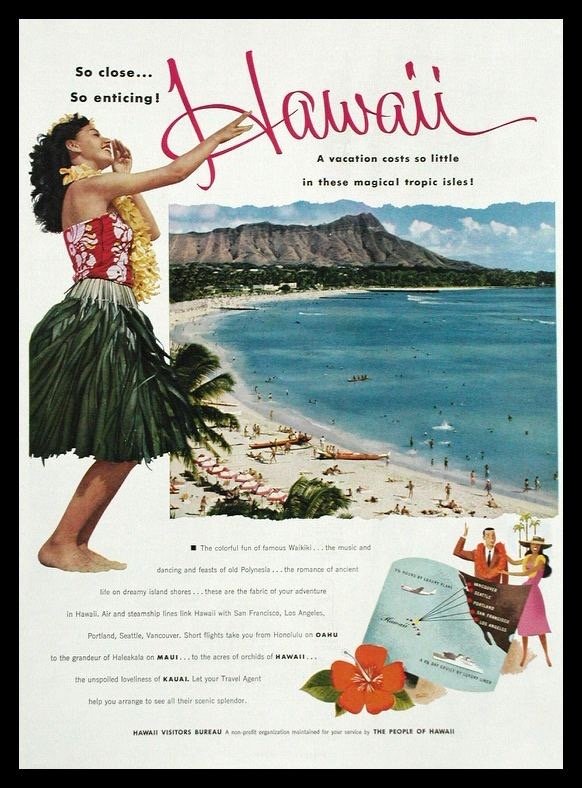
The Visitors Bureau joined in. In 1953 it named its first official Poster Girl, Mae Beimes, and its 1950s adverts paired a smiling dancer with a photograph of Waikīkī and the promise that a holiday "costs so little in these magical tropic isles". After 1959 the jets made the promise real, and the advertising budget grew with the visitor numbers (see Hawaii tourism's golden age).
The hula girl and her critics
Look at enough of these images and a pattern appears. The visitor is usually a white mainland couple. The Hawaiian is usually a young woman, smiling, garlanded and offering something: a lei, a dance, a basket of fruit. Hawaiian men appear less often, typically paddling a canoe or playing music. Hawaiian history, language and politics are almost entirely absent.
The most famous critique came from the Native Hawaiian scholar and activist Haunani-Kay Trask. In her essay "Lovely Hula Hands: Corporate Tourism and the Prostitution of Hawaiian Culture", first published in the winter of 1991 to 1992 and collected in her book From a Native Daughter (1993), she argued that the industry had turned Hawaiian culture, and Hawaiian women in particular, into a product for sale, while most of the profits flowed elsewhere. Her language was deliberately provocative, and more than thirty years later the essay is still widely read and debated in the islands.
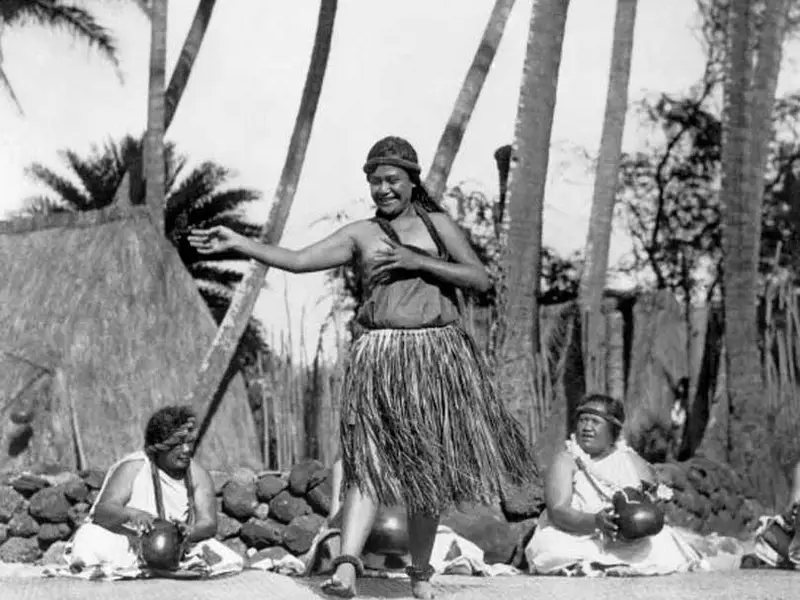
There is another side. Many of the dancers and musicians in these images were skilled professionals who kept hula and Hawaiian music alive through difficult decades (see the history of hula). And the posters are, by any measure, fine examples of mid-century commercial art. Both things can be true: the images are beautiful, and they tell only the story their sponsors wanted told.
Collecting vintage Hawaii posters and ads
Vintage Hawaiʻi advertising is a lively collecting field, and prices run from a few dollars to thousands. A few tips:
- Magazine adverts are the easy start. Pages cut from 1950s and 1960s magazines, like those on this page, are plentiful and cheap. Look for complete pages with the date or page number intact.
- Original posters cost more. Airline posters were printed in limited runs for offices and agencies. Dealers grade them by condition and often back them on linen. As one example, a 1956 Eugene Savage Matson lithograph was listed by a specialist dealer at $450.
- Know the reproductions. Many designs have been reprinted. Compare the size and printer's credit line with documented originals, and be wary of bright white paper, perfect condition and prices that seem too good to be true.
- Menus and postcards from Matson liners and Waikīkī hotels are affordable ways to collect the period's art.
- Buy from reputable dealers who state the printing method, date and any restoration.
Seeing the old dream today
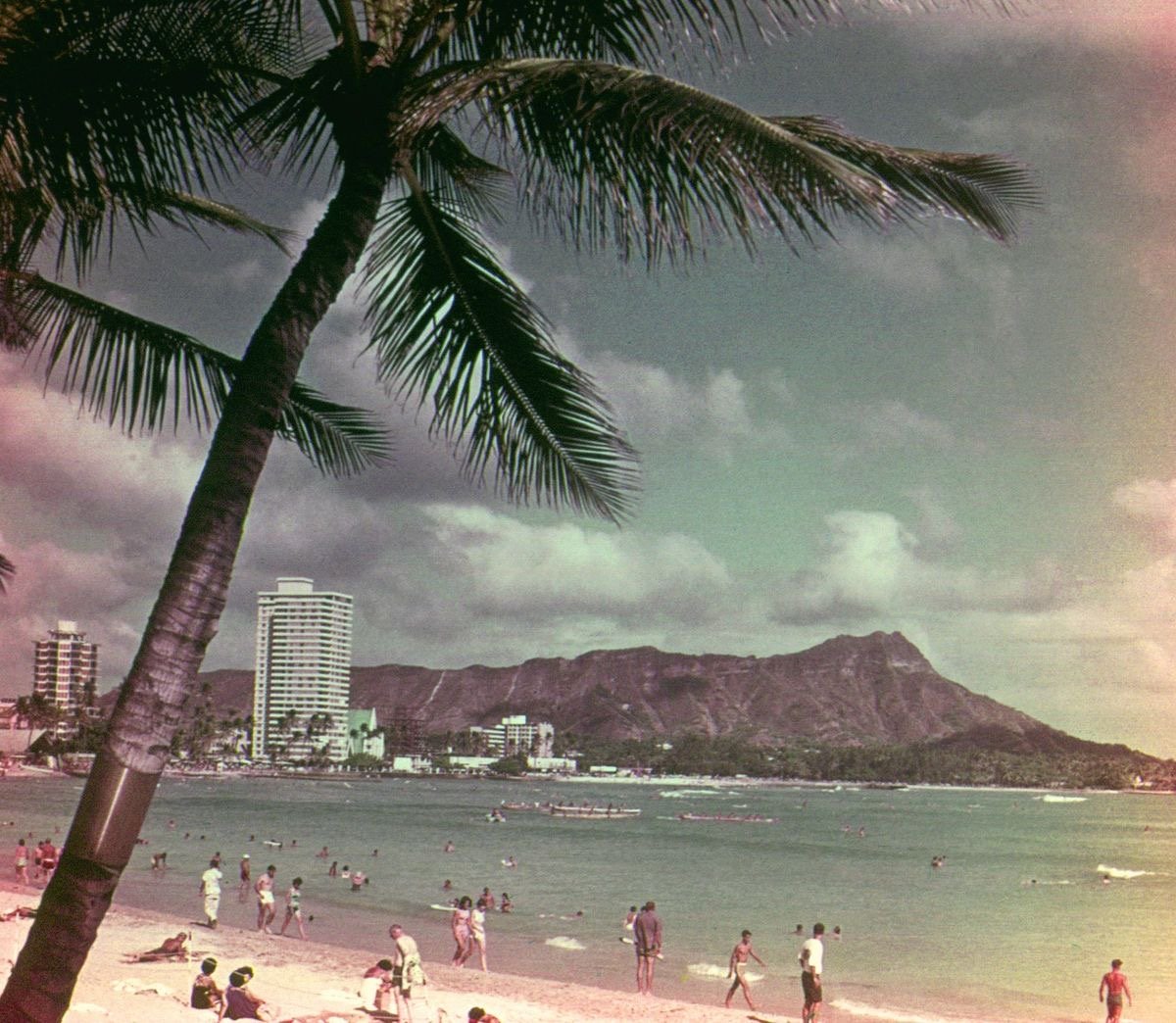
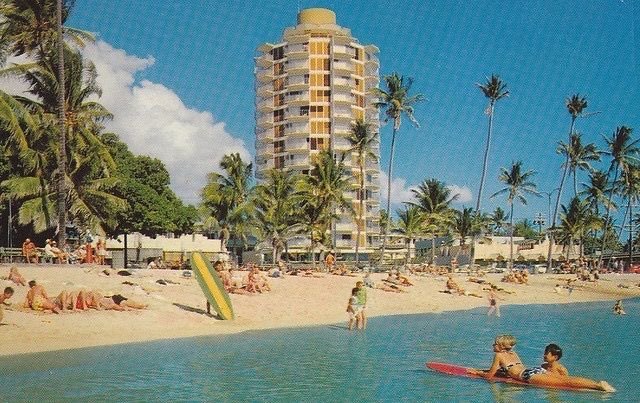
The places in these images are still there. Walk the shore of Waikīkī and you can still find seawalls and lawns with almost the same view the Northwest Orient photographer chose, catamarans included. Outrigger canoe rides still launch from the beach (see Waikīkī in the 1960s and 1970s).
What has changed is the story. Today's best hula is performed by hālau on their own terms, at festivals such as the Merrie Monarch, and today's visitors are asked to come as guests rather than as honorary "Hawaiians". Our guide to visiting Hawaii respectfully explains what that means in practice, and our book The History of Hawaii tells the parts of the story the posters left out.
Quick answers
When was the Hawaii Visitors Bureau founded?
Its roots go back to the Hawaii Promotion Committee of 1903, which became the Hawaii Tourist Bureau in 1919. It was relaunched as the Hawaii Visitors Bureau in 1945 and renamed the Hawaiʻi Visitors and Convention Bureau in 1996.
Who painted the Matson menu covers?
The best known are by Eugene Savage, whose murals of Hawaiian themes, commissioned by Matson in 1938 and finished in 1940, were reproduced as menu covers aboard the Lurline from 1948. Frank Macintosh designed earlier Matson menus.
How can I tell if a vintage Hawaii poster is original?
Compare its size and printer's credit line with documented originals, be wary of bright white paper and perfect condition, and buy from dealers who state the printing method, date and any restoration.
What is Lovely Hula Hands by Haunani-Kay Trask about?
It is an essay, first published in 1991 to 1992 and collected in From a Native Daughter (1993), arguing that corporate tourism commodified Hawaiian culture and especially Hawaiian women, while most of the profits left the islands.
What are the red warrior signs in Hawaii?
They are Hawaiʻi Visitors and Convention Bureau warrior markers, a registered trademark of the bureau, placed to point visitors towards culturally, historically or scenically significant sites.
Facts checked October 2026 against the sources below and the research for our book The History of Hawaii. Vintage photos and adverts are shown as period illustrations; adverts are credited to their original advertisers.
- HVCB: History of the Hawaiʻi Visitors & Convention Bureau
- HVCB: Warrior Marker
- Northwest Airlines History Centre: 1957 Airventure Guide to Hawaii
- Limited Runs: Matson Lines Hawaii, Festival of the Sea (Eugene Savage)
- 1stdibs: 1938 Frank Macintosh Fruit Harvest menu cover
- Civil Beat: A 30-year-old rant on Hawaii tourism still rings true (2021)