More than half of Native Hawaiians signed their names against it. Congress annexed the islands anyway, by a simple vote in the middle of a war. The story of 1898, and the questions it left behind.
Noon at ʻIolani Palace
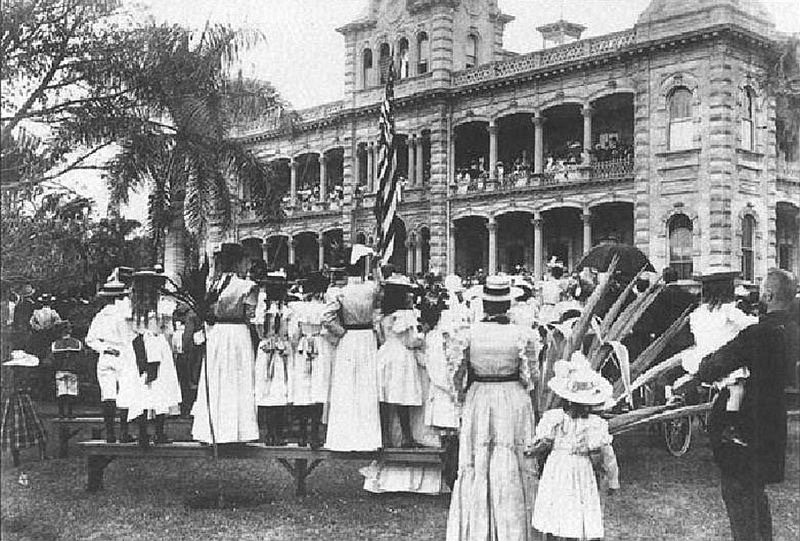
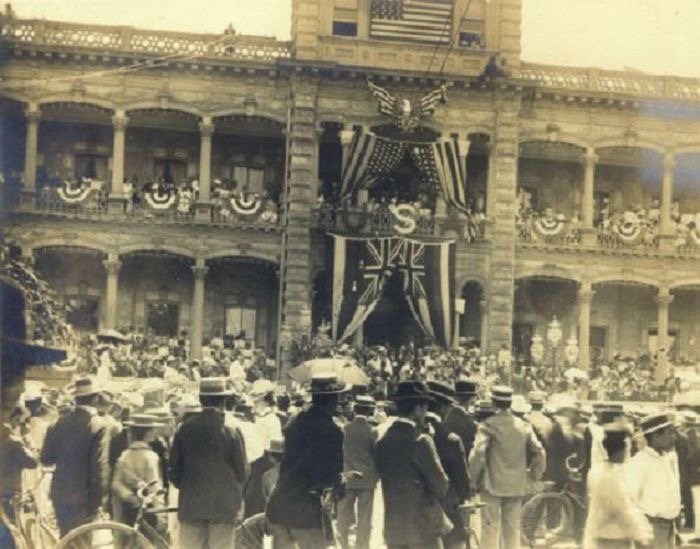
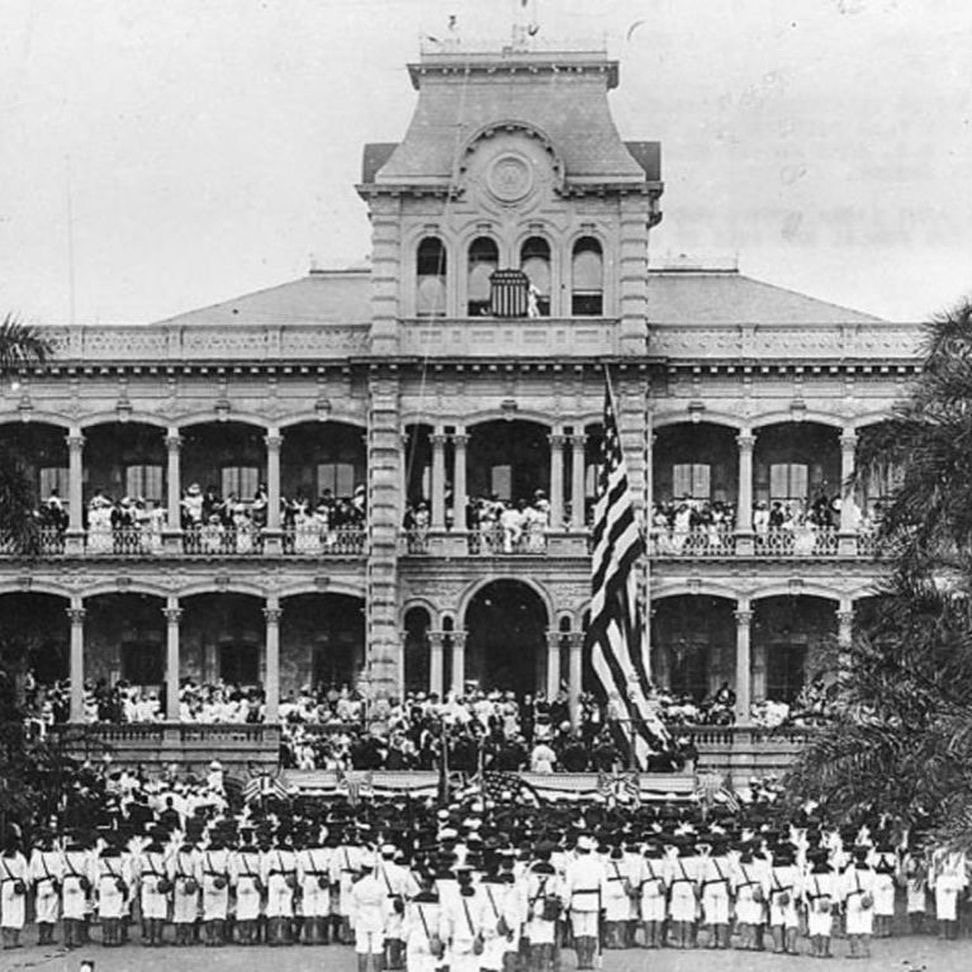
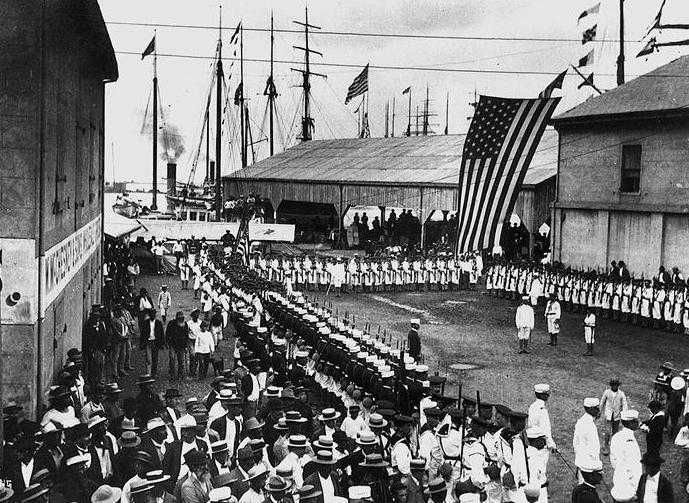
Around noon on 12 August 1898, crowds packed the grounds and verandas of ʻIolani Palace in Honolulu. American troops stood in ranks on the lawn. On the front steps, Sanford B. Dole, president of the Republic of Hawaii, formally handed sovereignty over the islands to the United States.
The Hawaiian flag was lowered from the palace and the Stars and Stripes raised in its place. Many Native Hawaiians stayed away, and none of the former leaders of the Hawaiian Kingdom attended. For them it was a day of mourning.
How Hawaiʻi reached that moment is a story of a narrow republic, a petition signed by thousands, a war on the other side of the world and a vote in Washington that changed the rules.
A republic for the few
After the overthrow of the Hawaiian Kingdom in January 1893, the men who took power hoped for quick annexation. President Grover Cleveland blocked it, so on 4 July 1894 they proclaimed the Republic of Hawaii, with Dole as its first and only president.
It was a republic run by a small elite. Voters had to swear an oath of allegiance that most royalists refused, Asian residents were largely shut out, and the annexationist American Union Party won every seat. After a failed royalist rising in January 1895, Queen Liliʻuokalani was forced to abdicate and royalist leaders were jailed.
The Kūʻē petitions
When William McKinley became president in 1897, annexation returned. On 16 June 1897 he signed a treaty with envoys of the Republic, and the former queen, then in Washington, lodged a formal protest.
Native Hawaiians answered with paper. Between 11 September and 2 October 1897, at meetings on the five main islands, the Hui Aloha ʻĀina (Hawaiian Patriotic League) and its women's branch collected signatures against annexation "in any form or shape". The result, known as the Kūʻē (opposition) petition, ran to 556 pages and 21,269 names, more than half of the roughly 39,000 Native Hawaiians and part-Hawaiians counted that year. A second group, the Hui Kālaiʻāina, gathered about 17,000 signatures calling for the monarchy's restoration.
Four delegates, James Kaulia, David Kalauokalani, John Richardson and William Auld, carried the petition to Washington. On 9 December 1897 Senator George Hoar read it to the Senate. By the time the delegates left in February 1898, only 46 senators would back the treaty, short of the two-thirds needed. It died.
For most of the 20th century the petitions lay almost forgotten in the US National Archives. The work of Nālani Minton and the scholar Noenoe Silva brought them back to light, and a complete copy returned to Hawaiʻi in 1998.
War changes the vote
Events far away changed everything. After the USS Maine exploded in Havana harbour in February 1898, the United States went to war with Spain, and soon American troops were heading across the Pacific to the Philippines. Honolulu, a mid-ocean harbour and coaling stop, suddenly looked strategic.
When the first transports carrying US troops to Manila called at Honolulu in June 1898, the Republic welcomed them openly, setting aside any pretence of neutrality. Supporters of annexation argued that the islands were already serving as an American base and should be made one in law. Opponents in Congress, including anti-imperialists and some sugar-beet interests at home, objected, but they were now in the minority.
Annexationists dropped the treaty, which needed two-thirds of the Senate, in favour of a joint resolution, which needed only a simple majority in each house. The Newlands Resolution, named after Representative Francis G. Newlands of Nevada, moved quickly.
| Date | Step | Result |
|---|---|---|
| 16 June 1897 | Annexation treaty signed | Stalled at 46 Senate votes, short of two-thirds |
| 15 June 1898 | House votes on Newlands Resolution | Passed 209–91 |
| 6 July 1898 | Senate votes | Passed 42–21 |
| 7 July 1898 | McKinley signs | Annexation approved |
| 12 August 1898 | Ceremony at ʻIolani Palace | Sovereignty transferred |
Under the resolution the Republic ceded its crown, government and public lands to the United States. The 1993 Apology Resolution later put that area at about 728,000 ha (1.8 million acres).
From annexation to territory
For almost two years the islands were run much as before, by the Republic's officials. Then the Hawaiian Organic Act, signed by McKinley on 30 April 1900 and in force from 14 June, created the Territory of Hawaii. The president appointed its governor, the first being Dole; residents elected a legislature and sent a non-voting delegate to Congress. The act also ended the old penal labour contracts on the plantations, a turning point in Hawaii's sugar plantation history.
Hawaiians quickly made their voices heard at the ballot box. Robert W. Wilcox's Home Rule Party won a majority in the first territorial Senate in 1900, and Prince Jonah Kūhiō Kalanianaʻole, jailed as a royalist in 1895, served as delegate to Congress from 1903 until 1922. He championed the Hawaiian Homes Commission Act of 1921, which set aside land for Native Hawaiian homesteads.
Annexation also tied Hawaiʻi firmly to the US military and to the sugar economy of the Big Five, setting the stage for Pearl Harbor and, eventually, statehood in 1959.
Was annexation legal? The debate today
The question has never gone away. Many Native Hawaiians and sovereignty advocates argue that a domestic resolution of Congress could not lawfully absorb a foreign nation, which normally requires a treaty, and that the Kūʻē petitions show annexation lacked the consent of the people.
The 1993 Apology Resolution acknowledged that Native Hawaiians "never directly relinquished their claims to their inherent sovereignty" to the United States, though it states that it settles no claims. US courts, including the Supreme Court in 2009, have treated annexation and statehood as valid. Between those positions lies a wide range of Native Hawaiian views, from federal recognition to full independence, discussed further in the Hawaiian Renaissance.
Where to see this history
Stand at the front steps of ʻIolani Palace in downtown Honolulu, where the 1898 ceremony took place. The palace, open Tuesday to Saturday for tours booked online (as of October 2026), tells the story of the monarchy and its end; read our ʻIolani Palace history before you go. The grounds are free to walk and quiet in the early morning.
If you want to see the petitions themselves, the University of Hawaiʻi at Mānoa Library offers a research guide to the Kūʻē petitions, and their pages, written in Hawaiian and English, are worth reading name by name. Combine a visit with the rest of downtown using our things to do in Honolulu guide.
Annexation sits at the hinge of Hawaiʻi's modern story, between kingdom and territory, and our book The History of Hawaii follows both sides of it in detail.
Quick answers
When was Hawaii annexed by the United States?
President McKinley signed the Newlands Resolution annexing Hawaiʻi on 7 July 1898, and sovereignty was formally transferred at a ceremony at ʻIolani Palace on 12 August 1898. The Territory of Hawaii was created by the Organic Act in 1900.
Why did the US annex Hawaii in 1898?
Annexationists in Hawaiʻi had sought it since the 1893 overthrow, and sugar interests wanted secure access to the US market. The decisive factor was the Spanish-American War of 1898, which made Honolulu valuable as a mid-Pacific naval and coaling base.
What were the Kūʻē petitions?
Petitions against annexation organised by the Hui Aloha ʻĀina in 1897. They carried 21,269 signatures on 556 pages, more than half of the Native Hawaiian population, and helped defeat the 1897 annexation treaty in the US Senate.
Was the annexation of Hawaii legal?
US courts have treated it as valid. Many Native Hawaiians and sovereignty advocates argue it was not, because it was done by a joint resolution rather than a treaty and without the consent of the Hawaiian people. The 1993 Apology Resolution notes that Native Hawaiians never directly relinquished their claims to sovereignty.
What was the Newlands Resolution?
The joint resolution of Congress that annexed Hawaiʻi, named after Representative Francis G. Newlands. It passed the House 209–91 on 15 June 1898 and the Senate 42–21 on 6 July 1898.
Facts checked October 2026 against the sources below and the research for our book The History of Hawaii. Dates and figures for early Hawaiian history are estimates and scholars still debate some of them.
- US National Archives: Petition Against the Annexation of Hawaii (1897)
- University of Hawaiʻi at Mānoa Library: Kūʻē Petitions research guide
- Wikipedia: Newlands Resolution
- Wikipedia: Kūʻē Petitions
- Wikipedia: Territory of Hawaii
- Congress.gov: S.J.Res.19, Apology Resolution (enrolled text)
- Legal Information Institute: Hawaii v. Office of Hawaiian Affairs (2009)