For 181 years sugar shaped Hawaiʻi's land, politics and people. It drew workers from across the world, gave the islands a new language and ended with one last truck of cane on Maui.
The last load at Puʻunēnē
On Monday 12 December 2016, a driver named Fermin Domingo steered a heavy cane hauler up to the mill at Puʻunēnē on Maui. He had worked for Hawaiian Commercial & Sugar Company for 40 years. The load he delivered was the last commercial sugar cane harvest in Hawaiʻi.
It closed a story that began in 1835 and shaped almost everything about modern Hawaiʻi: who owns the land, who lives on the islands, how people talk and how they vote. Drive through central Maui or Oʻahu's North Shore and you can still read it in mill stacks, camp houses and long irrigation ditches.
Kōloa, 1835: where it began
Sugar cane itself was old in Hawaiʻi. Polynesian voyagers carried it here as one of their canoe plants, centuries before any mill (see how Polynesians discovered Hawaii). Commercial sugar began on Kauaʻi in 1835, when the Honolulu firm Ladd & Co. leased about 400 ha (980 acres) at Kōloa and started clearing fields.
The first mill failed. A second, built in 1841 on the Waihohonu stream, worked until 1912, and its stone ruins are now a National Historic Landmark. Kōloa also saw the islands' first recorded labour dispute: in 1841 Hawaiian workers paid 12½ cents a day in company scrip struck for higher pay, and lost.
Two laws then set the industry's course. The Masters and Servants Act of 1850 allowed labourers to be bound to multi-year contracts, with penalties for leaving. And the Reciprocity Treaty of 1875, won by King Kalākaua, let Hawaiian sugar into the United States duty-free. Production soared and so did the planters' demand for workers.
Workers from across the world
Disease had devastated the Native Hawaiian population, so planters recruited abroad. Over roughly a century, depending on the estimate, between about 337,000 and 350,000 people came to work the cane fields, and each group arrived with its own language, food and faith.
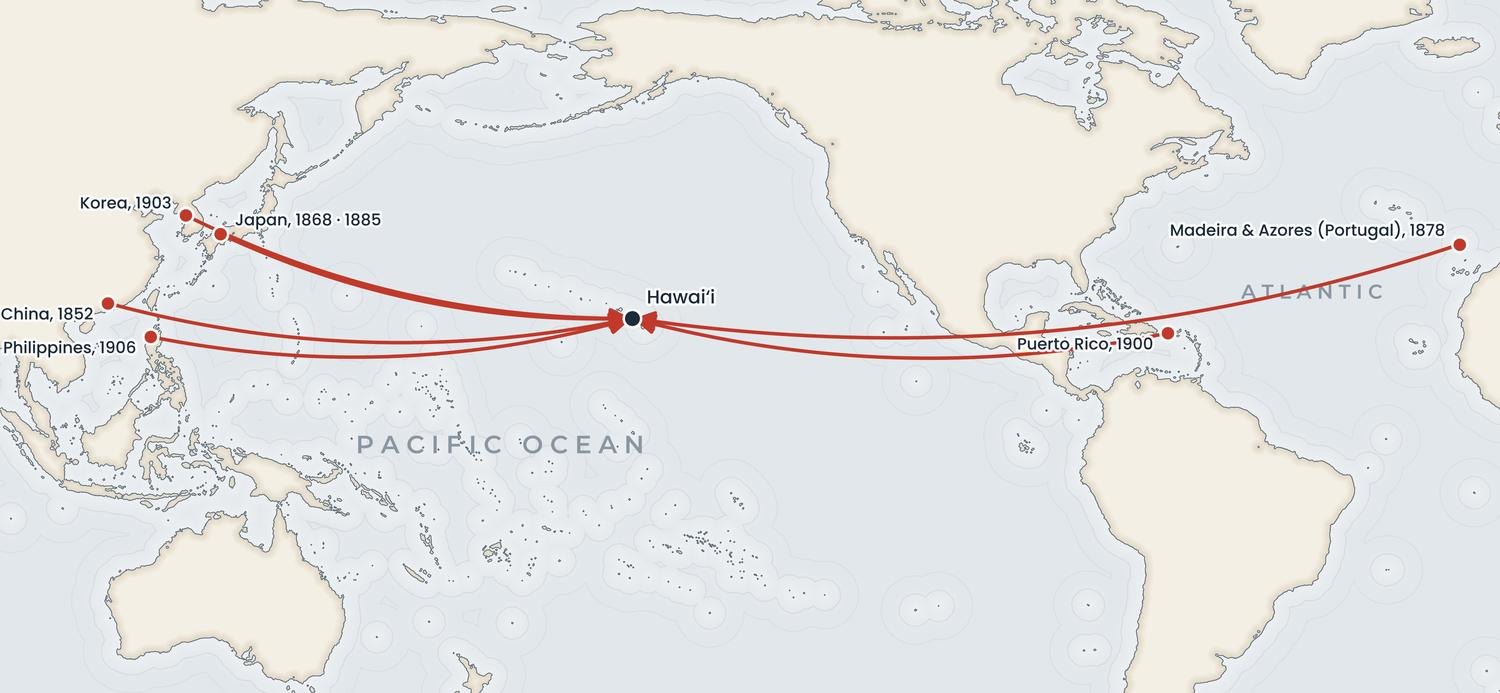
| People | First large arrival | Note |
|---|---|---|
| Chinese | 3 January 1852, the Thetis | Almost 50,000 came by 1887 |
| Japanese | 8 February 1885, the City of Tokio | 943 people on the first government ship |
| Portuguese | 30 September 1878, the Priscilla | Came as families, from Madeira and the Azores |
| Puerto Rican | 23 December 1900 | After hurricanes wrecked island cane fields |
| Korean | 13 January 1903, the Gaelic | About 7,000 within three years |
| Filipino | 20 December 1906, the Doric | The sakada, mostly Ilocanos |
Figures vary between sources, and many workers went home when their contracts ended. A small group of Japanese migrants had already arrived in 1868, and smaller numbers of Germans, Norwegians and others also came. Those who stayed raised families, opened stores and temples, and became the ancestors of a large share of today's islanders.
Families followed the workers. From 1907 Japanese "picture brides", married by proxy after exchanging photographs, crossed the Pacific to husbands they had never met. Filipino recruitment grew fastest of all: more than 100,000 Filipinos arrived between 1909 and 1930, most of them young men from the Ilocos region of northern Luzon. Each wave arrived as planters tried to replace, or play off against each other, the groups already in the fields.
Camp life and a new language
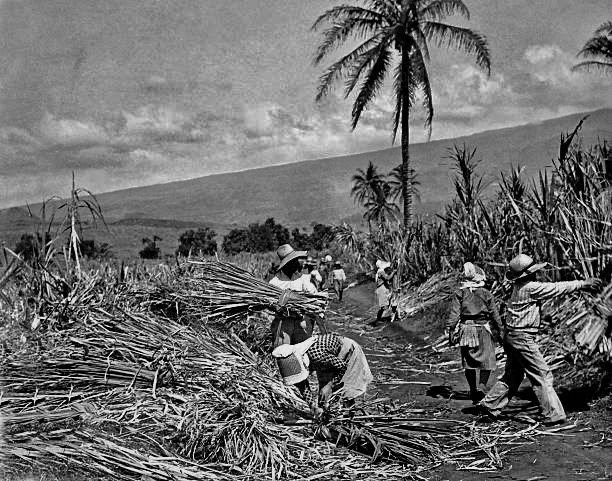
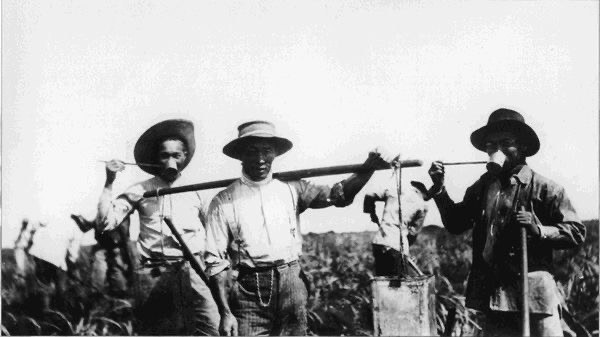
A field day ran ten hours or more under the eye of a luna (overseer), whose harshness workers long resented. Managers housed each nationality in its own camp, which made it harder for workers to organise, and paid different groups different rates for similar work. In 1909 Japanese field hands earned $18 for a 26-day month, while Portuguese and Puerto Rican labourers doing much the same job received $22.50.
Pay came partly in kind. Under the perquisite system the company supplied housing, fuel and medical care, which kept cash wages low and tied families to the plantation.
Out of the camps came something lasting. People who shared no language built a common one, drawing on Hawaiian, English, Portuguese, Cantonese, Japanese, Ilocano and more. Their children made it a full mother tongue, Hawaiʻi Creole English, known to everyone simply as Pidgin. In 2015 the US Census Bureau added it to its list of languages spoken at home. Listen for da kine and brah on any beach.
Sugar and power
Reciprocity made sugar enormously profitable and plantation owners enormously influential. Business came to be dominated by five agencies, the Big Five: Castle & Cooke, Alexander & Baldwin, C. Brewer & Co., Theo H. Davies and H. Hackfeld (later American Factors). Most had roots in missionary families.
The same business circle pressed the Bayonet Constitution on Kalākaua in 1887 and was central to the overthrow of Queen Liliʻuokalani in 1893, a story told in our article on the overthrow of the Hawaiian Kingdom. Annexation in 1898 removed the tariff threat for good, and the 1900 Organic Act finally made the old penal labour contracts illegal.
Strikes that changed Hawaiʻi
Workers fought back repeatedly. Japanese labourers struck across Oʻahu in 1909, and in 1920 Filipino and Japanese workers walked out together for the first time. Both strikes failed, but racial pay scales were gradually abandoned.
The bloodiest day came on Kauaʻi. On 9 September 1924, at Hanapēpē, a clash between Filipino strikers and police left 16 strikers and 4 police officers dead. In 2019 researchers located a trench in the Hanapēpē Filipino Cemetery believed to hold strikers' graves.
The turning point was the International Longshore and Warehouse Union (ILWU), which did what the old ethnic unions could not and organised workers of every background together. On 1 September 1946 more than 25,000 sugar workers shut down 33 of the 34 plantations. After 79 days they won higher wages and the end of the perquisite system, with benefits converted into cash.
That solidarity reshaped politics. Labour helped Democrats win the territorial legislature in 1954, a shift that led on to statehood in 1959.
The long goodbye, and where to see it
Machines replaced many workers from the 1960s, and as costs rose the plantations closed one by one through the 1990s and 2000s. By 2016 only Hawaiian Commercial & Sugar on Maui remained, with about 650 employees in its final year. More than 500 plantations, mills and growers had come and gone.
The best place to meet this history is the Alexander & Baldwin Sugar Museum at 3957 Hansen Road, Puʻunēnē, beside the old mill. As of October 2026 it opens Monday to Thursday, 10 am to 2 pm (last entry 1 pm), with adult admission $12 and free entry for kamaʻāina. Its camp maps help descendants trace their families. Combine it with our things to do on Maui guide.
On Kauaʻi, the Old Sugar Mill of Kōloa ruins and the 1985 sugar monument, with bronze figures of the industry's peoples, stand at the junction of Maluhia Road and Kōloa Road and are free to visit. The cemetery at Hanapēpē deserves a quiet, respectful stop. More island sites are in our things to do on Kauaʻi guide.
Sugar's place in the making of modern Hawaiʻi is traced in depth in our book The History of Hawaii, alongside its younger partner, pineapple.
Quick answers
When did sugar plantations start in Hawaii?
Commercial sugar began in 1835, when Ladd & Co. started a plantation at Kōloa on Kauaʻi. The 1841 mill ruins there are a National Historic Landmark.
When did the last sugar plantation in Hawaii close?
Hawaiian Commercial & Sugar Company on Maui brought in Hawaiʻi's last sugar harvest on 12 December 2016 and closed soon after, ending 181 years of commercial sugar.
Why did so many immigrants come to Hawaii to work on plantations?
Disease had sharply reduced the Native Hawaiian population, so planters recruited contract workers from China, Japan, Portugal, Puerto Rico, Korea and the Philippines. Estimates range from about 337,000 to 350,000 people over roughly a century.
What was the 1946 sugar strike in Hawaii?
On 1 September 1946 more than 25,000 workers organised by the ILWU shut down 33 of the islands' 34 sugar plantations. After 79 days they won higher wages and the end of the perquisite system.
Where did Hawaiian Pidgin come from?
Pidgin grew on the plantations as workers from many countries needed a common language. Their children made it a full first language, known to linguists as Hawaiʻi Creole English.
Facts checked October 2026 against the sources below and the research for our book The History of Hawaii. Dates and figures for early Hawaiian history are estimates and scholars still debate some of them.
- National Park Service: Old Sugar Mill of Kōloa
- The Maui News: End of an era (final HC&S cane haul)
- NBC News: Hawaii's last sugar plantation finishes its final harvest
- Wikipedia: Sugar plantations in Hawaii
- Wikipedia: SS City of Tokio
- Wikipedia: Hawaiian sugar strike of 1946
- Wikipedia: Hanapēpē massacre
- Alexander & Baldwin Sugar Museum: Visit