Before the jets and the towers, Hawaiʻi was a territory of plantation towns, union halls, Sunday drives and a radio show heard around the world. This is what the islands felt like in their last decade before statehood.
A Sunday drive below Koko Head
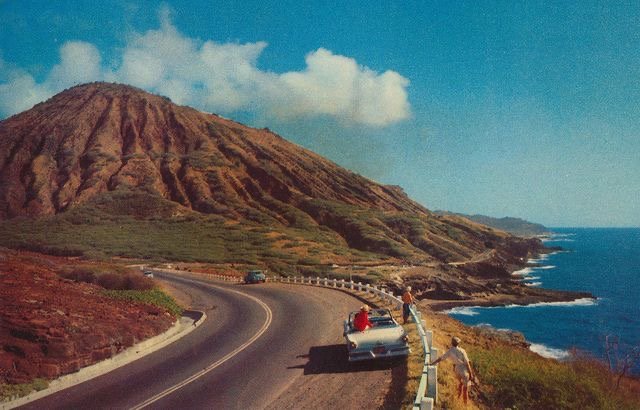
Picture a Sunday afternoon in the mid-1950s. A family has driven out from Honolulu along Kalanianaʻole Highway, past the market gardens and the old fishpond at Maunalua, and pulled over on the bend below Koko Head. The convertible's top is down. Below the guardrail, the swell breaks white against black lava, and there is hardly another car on the road.
That scene, preserved on countless colour postcards, is a good place to start. The coast road was there, but the suburbs were not. Kuapā, the great fishpond behind the beach at Maunalua, was still a working pond. Dredging began around 1959, and in 1961 Henry J. Kaiser's company signed a lease with the Bishop Estate to turn the pond and its wetlands into the marina suburb of Hawaiʻi Kai. Within a few years the quiet drive had a city behind it.
The last years of a territory
In the 1950s Hawaiʻi was still the Territory of Hawaii. Its governor was appointed in Washington, and its one delegate to Congress could speak but not vote. The census counted 499,794 people in 1950 and 632,772 in 1960, a rise of more than a quarter in ten years, driven by returning servicemen, the military and a new generation born after the war.
It was an unusually mixed society. The children and grandchildren of plantation workers from Japan, China, Portugal, the Philippines, Korea and Puerto Rico had grown up alongside Native Hawaiian and haole (white) neighbours, and they spoke a shared language at school and on the street: Pidgin. Many of the young men had come home from the war with the GI Bill and big ambitions. How they changed island politics in 1954, and how the long statehood campaign ended in 1959, is told in our article on Hawaii statehood 1959. This page is about daily life around those events.
Plantation towns and union halls
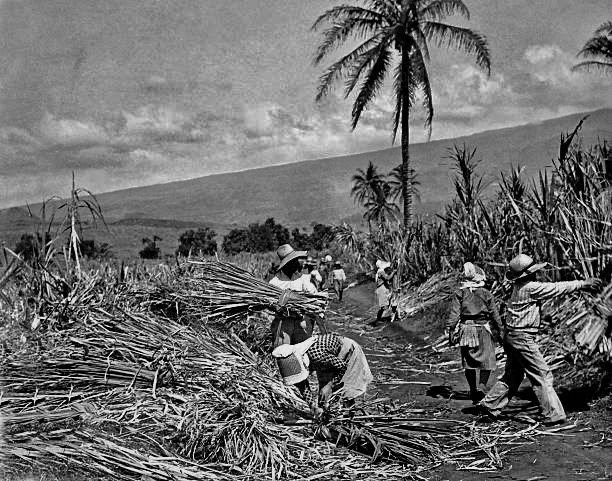
Outside Honolulu, most people still lived by sugar and pineapple. A plantation town meant a mill, a company store, a school, rows of wooden camp houses and a church or temple for each community. Whistles marked the working day. The history of sugar in Hawaiʻi explains how those towns were built.
What changed in the late 1940s was power. In the 1946 sugar strike more than 25,000 workers walked out for 79 days, and the old system in which the company paid partly in housing, fuel and medical care gave way to cash wages. Three years later, on 1 May 1949, about 5,000 dockworkers of the ILWU struck for pay closer to that of West Coast longshoremen, who earned $1.82 an hour against $1.40 in Hawaiʻi. The strike lasted 177 days. The territorial legislature passed a Dock Seizure Act, and a group of employers' wives known as the Broom Brigade picketed the union offices, but the dockers won a 21-cent raise in stages.
The 1950s were the decade in which those victories became ordinary life. Plantation workers had paid holidays and pensions, union families had savings, and many of their children were the first in the family to go to college.
Hawaii Calls: the islands on the radio
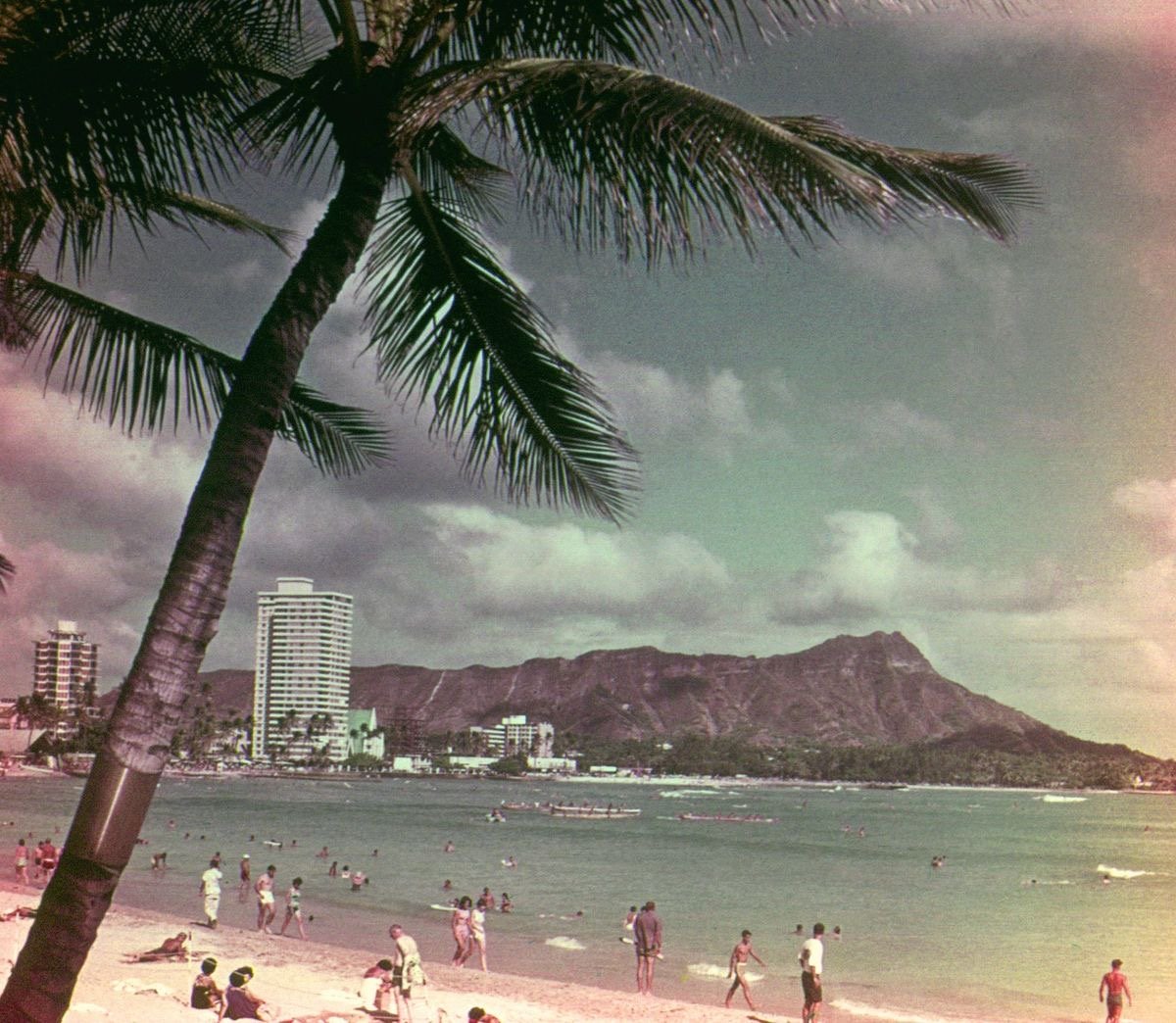
For millions of people who would never visit, the sound of 1950s Hawaiʻi came through the radio. Hawaii Calls had first gone on air on 3 July 1935, broadcast live from the banyan courtyard of the Moana Hotel on Waikīkī Beach. Its host, Webley Edwards, opened with the sound of the surf, then introduced singers and steel guitarists such as Alfred Apaka, Hilo Hattie and Haleloke.
At its peak the show was carried by some 750 stations around the world, and in the 1950s Edwards also turned it into a run of best-selling Capitol Records albums. It stayed on air until 1975. For many mainland listeners, the slack of a steel guitar and the hush of the surf at the Moana were Hawaiʻi, years before they could afford the trip.
Television arrived late. Hawaiʻi's first station, KGMB-TV, went on air on 1 December 1952, and KONA-TV (today KHON) followed a couple of weeks later. Early sets were few, programmes from the mainland arrived on film days after they had aired, and radio remained the voice of the islands for most of the decade.
Cars, tunnels and new suburbs
The 1950s were the car decade on Oʻahu. Families bought big American sedans and convertibles shipped from the West Coast, and the island's roads struggled to keep up. To cross the Koʻolau mountains to Kailua and Kāneʻohe, drivers still climbed the old Pali road with its hairpin bends until the first of the new Pali Highway tunnels opened to one-way traffic in 1957. The second tunnel followed in 1961.
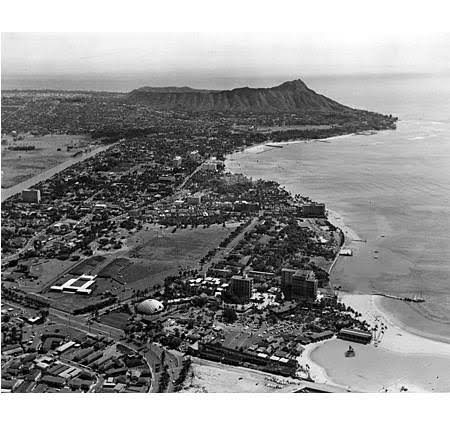
New roads meant new suburbs. Former farmland on the edges of Honolulu filled with tract houses, and the first shopping centres appeared. Kaiser, the American industrialist who had settled in Honolulu in the mid-1950s, built the Hawaiian Village Hotel at the ʻEwa end of Waikīkī before turning to Hawaiʻi Kai. On the neighbour islands, life moved at a slower pace: small-town main streets with a gas station, a general store, a movie theatre and a line of parked cars under the palms. Flying between the islands was becoming normal, a story told in our history of Aloha Airlines and inter-island flights.
Selling paradise before the jets
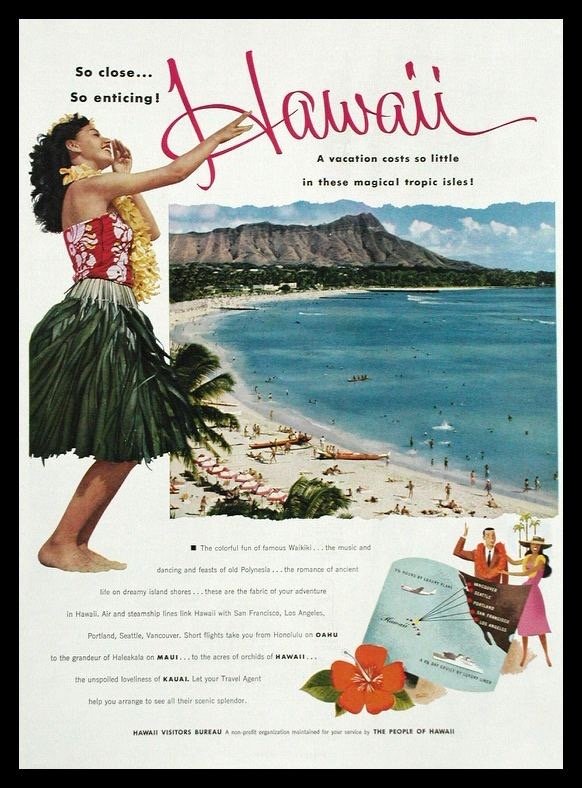
Tourism was growing but still modest. Official figures count 109,798 overnight visitors in 1955 and 243,216 in 1959. A growing share flew in on propeller airliners, though the grandest still sailed on Matson's white liners (see boat days and the Matson liners). The first high-rise hotels appeared in Waikīkī in 1955, and the Hawaii Visitors Bureau filled American magazines with hula dancers, lei and beaches.
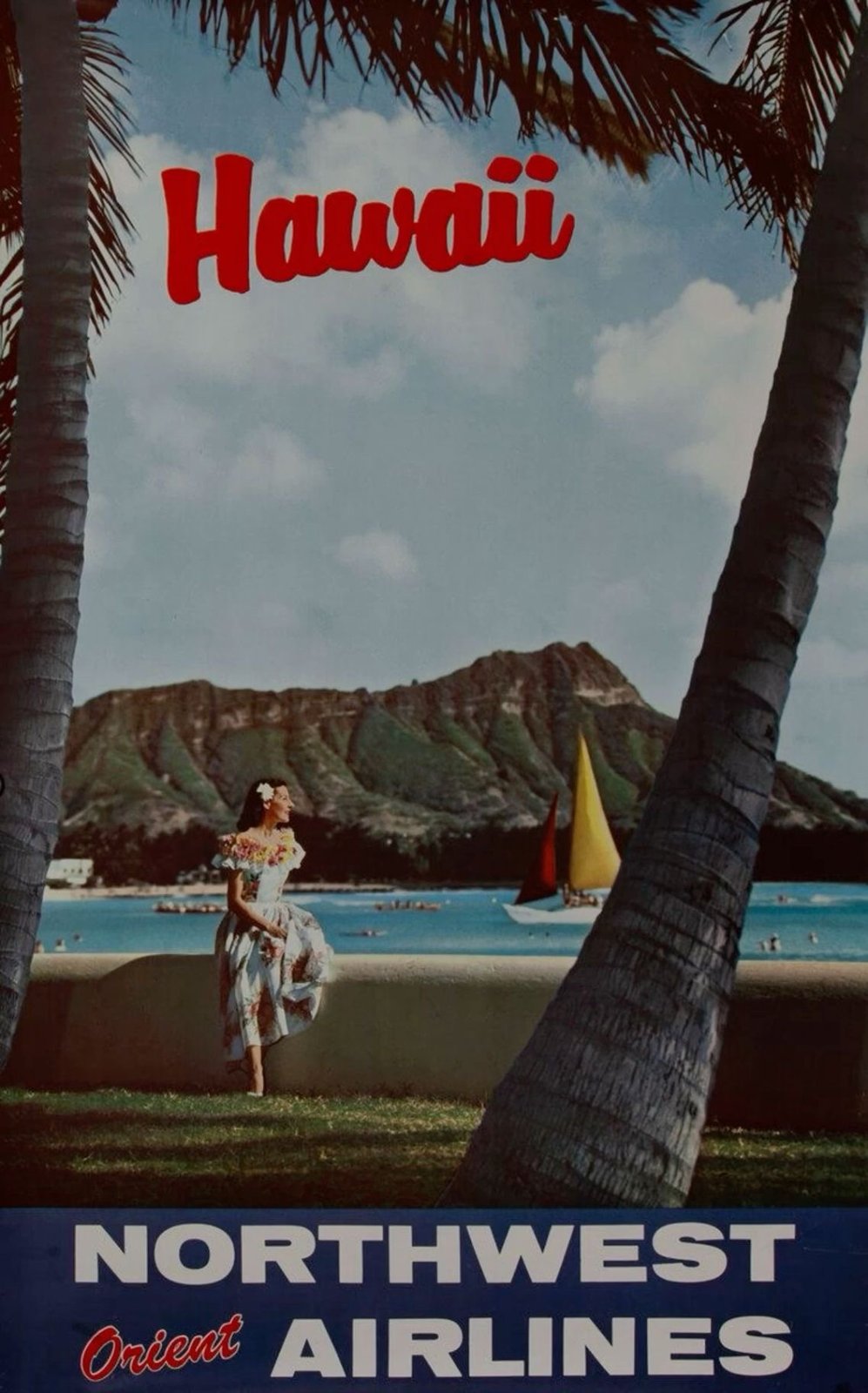
Locals were part of the show. Aloha Week, launched in 1947, filled each autumn with parades, hula and royal pageants, and printed aloha shirts and muʻumuʻu became everyday wear (our aloha shirt history tells that story). How the islands were packaged for visitors, and what that imagery left out, is the subject of vintage Hawaii travel posters and ads.
The decade that ended in a star
By the end of the 1950s almost everything was poised to change at once. The Democratic victory of 1954 had broken the old planter oligarchy, the statehood vote of June 1959 passed with 94 per cent, and jet airliners began flying to Honolulu the same year. The boom that followed is the story of our golden age of Hawaii tourism.
Not everyone saw only progress. For many Native Hawaiians, statehood closed a chapter that had opened with the overthrow of 1893, and the farms, fishponds and quiet coasts lost to development in the next twenty years fed the protests of the 1970s. The fuller story of these decades is told in The History of Hawaii.
Where to find 1950s Hawaiʻi today
- Kalanianaʻole Highway and Koko Head, Oʻahu: the coast road below the postcard view still curves past the Hālona Blowhole lookout. Park only in marked lookouts and keep well back from the rocks.
- Hawaiʻi's Plantation Village, Waipahu: an outdoor museum of some 20 restored and replica camp houses and buildings, opened in 1992, with guided tours by volunteers.
- Moana Surfrider, Waikīkī: the banyan courtyard where Hawaii Calls was broadcast is open to anyone for a drink or a look.
- Old Pali Road: part of the old road survives as a walking route from the Nuʻuanu Pali lookout, a reminder of the drive before the tunnels.
- Plantation towns: Waialua and Haleʻiwa on Oʻahu, Hanapēpē on Kauaʻi and Hōlualoa or Honokaʻa on the Big Island keep their wooden storefronts. See things to do on Oʻahu for ideas.
Quick answers
Was Hawaii a state in the 1950s?
Not until the very end. Hawaiʻi was a US territory for the whole decade and became the 50th state on 21 August 1959, after a plebiscite in June in which about 94 per cent voted yes.
What was the population of Hawaii in 1950?
The 1950 census counted 499,794 people in the Territory of Hawaii. By 1960 the population had grown to 632,772.
What was Hawaii Calls?
A radio show broadcast live from Waikīkī, usually from the courtyard of the Moana Hotel, from 1935 to 1975. Hosted by Webley Edwards, it featured Hawaiian music and at its peak was carried by about 750 stations worldwide.
When did Hawaii get television?
Hawaiʻi's first TV station, KGMB-TV, began broadcasting on 1 December 1952. KONA-TV, now KHON, followed about two weeks later.
What was the 1949 Hawaii dock strike?
A 177-day strike by about 5,000 ILWU longshoremen, from 1 May to 23 October 1949, for wages closer to those on the US West Coast. It ended with a 21-cent raise paid in two stages.
Facts checked October 2026 against the sources below and the research for our book The History of Hawaii. Vintage photos and adverts are shown as period illustrations; adverts are credited to their original advertisers.
- Hawaii Calls (radio programme)
- Hawaiian longshoremen win 177-day strike, 1949 (Global Nonviolent Action Database)
- Hawaiian sugar strike of 1946
- How the Pali Highway came to be (Historic Hawaiʻi Foundation)
- Hawaiʻi Kai, Hawaii
- KGMB
- State of Hawaii Data Book, Table 1.01: Population of counties 1831 to 2010
- Hawaiʻi's Plantation Village marks 30th anniversary (Hawaiʻi Public Radio)