From star-guided canoes to the 50th state, Hawaiʻi's story spans a thousand years. Here are the dates that shaped it, and where to see them today.
A strange visit in a long story
On 18 January 1778 lookouts aboard HMS Resolution sighted Oʻahu, and two days later Captain James Cook anchored off Waimea on Kauaʻi. For Europe, that was the moment Hawaiʻi entered the written record. For the people watching from the beach, it was an unusual visit in the middle of a very long story.
By then Hawaiians had lived on these islands for something like six to eight centuries. They had built farms and fishponds, temples and chiefdoms, and they kept their past in chant and genealogy rather than on paper. Any honest Hawaii history timeline has to begin with them.
What follows walks through the turning points era by era, with a table of key dates you can scan in a minute. Each era has its own longer story in the Journal, linked as you go.
Voyagers and chiefs (c. 1000–1778)
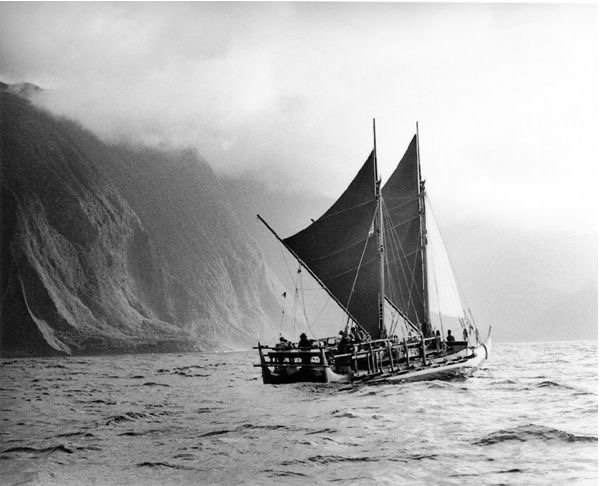
The first Hawaiians arrived by double-hulled canoe from eastern Polynesia, most likely from the Marquesas and the Society Islands. The date is still argued over. Older estimates reached back to AD 300 or earlier, but better radiocarbon dating has pulled most of them later, to roughly AD 1000–1200, and one influential 2011 study argued for a rapid burst of settlement across remote Polynesia around 1190–1290. We tell that story in how Polynesians discovered Hawaiʻi.
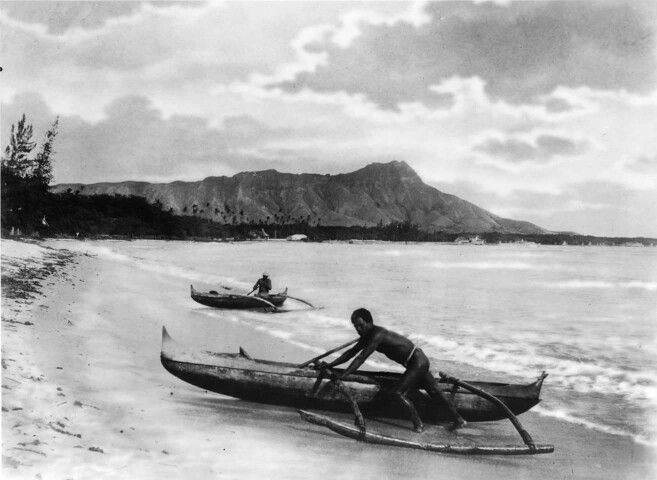
Over the centuries that followed the islands filled with people and with order. Land was divided into ahupuaʻa running from the mountains to the reef, daily life was governed by kapu (sacred law), and ruling chiefs, the aliʻi, competed for power island by island. The stone wall of Heʻeia Fishpond in Kāneʻohe Bay probably dates from the 1200s to 1400s, and Hale o Keawe, the temple at Hōnaunau that held the bones of chiefs, was built around 1650.
For a closer look at that world, with its taro terraces, temples and seasons, read daily life in ancient Hawaiʻi.
Contact and unification (1778–1819)
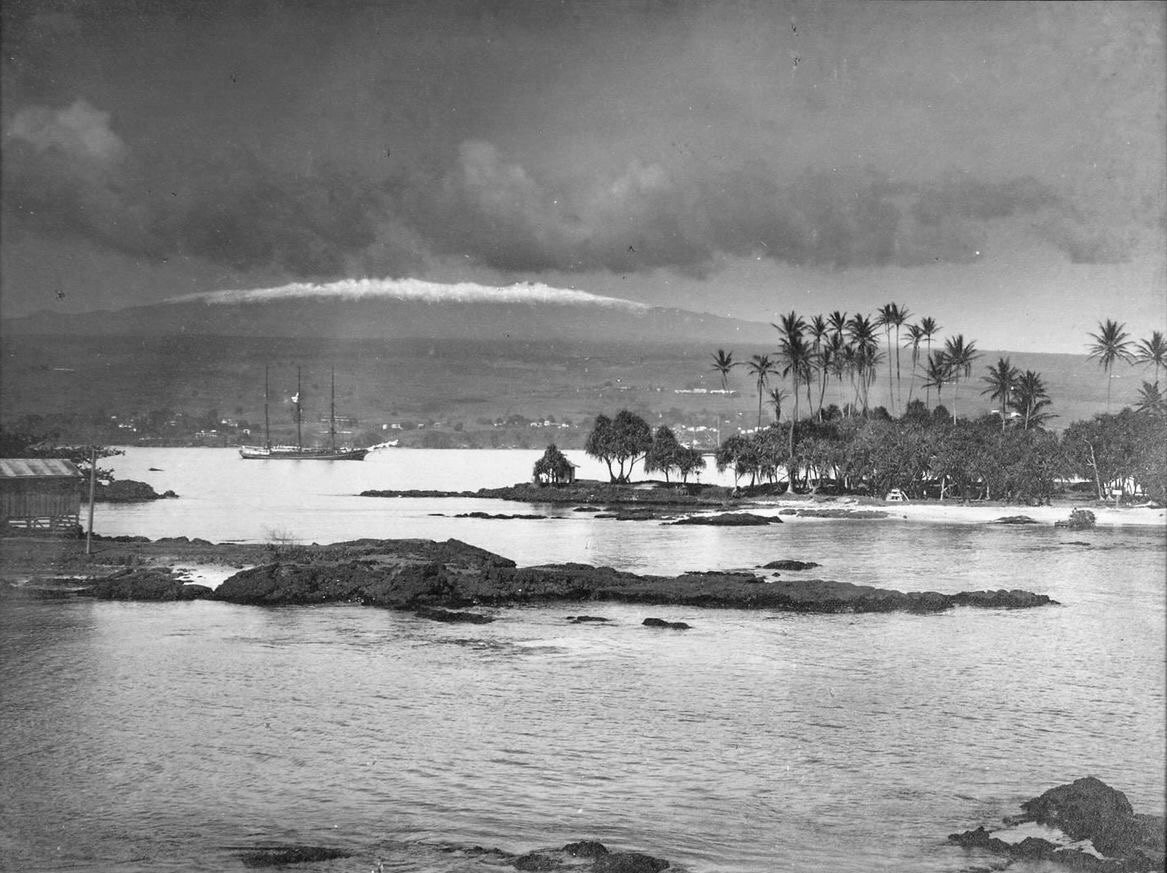
Cook came back late in 1778 and anchored at Kealakekua Bay on Hawaiʻi Island in January 1779, during the Makahiki, the season of the god Lono. Relations soured after his ships left and returned for repairs. On 14 February 1779, when he tried to take the ruling chief Kalaniʻōpuʻu hostage over a stolen boat, fighting broke out at Kaʻawaloa and Cook was killed. The full account is in Captain Cook in Hawaiʻi.
Western ships brought guns, trade goods and diseases, and an ambitious chief from Kohala made skilful use of the new weapons and the foreigners who knew them. Kamehameha won control of Hawaiʻi Island in the early 1790s, took Maui, Molokaʻi and Oʻahu in 1795 after the Battle of Nuʻuanu, and in 1810 Kaumualiʻi of Kauaʻi agreed to rule under him without a war. For the first time the whole chain formed one kingdom. Meet the man in Kamehameha the Great.
The Kingdom of Hawaiʻi (1819–1893)
Kamehameha died on 8 May 1819. Within months his son Liholiho, urged on by his mother Keōpūolani and the late king's powerful widow Kaʻahumanu, sat down to eat with women at a feast in Kailua. The ʻai kapu (sacred eating) was broken and the old religious order collapsed, a decision made by Hawaiian leaders themselves. The first American Protestant missionaries landed at Kailua-Kona on 4 April 1820, and the first printing in Hawaiian followed on 7 January 1822. Reading spread with astonishing speed.
The decades that followed were dizzying. Sandalwood traders and then whaling fleets made Lahaina and Honolulu busy ports, while introduced diseases cut the Native Hawaiian population drastically. A first constitution came in 1840, and the Māhele of 1848 divided the kingdom's lands, opening the way to private ownership, including by foreigners. Sugar, beginning with the Kōloa plantation on Kauaʻi in 1835, drew workers from China, Japan, Portugal, the Philippines and beyond.
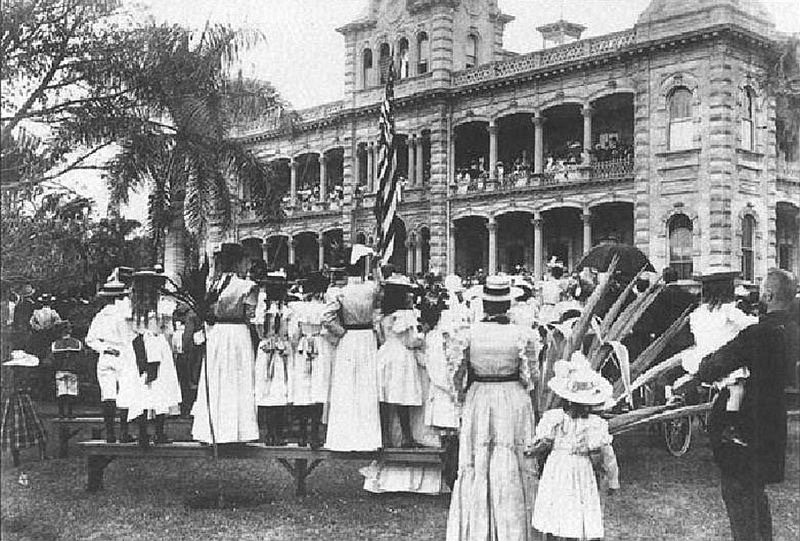
King Kalākaua signed the Reciprocity Treaty with the United States in 1875, toured the world and completed ʻIolani Palace in 1882. In July 1887 an armed group dominated by American businessmen forced him to accept the so-called Bayonet Constitution, which stripped much of the crown's power and tied the vote to income and property, shutting out most Asian residents.
Overthrow, annexation and territory (1893–1959)
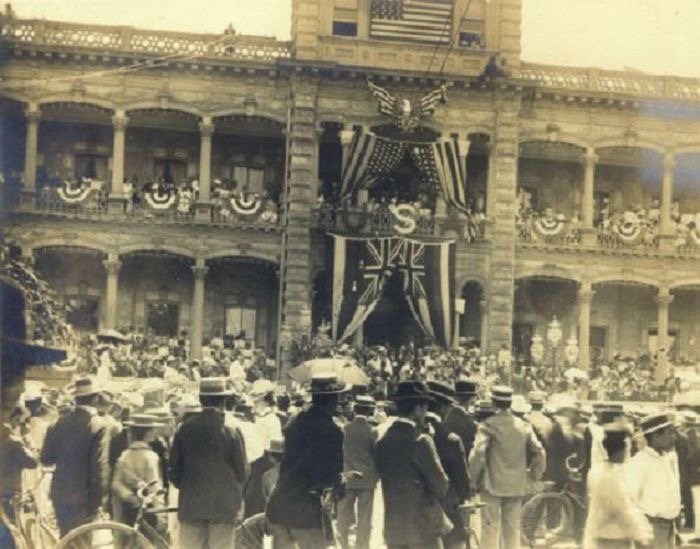
On 17 January 1893 a group calling itself the Committee of Safety, backed by the US minister John L. Stevens and by sailors and marines landed from USS Boston, overthrew Queen Liliʻuokalani. She yielded, in her own words, "to the superior force of the United States of America", under protest and in the hope that Washington would restore her. President Grover Cleveland's investigator agreed that the landing had been improper, but the provisional government refused to step aside and proclaimed the Republic of Hawaii on 4 July 1894. After a failed rising in January 1895 the queen was forced to abdicate. The story is told in full in the overthrow of the Hawaiian Kingdom.
In 1897 more than 21,000 Native Hawaiians signed the Kūʻē petition against annexation, and a treaty stalled in the US Senate. Congress turned instead to a joint resolution, the Newlands Resolution, signed by President McKinley on 7 July 1898. On 12 August the Hawaiian flag was lowered at ʻIolani Palace, and the Organic Act made Hawaiʻi a US territory from 14 June 1900. A century later, on 23 November 1993, Congress formally apologised for the US role in the overthrow.
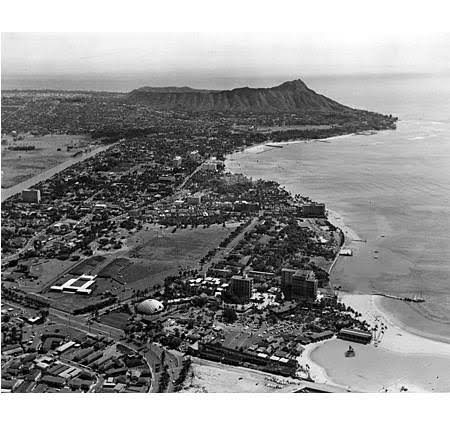
The territorial years brought pineapple, the first big hotels at Waikīkī and, in the end, war. Japan's attack on Pearl Harbor began at 7.48 am on 7 December 1941. Martial law followed the same day and lasted until October 1944, while thousands of Japanese American men from the islands served in the 100th Infantry Battalion and the 442nd Regimental Combat Team. Read Pearl Harbor history for the details.
Statehood and renaissance (1959 to today)
Statehood came in 1959. President Eisenhower signed the Admission Act on 18 March, island voters approved it overwhelmingly on 27 June, and Hawaiʻi became the 50th state on 21 August. Jet airliners arrived the same year, and within a decade tourism had become the engine of the economy.
From the 1970s the Hawaiian Renaissance brought language, hula and voyaging back to the centre of island life. The canoe Hōkūleʻa sailed to Tahiti without instruments in 1976, activists landed on the bombed island of Kahoʻolawe the same year, and in 1978 Hawaiian became an official language of the state. Questions of land, sovereignty and the stewardship of sacred places such as Maunakea remain very much alive.
Recent chapters include the 2018 eruption of Kīlauea, the wildfire that destroyed historic Lahaina on 8 August 2023, and the designation of Papahānaumokuākea National Marine Sanctuary in the north-western islands in January 2025.
Key dates in Hawaiian history
Dates before 1778 come from archaeology and chiefly genealogies and are estimates; everything after rests on written records.
| Date | Event |
|---|---|
| c. AD 1000–1200 | Likely window for first Polynesian settlement (still debated) |
| 20 January 1778 | Captain James Cook anchors off Waimea, Kauaʻi |
| 14 February 1779 | Cook is killed at Kaʻawaloa, Kealakekua Bay |
| 1795 | Battle of Nuʻuanu: Kamehameha takes Oʻahu |
| 1810 | Kaumualiʻi of Kauaʻi accepts Kamehameha's rule; the islands are united |
| 1819 | Kamehameha dies (8 May); the kapu system ends late in the year |
| 4 April 1820 | First American Protestant missionaries land at Kailua-Kona |
| 1840 | First constitution of the Kingdom of Hawaiʻi |
| 1848 | The Māhele divides the kingdom's lands |
| 1882 | ʻIolani Palace is completed |
| 6 July 1887 | Kalākaua is forced to sign the Bayonet Constitution |
| 17 January 1893 | Queen Liliʻuokalani is overthrown |
| 7 July 1898 | Newlands Resolution signed; flag transfer on 12 August |
| 14 June 1900 | The Territory of Hawaii begins |
| 7 December 1941 | Attack on Pearl Harbor; martial law declared |
| 21 August 1959 | Hawaiʻi becomes the 50th US state |
| 1976 | Hōkūleʻa sails to Tahiti; first landing on Kahoʻolawe |
| 1978 | Hawaiian becomes an official language of the state |
| 23 November 1993 | US Apology Resolution, Public Law 103-150 |
| 8 August 2023 | Wildfire destroys Lahaina, Maui |
Where to see Hawaiʻi's history today
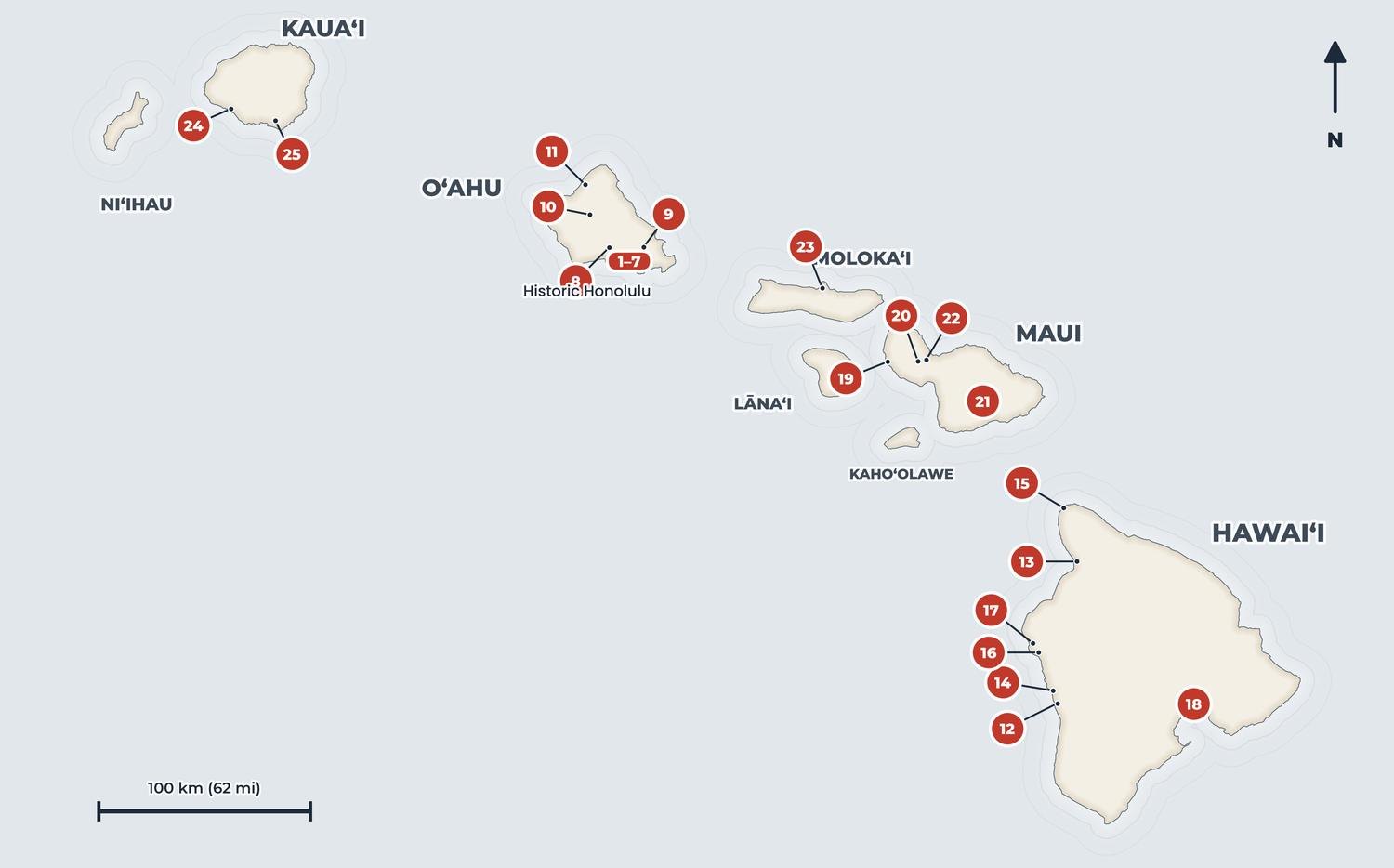
Honolulu is the natural place to start. ʻIolani Palace, often called the only royal palace on US soil, tells the story of the monarchy and the overthrow; Bishop Museum holds the finest collection of Hawaiian cultural objects anywhere; and Pearl Harbor National Memorial covers 1941.
On Hawaiʻi Island, Puʻuhonua o Hōnaunau, Puʻukoholā Heiau and Kealakekua Bay take you back to the age of chiefs and first contact. On Kauaʻi, a modest monument at Waimea marks Cook's landing. The map below shows the main sites across the islands.
For a site-by-site plan, see the best historic sites in Hawaiʻi, and if you want the whole story in one place, our book The History of Hawaii follows every era in this timeline in depth.
Quick answers
When was Hawaii first settled?
Most archaeologists now place the first Polynesian settlement between about AD 1000 and 1200, though some studies argue for a slightly later date around 1190–1290. The exact date is still debated.
When did Hawaii become a US state?
Hawaiʻi became the 50th US state on 21 August 1959, after President Eisenhower signed the Admission Act in March and island voters approved statehood on 27 June 1959.
Who was the last monarch of Hawaii?
Queen Liliʻuokalani, who reigned from January 1891 until she was overthrown on 17 January 1893. She was forced to abdicate in January 1895 and died in Honolulu in 1917.
When did Hawaii become part of the United States?
The United States annexed Hawaiʻi by the Newlands Resolution, signed on 7 July 1898, with the formal transfer on 12 August 1898. It became an organised US territory on 14 June 1900.
What year did Captain Cook arrive in Hawaii?
Captain James Cook reached Hawaiʻi in January 1778, anchoring off Waimea, Kauaʻi, on 20 January. He was killed at Kealakekua Bay on 14 February 1779.
Facts checked October 2026 against the sources below and the research for our book The History of Hawaii. Dates and figures for early Hawaiian history are estimates and scholars still debate some of them.
- Historical timeline (Hawaiʻi Tourism Authority)
- East Polynesia colonized faster and more recently than previously thought (University of Hawaiʻi)
- Cook Landing Site (National Park Service)
- Joint Resolution for Annexing the Hawaiian Islands (National Archives)
- Hawaii timeline (United States Senate)
- Apology Resolution
- ʻAikapu (Images of Old Hawaiʻi)
- A Sanctuary At Last: NOAA announces Papahānaumokuākea National Marine Sanctuary