In August 1879 a ship full of Portuguese plantation workers sailed into Honolulu with a few little four-stringed guitars in its hold. Within a generation, that instrument had a Hawaiian name, a royal patron and fans across the world.
A song on the Honolulu wharf
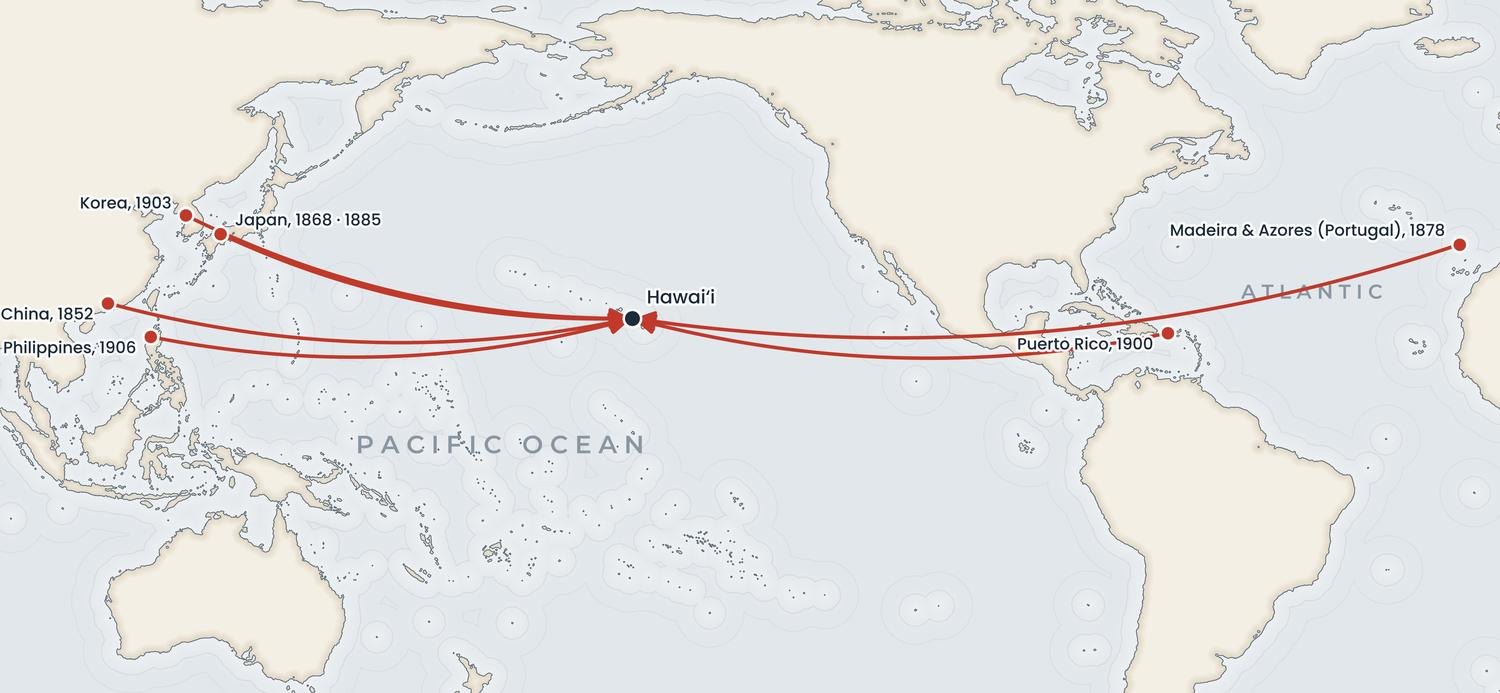
On 23 August 1879 the British barque Ravenscrag dropped anchor in Honolulu Harbor after a voyage of about four months from Funchal, the capital of Madeira. Aboard were 427 men, women and children, contract workers recruited for Hawaiʻi's sugar plantations.
Island tradition says that one passenger, João Fernandes, was so glad to see land that he borrowed a small four-stringed machete from a fellow traveller and began to play folk songs on the dock. Whether or not it happened quite like that, the story captures something true: music came ashore with the Madeirans, and Honolulu was ready to listen.
Among the passengers were three cabinetmakers with families to feed. Their names were Augusto Dias, Manuel Nunes and José do Espírito Santo, and between them they would build the instrument the world now calls the ʻukulele.
The machete and three cabinetmakers
The machete de braga, also called the braguinha, was Madeira's smallest stringed instrument: four strings, a small body, a bright voice. Its bigger cousin, the five-string rajão, was tuned differently. Madeiran tradition holds that the ʻukulele was born when its makers combined the braguinha's compact body with tuning drawn from the rajão, giving the open, cheerful chord shapes players still learn first.
Dias, Nunes and Santo all served out their plantation contracts first. By 1885 each had opened a small shop in Honolulu's crowded Chinatown, making guitars, furniture and machetes. The 1884 city directory already lists Dias as a guitar and furniture maker on King Street. Their shops moved often, and fire was a constant threat: Chinatown burned in 1886, and again in January 1900, when Dias lost his workshop.
The three men were rivals as much as colleagues. Nunes later printed labels calling himself "Inventor of the Ukulele and Taro Patch Fiddle in 1879", the taro patch being a larger relative. Historians prefer to give the credit to all three, and to the Hawaiian players who adopted the instrument as their own.
A king's instrument
What turned a migrant's guitar into a Hawaiian icon was royal patronage. King Kalākaua, the Merrie Monarch, loved music and was reviving hula after decades of missionary disapproval. The little guitar suited his court perfectly.
According to family accounts, Dias, Fernandes and a fellow Madeiran musician played for the king in the royal bungalow on the grounds of ʻIolani Palace, and Kalākaua was a regular visitor to the Dias shop, where Dias's daughter translated because the king spoke no Portuguese. A photograph from around 1890 shows members of the king's Hui Lei Mamo with a guitar, an ʻukulele and a taro patch.
Under royal favour the ʻukulele joined the new style of hula that grew from the 1880s, sung to melody with guitar and ʻukulele rather than chant and drum (see our history of hula). Kalākaua's sister and successor, Queen Liliʻuokalani, was a gifted composer whose songs were soon being strummed on it.
Jumping flea or a gift that came?
Nobody knows for certain how the instrument got its name. The favourite story concerns Edward Purvis, a small, lively former British army officer at Kalākaua's court, who played the machete with such energy that Hawaiians nicknamed him ʻukulele: from ʻuku, flea, and lele, jumping. The name, so the story goes, passed from the man to the instrument.
Others link "jumping flea" to the way a good player's fingers dance across the fretboard. Queen Liliʻuokalani is credited with a gentler reading: uku, gift or reward, and lele, to come, making the ʻukulele "the gift that came here".
In Hawaiian the word begins with an ʻokina, a glottal stop (more in our history of the Hawaiian language), and is pronounced roughly oo-koo-leh-leh. Most English speakers outside the islands say "you-ka-lay-lee" instead.
1915: the mainland catches ʻukulele fever
The ʻukulele's big break came in San Francisco. At the 1915 Panama-Pacific International Exposition, which drew almost 19 million visits over nine months, the Hawaiian Pavilion was one of the hits of the fair, attracting 34,000 people on a single day. Visitors came for the music, the hula and a strange new drink called pineapple juice.
Within a few years the ʻukulele was a national craze, and Hawaiian music was among the most sought-after sounds on the mainland. In the 1920s performers such as Cliff "Ukulele Ike" Edwards, Roy Smeck and May Singhi Breen made it a fixture of vaudeville and radio, and in the 1950s the television host Arthur Godfrey set off a second boom.
Back in Honolulu, a new generation of Hawaiian makers took over from the Madeiran pioneers. Santo died in 1905, Dias in 1915 and Nunes in 1922. In 1916 Samuel Kamaka began making koa ʻukulele in the basement of his Kaimukī home, and in 1928 he patented an oval body, the "pineapple" ʻukulele. His family firm still builds instruments in Honolulu today.
Hawaiian players were pushing the instrument forward too. Ernest Kaʻai, often described as the first ʻukulele virtuoso, helped show that the little instrument could lead a tune as well as keep the rhythm. Kamaka's business moved from the basement to a King Street shop in 1921 and, in 1959, to the South Street factory where it still works. By then the instrument had passed from Madeiran migrants to Hawaiian craftsmen to a worldwide audience in a little over three generations.
Fading, then a second life
By about 1970, the University of Hawaiʻi has noted, the ʻukulele had become something of an oddity outside the islands, and even at home it was used mostly in school classrooms and tourist shows. Island masters such as Eddie Kamae and Herb Ohta kept serious playing alive.
The revival came from Hawaiʻi itself. In 1971 the teacher Roy Sakuma started a free ʻukulele festival at the Kapiʻolani Park bandstand in Waikīkī, held each July for more than fifty years. The Hawaiian Renaissance brought new pride in island music, and Israel Kamakawiwoʻole's gentle voice over a strummed ʻukulele carried the sound to audiences around the world.
Then Jake Shimabukuro's lightning-fast technique showed what the four strings could really do. Today the ʻukulele is played and taught around the world, cheap, portable and friendly to beginners, a long way from a borrowed machete on a Honolulu dock.
Where to see ʻukulele history today
- Kamaka Hawaii factory tour: a free guided tour of the family workshop at 550 South Street, Honolulu, Monday to Thursday at 10.30 am, lasting 45 to 60 minutes. Reserve through kamakahawaii.com; under-18s must come with a parent or guardian, and groups of more than five book by phone. The open-air factory can be warm, so bring water.
- Chinatown, Honolulu: walk King Street and the blocks where Dias, Nunes and Santo once kept shop, combined with our guide to things to do in Honolulu.
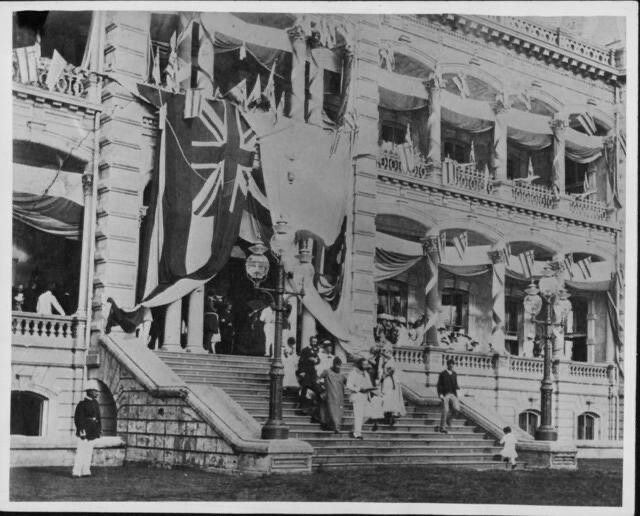
- ʻIolani Palace: the royal home where Kalākaua's court made the ʻukulele fashionable.
- Kapiʻolani Park bandstand, Waikīkī: home of decades of ʻukulele festivals and still a stage for island music.
The ʻukulele is one thread in a much larger story of migration, monarchy and music, told in full in The History of Hawaii.
Quick answers
Did the ukulele come from Hawaii or Portugal?
Both. It developed in Honolulu in the 1880s from the machete, or braguinha, a small four-stringed guitar brought by immigrants from the Portuguese island of Madeira in 1879. Hawaiians adopted it, named it and made it their own.
Who invented the ukulele?
Credit usually goes to three Madeiran cabinetmakers who arrived on the Ravenscrag in 1879: Augusto Dias, Manuel Nunes and José do Espírito Santo. Each opened an instrument shop in Honolulu by 1885.
What does ukulele mean in Hawaiian?
It is most often translated as "jumping flea", from ʻuku (flea) and lele (jumping). Queen Liliʻuokalani is credited with another reading, "the gift that came here".
How did King Kalākaua popularise the ukulele?
Kalākaua loved music and revived hula at his court. Madeiran musicians played for him at ʻIolani Palace, he visited the Dias shop, and under his patronage the ʻukulele became part of Hawaiian court music and modern hula.
Can you tour a ukulele factory in Hawaii?
Yes. Kamaka Hawaii, founded in 1916, offers a free guided factory tour at 550 South Street in Honolulu, Monday to Thursday at 10.30 am. Reserve online in advance.
Facts checked October 2026 against the sources below and the research for our book The History of Hawaii. Dates and figures for early Hawaiian history are estimates and scholars still debate some of them.
- When the Ukulele as We Know It Arrived in Hawaii (Ukulele Magazine)
- Manuel Nunes, ʻUkulele Hall of Fame
- Augusto Dias, ʻUkulele Hall of Fame
- Braguinha and rajão in Hawaii (Madeira Regional Directorate of Culture)
- The ʻukulele (University of Hawaiʻi, Mālamalama)
- How the Ukulele Got Its Name (Merriam-Webster)
- When the Ukulele Came to San Francisco (KQED)
- Our Legacy and Factory Tour (Kamaka Hawaii)